Showing posts with label Apologetics. Show all posts

Thursday, February 27, 2020

Ash Wednesday 2020

By Donald Sensing


The story is told of Sean O'Flannery, a lad who moved to Boston from Dublin. Coming home from school one day he went into an ice cream shop and told the jerk behind the counter (the soda jerk) "One scoop of yer best chocolate ice cream in four dishes!"

Soda jerks get strange requests, so he set four dishes with one scoop each in front of Sean. Sean took a spoon of one, held it before his face and loudly announced, "This is me beloved cousin eating ice cream back in the old country!" He ate the ice cream and took a spoonful from another scoop, "This is me dear friend Kelly eating ice cream back in me homeland!" The third dish he said was his favorite uncle, Finian, eating ice cream back home.

Sean raised the last scoop and said, "And this dish is for me!"

This practice went on for several months until one evening as the soda jerk was filling the four dishes Sean stopped him and said quietly, "Only three dishes today, please."

The soda jerk asked, "Did you suffer a loss and that is why you only want three scoops?"

"Heaven's no!" protested Sean O'Flannery. "It's Lent now, and I've given up ice cream!"

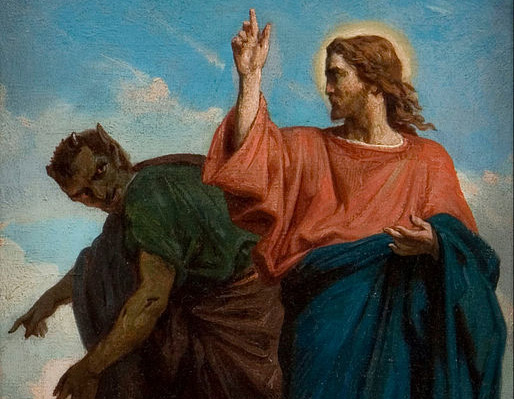
The word “Lent” comes from the Anglo-Saxon word, “lencten,” meaning Spring, the season in which Easter occurs. The forty days before Easter constitute the Lenten season, but the forty-day count does not include Sundays. All Sundays celebrate the resurrection, and so are excluded from the forty days count. The forty days duration is drawn from the length of time Jesus spent in prayer and fasting in the wilderness before he set out on his three-year ministry.

Matthew 4.1-4: 

1 Then Jesus was led by the Spirit into the wilderness to be tempted by the devil. 2 After fasting forty days and forty nights, he was hungry. 3 The tempter came to him and said, “If you are the Son of God, tell these stones to become bread.”
4 Jesus answered, “It is written: ‘Man shall not live on bread alone, but on every word that comes from the mouth of God.
As originally conceived by the church long ago, the Lenten sacrifice was instituted as a “means of penitential preparation and preparation for baptism, which in the early church customarily took place on Easter Sunday.”

The tradition of fasting during Lent is an early one, originally done between Good Friday and Easter morning, the forty hours that Jesus was in the tomb. Christians would partake of no food or drink at all during that time. The fast was extended to the forty days before Easter sometime between 300 and 325, and changed so that food could be eaten only when evening had come.

The idea behind the fast was to imitate Christ. In addition to fasting, Christians would devote themselves to making prayer a faithful habit. So “prayer and fasting” have been closely linked for a long time.

And that brings me, by a rather circuitous route, to chocolate.

Chocolate is an absolutely unessential food, nutritionally speaking. We eat chocolate for no reason other than it is pleasurable. Since denial of the flesh is a prominent theme of Lent, rejection of chocolate in Lent is often offered as the Lenten sacrifice, particularly by people who wish to diet anyway.

But the Lenten season is also a time we ponder and wonder about the love of God. God’s love knows no bounds or limits and was so strong that not even the prospect of cruel death could deter Jesus from his redemptive mission. While we deny the pleasures of life during Lent, Jesus denied his life itself for the sake of his love for us.

Perhaps that fact could put a different spin on our concepts of giving something up for Lent. The Lenten sacrifice is best oriented toward that which most blocks our spiritual growth. It is each to ask ourselves, “What is it that most keeps me from Christ-likeness?” If that thing is chocolate, then it is appropriate to give up chocolate for Lent. But if something else is your greatest obstacle in being more Christlike, then giving up chocolate is a spiritually pointless exercise.

The question is this: “What is the one thing that most hinders my Christian growth into the person whom God wants me to be?” The answer may not be easy, but it will always involve self-denial. We think that following Christ is hard because to obey Christ we must first disobey ourselves, and it is disobeying ourselves that makes us think following Christ is hard.


But Jesus said his yoke is easy, his burden is light. We just have to get over ourselves to do it.

As Robert Mulholland put it, “Jesus is not talking about giving up candy for Lent. He is calling for the abandonment of our entire, pervasive, deeply entrenched matrix of self-referenced being.”

If we focus on that between now and Easter Day, then we have a chance to become more mature in Christian faith and practice. It may be a habit that is out of true with Christian character that needs to be overcome for further growth. Or it may be a thing undone which must be done for deeper development to occur. The Lenten idea is for our habits to change enough in the next few weeks so that we can continue at a higher level of discipleship after Easter. The Lenten season and the Lenten sacrifice are not the points in and of themselves, the whole life of discipleship is.

Focusing on the one big thing is not the only Lenten discipline that would be helpful for spiritual development. Methodism’s founder, John Wesley, insisted that the only thing that distinguishes the Christian from the non-Christian are how we use our time and money. So, for the period of Lent I would suggest focusing on those two things in addition to whatever one big spiritual obstacle you might have. Some suggestions:

  • Tithe all your income until Easter. 
  • Devote yourself to prayer daily and attending worship every Sunday. If you are traveling, say on business or spring break, then worship wherever you are.
  • Read the Bible each day. 
  • Call someone you love and let them know. 
  • Ask people who live alone to join you for lunch or whether you can visit them. 
  • Become involved in Christian ministries.
  • Re-establish or reinforce important relationships in your life.

Spiritually speaking, it is not enough to simply excise sin or personal vices from our lives. We have to replace vice with virtue. Thus, simply giving up something like chocolate for Lent is simply silly if we are only counting the days when we can start doing it again. That’s a game, not a spiritual discipline.


Lent should be a period of joyful, God-directed introspection into how we may be further united with Christ in godly love. If we make Lent into a severe, joyless, self-justifying exercise in self-denial, we have missed the point. Jesus sternly admonished teachers of the religious law and the Pharisees not to practice the letter of the law while neglecting “the more important matters of justice, mercy and faithfulness” (Matt 23:23).

When a lawyer asked Jesus, “which is the greatest commandment in the Law?” Jesus replied, “‘Love the Lord your God with all your heart and with all your soul and with all your mind.” And the second is like it: ‘Love your neighbor as yourself.’”

That is the whole point of spiritual growth and spiritual discipline, and hence the whole point of Lent: love. We are to be living ambassadors from God to one another and the world at large in Christ’s name. Christ was crucified, buried and raised from the dead for our sake and the sake of the whole world. Let us rededicate ourselves to being Christ’s ambassadors. It’s Lent, after all; it’s all about love, you see, Lent is all about love.

Sunday, April 21, 2019

He is risen! He is risen, indeed!

By Donald Sensing


Bookmark and Share

Saturday, April 20, 2019

As Jesus lay lifeless

By Donald Sensing

“Lord Jesus Christ, Son of the living God, who as on this day rested in the sepulchre, and thereby sanctified the grave to be a bed of hope to Your people: Make us so to abound in sorrow for our sins, which were the cause of Your passion, that when our bodies rest in the dust, our souls may live with You; who lives and reigns with the Father and the Holy Spirit, one God, world without end.” – Titusonenine
HT: Gerard

Bookmark and Share

Can a Scientist Believe in the Resurrection of Jesus?

By Donald Sensing


Well, yes, as it turns out, and an enormous number across the scientific disciplines do. Some of them explain why.
The Resurrection is certainly an extraordinary claim. However—although extremely unlikely based on our experience so far—the probability of such an event also cannot be demonstrated to be zero. Regarding the Resurrection of Jesus, no evidence to the contrary—such as an identified body—exists. As a supernatural, one-off, historical phenomena, we cannot expect the Resurrection to be definitively confirmed or denied by any specific scientific test. This does not, however, negate other evidence that supports the plausibility of the Resurrection as a real event embedded within a true gospel story. This evidence includes but is not limited to: records of eyewitness accounts, peculiarities of the Bible compared to other historical or religious texts, and of course personal experience. When considered individually, this evidence is not overwhelmingly compelling but cumulatively converges upon plausibility.

Personally, I choose to believe that not all things worth knowing can be examined through the scientific lens, which makes faith entirely reasonable. 
 Sarah Bodbyl Roehls, research associate/senior scientist specializing in evolutionary biology and education, Michigan State University

Bookmark and Share

Friday, April 19, 2019

Execution Day - The Case Against Christ

By Donald Sensing

"The Three Crosses," by Rembrandt
Sometime on the Friday after Passover, almost 2,000 years ago, Roman soldiers, acting on orders of Pontius Pilate, prefect of Judea, took Jesus of Nazareth to a low hill outside Jerusalem and crucified him to death. As crucifixion deaths went, Jesus' death came pretty quickly, within a few hours. It was not unusual for victims to linger on the cross for days.

There were two criminals also crucified alongside Jesus. Because it was Passover week, emotions ran high among the Jews who had made pilgrimage to Jerusalem for the holy observances. There were many thousands of pilgrims there, some historians say more than 100,000. At sunset on Fridays the Jewish Sabbath began then as now, and even hardened Roman soldiers were uneasy about the execution of these men continuing when the Sabbath began during this particular week. So they decided to break the victims' legs in order to make quick their suffocation to death. Crucifixion is, after all, a form of hanging, killing by suffocation. With their legs broken, the victims could not push up to take a breath and so would die a quick, though brutal death ("excruciating" derives from the same root as "crucifixion," and it is no accidental relationship).

But when they came to Jesus to break his legs, they discovered he had already died. Another soldier, probably more experienced and thus leaving nothing to chance, took his long spear and plunged it into Jesus' side, almost certainly penetrating his heart, since that would have been the whole point of spearing him to begin with.

Before sundown, the Romans permitted some of Jesus' friends to retrieve his body and entomb it.

One of the vexing problems about Jesus' execution is that we really don't know exactly why Jesus was crucified. Of course, we know why the Romans crucified people - political offense against the empire - but just what Jesus did, or was accused of doing, relating to that is not fully clear. Even stipulating that the Jewish high council, the Sanhedrin, wanted to be quit of Jesus, they could have ordered him stoned to death for religious offenses without getting the Romans involved. The Gospels are clear enough that religious charges against Jesus not only could easily be made, they were made.

"Ecce homo" - Behold, the man.
Pilate, we know from Roman historians, was a weak man, inclined to violence to solve his problems, and was unskilled as a procurator. In fact, most modern historians have concluded that Judea had the singular misfortune among Roman provinces to suffer uncharacteristically inept Roman governance for several decades, including those on both ends of Jesus' life.

Certainly, Pilate thought almost nothing of crucifying Jews; during Jesus' own lifetime Pilate had sentenced hundreds, probably thousands, of Jews to the cross and had killed numberless more by other means. So one more was not even a statistic. (Jesus himself spoke of a time when Pilate had sent his cavalry, swords swinging, into a group of men making sacrifices, killing the lot of them, for reasons not related. Pilate seems to have been extremely paranoid about crowds of Jews who gathered for any reason.)

There are no notes from the trial of Jesus before Pilate. The accounts of the Gospels were written down many years later, decades, in fact. Even so, some historical facts are not disputed. The Sunday before Passover, about 33 AD, Jesus and his disciples arrived in Jerusalem. The crowd that greeted them joyfully soon dissipated. Jerusalem was packed with Jewish pilgrims in the city to celebrate Passover. Having been under Roman (hence pagan) occupation for many decades, and the pagan Greeks before that, the Jews' nationalistic fervor ran high during the holy season, so high, in fact, that Pilate abandoned his offices in Caesarea, seventy-five miles northwest, to come to Jerusalem along with a couple of thousand soldiers.

Pilate was a very violent ruler. He had little compunction about sentencing people to death. Many hundreds of Jews, if not more, had already died by his command. The first-century Jewish historian Philo wrote that Pilate was not much worried about niceties of the law such as a proper trial for the accused.

The level of collusion between the Jewish high council (the Sanhedrin) and Pilate is unclear. It was mediated by the high priest, Caiaphas, in any event. All four Gospels present Jesus as being hauled before the Caiaphas at his house and three say that there were other Jewish leaders present; Luke calls them "the elders of the people, both the chief priests and teachers of the law." Whomever they were, they are only presented as an echo board for Caiaphas.

What did Caiaphas have against Jesus? The synoptic Gospels indicate that Caiaphas's charge against Jesus was blasphemy. Matthew 26 records that after he was arrested and was brought before Caiaphas,
… the high priest said to him, "I put you under oath before the living God, tell us if you are the Messiah, the Son of God." 
Jesus said to him, "You have said so. But I tell you, From now on you will see the Son of Man seated at the right hand of Power and coming on the clouds of heaven." 
Then the high priest tore his clothes and said, "He has blasphemed! Why do we still need witnesses? You have now heard his blasphemy. What is your verdict?" 
They answered, "He deserves death."
I think the Gospel of John's explanation, which differs from the others', gives important insights to the dynamics of Caiaphas's relationship with Pilate, showing that the high priest was primarily concerned with preserving the lives of the people. John presents a more nuanced case of Caiaphas against Jesus that makes Caiaphas more concerned with politics with Pilate than internal affairs of religion. Chapter 11 records that Caiaphas was deeply fearful of Pilate's propensity to violence, so much that Caiaphas was willing to plot Jesus's death in order to prevent Pilate from slaughtering the crowds who followed Jesus and then turning his soldiers loose to ravage the country itself.

There was Roman precedent for this. A few years after Jesus was born, a would-be revolutionary named Judas the Galilean led a rebellion against Rome centered in the city of Tzippori (Sepphoris) in Galilee. This was before Pilate became prefect, but the Roman response was crushing. According to Tacitus, the Roman Syrian governor sent two legions who laid waste to the entire city, crucified up to 2,000 men and sold the rebels' families into slavery. The shock of this savagery would have been vivid in Caiaphas's mind. It was the sort of thing, or worse, that he reasonably feared Pilate would render to Judea if Jesus continued unchecked.

The crowds Jesus drew were particularly worrisome because they signified that Jesus was gaining a growing following. There were royal politics involved here. The last king of the Jews had been Herod the Great, who had died in 1 BC. He was never accepted by the Judeans as a proper king because there was question of whether he actually was Jewish at all. Herod the Great’s throne was at the time vacant – when he had died in 1 BC, his territory was divided by the Romans into four parts, each ruled by a different descendant. What if, with the masses supporting him, Jesus attempted to claim the throne of David, to which he was by descent from David entitled? A power play by Jesus for the throne would have been brutally extinguished by the Romans.

To both the Jewish leaders and the Romans, a Jew with messianic intentions was foremost a political figure and in the minds of many Jews (and certainly Pilate), a potential military leader as well. That Jesus had said and done nothing to demonstrate such intentions would have been of no comfort to Caiaphas; as we say today, absence of evidence is not evidence of absence. After all, what insurrectionist or revolutionary announces his goals before acting on them?

On Thursday evening of what would become known as Holy Week, Judas Iscariot, one of the disciples, traitorously brought the Temple police to Gethsemane, just outside Jerusalem. They arrested Jesus and bound him. Jesus’ disciples fled, leaving Jesus isolated.

The simplest narrative of events from then on is John's. Jesus was taken to the home of Annas, a former high priest, also Caiaphas’ father-in-law. Whereas in the synoptic gospels Jesus appears before a council of some kind and is found guilty of blasphemy at a drumhead court, in John no such council is present nor is there any sort of trial. Jesus, remaining bound, speaks only to Annas, who instead of pronouncing him guilty of some crime, "questioned Jesus about his disciples and his teaching." Jesus doesn't play along. An official present struck him on the face for responding insolently to the high priest.

Annas dispatches Jesus to Caiaphas, who quickly sends Jesus to Pilate. John 18 records,
Pilate came out to them and asked, “What charges are you bringing against this man?”

“If he were not a criminal,” they replied, “we would not have handed him over to you.”

Pilate said, “Take him yourselves and judge him by your own law.”

“But we have no right to execute anyone,” they objected.
Pilate’s response strikes me as entirely reasonable. Here is a Jewish man, Jesus, charged with – what? Well, he’s a criminal. Pilate sees no Roman interest here so he tells the Jewish leaders, you can take care of that yourself. They protest that they have no right to execute anyone.

But of course, they do have that right – for capital offenses under Jewish law. Their response to Pilate reveals to him that they are claiming Jesus is an offender against the imperium, for which only Pilate could adjudge death.

Pilate was personally despicable but that doesn’t mean he was stupid. Any Roman prefect would have relied on an extensive network of Jewish informers, probably paid, and his own Roman soldiers and officials to stay apprised of developments and rumors among the ruled. Pilate would have not been caught flat-footed when Jesus was brought to him. He would likely have known that the crowds hailed Jesus as a messiah, or deliverer, when Jesus entered the city on Palm Sunday, but deliverer from what? In Pilate’s mind, it could only be delivery from Roman rule.

(Jesus even knew that such suspicions were harbored against him. In Mark 14, when Jesus is arrested, he demands directly, "Am I leading a rebellion that you have come out with swords and clubs to capture me?")

Pilate would have known long before this day that Jesus was a celebrated teacher and preacher, reportedly a miracle worker, who was drawing ever-increasing crowds. So he got straight to the point and asked Jesus directly: “Are you the king of the Jews?” The dialog in John 18 is succinct:
“Is that your own idea,” Jesus asked, “or did others talk to you about me?”

“Am I a Jew?” Pilate replied. “Your own people and chief priests handed you over to me. What is it you have done?”

Jesus said, “My kingdom is not of this world. If it were, my servants would fight to prevent my arrest by the Jewish leaders. But now my kingdom is from another place.”

“You are a king, then!” said Pilate.

Jesus answered, “You say that I am a king. In fact, the reason I was born and came into the world is to testify to the truth. Everyone on the side of truth listens to me.”

“What is truth?” retorted Pilate. With this he went out again to the Jews gathered there and said, “I find no basis for a charge against him.”
Luke’s Gospel is more specific about the charges related to Pilate by Jesus’ Jewish captors, who tell Pilate, “We have found this man subverting our nation. He opposes payment of taxes to Caesar and claims to be Messiah, a king.” This does explain why Pilate asked Jesus whether he was a king. As for Jesus opposing paying taxes, it was (a) false and (b) even if true would not have exactly set him apart from 95 percent of all the Jews in the country. “Subverting the nation”? That’s nothing but Luke’s equivalent of their claim in John that Jesus was simply a criminal.

In any event, Pilate is unpersuaded but attempts to placate the accusers by having Jesus scourged. But Caiaphas and his allies want death. All four Gospels agree that Pilate attempts to grant Jesus amnesty by releasing a cutthroat insurrectionist named Barabbas to the hand-picked crowd Caiaphas has brought to the scene, “But the chief priests stirred up the crowd to have Pilate release Barabbas instead,” reports Matthew.

Finally, Pilate caves and order Jesus crucified. But why?

For someone whom Caiaphas feared would decimate the whole country because of Jesus, Pilate seems awfully peaceable when he had the chance to get rid of Jesus. He had to be cajoled, even threatened, into it. In John, the Jews present tell Pilate that to release Jesus would be the same as opposing Caesar – actually accusing Pilate of incipient treason!

But Pilate might have been trying all along to shift the blame for Jesus's execution from himself onto the Jewish leadership. It was Passover week, remember, when Jewish religious-nationalist passions ran high. Passover was the Jewish celebration and commemoration of their liberation from chattel slavery in Egypt, and here they Jews were in their own ancient homeland, under foreign occupation and rule.

Pilate himself had personal experience with such passions. Unlike previous prefects, Pilate ordered the imperial standards into Jerusalem with the symbols and images of Caesar Tiberius and had them planted on the Temple Mount. The Jews naturally saw this as a direct affront to the Second Commandment (Exodus chapter 20), which was,
You shall not make for yourself an idol, whether in the form of anything that is in heaven above, or that is on the earth beneath, or that is in the water under the earth. You shall not bow down to them or worship them … .”
Being ruled by Caesar was bad enough, but for images, or idols, of Caesar (whom the Romans claimed was divine) was intolerable, period. A crowd of angry Jews gathered in Caesarea, where Pilate lived and did most of his work, to deman removal, which Pilate refused. After five days, he ordered his soldiers to surround the demonstrators and told them he would have them all slain if they did not disperse. The Jews replied they would rather die than submit to the desecration of the holy city. Finally, Pilate had the images removed.

Later, Pilate had gold-plated shields set up in Herod’s palace in Jerusalem, though not with graven images. Again the Jews protested and when Pilate refused to relent, they sent a letter of protest to Tiberius. Tiberius sent a letter to Pilate, rebuking him harshly for such offenses and violations of precedent, and ordering the shields' prompt removal to Caesarea.

On the day Jesus was brought to him, Pilate may have thought his standing with Tiberius was shaky. Jesus still had devotees, perhaps thousands, who were unaware that he had been arrested overnight. Might they riot in protest? It was a real danger, as Matthew explicitly records the chief priests realized; it was the reason they decided not to snatch Jesus during the daytime.

If a riot there might be, Pilate might have thought, best to preemptively divert its rage away from the Romans and onto Caiaphas and company. Pilate would not be able to sit it out but reporting to Rome that the people were rebelling against their own religious authorities, not Pilate, was infinitely better than the other way around.

But while Pilate was trying to play Caiaphas, the high priest, knowing well Jesus's popularity among the masses (as well as his allies among some members of the Sanhedrin, Nicodemus, for example) may well have been trying to set up Pilate to take the heat for him, also. Both men probably wanted to put the monkey on the other's back. This would help explain why Caiaphas gave Jesus such a cursory hearing before trundling him over to Pilate and the resistance to executing Jesus that Pilate gave right back to Caiaphas.

Caiaphas finally played his trump card. Caesar Tiberius was one of the greatest generals Rome ever produced, which, with family connections, led him to become Caesar in AD 14. But he had checked out of affairs of state in 26, moving to isle of Capri. He had left state affairs to Praetorian Prefect Lucius Sejanus. It was Sejanus who had appointed Pilate to his prefecture.

In 31, Tiberius learned that Sejanus was actively plotting to depose (meaning kill) Tiberius and seize the emperorship himself. Tiberius ordered Sejanus executed and began executing Sejanus' partners and political appointees, starting with the most recent appointees and working down to the earlier. Pilate owed his office to Sejanus but escaped the purge probably because his appointment was made very early in Sejanus' rule, long before Sejanus had turned traitor.

Even so, Pilate must have known that his own political, and perhaps physical survival depended on demonstrated devotion to Tiberius. This was Pilate's political Achilles' Heel and it was there that Caiaphas aimed a nearly-explicit threat: if you free Jesus we will report to Rome that you failed to defend Caesar against an insurrectionist, a pretender to the still-vacant throne of Herod the Great, who was a Roman vassal we did not recognize as legitimate in the first place, but matters not, for, "We have no king but Caesar," Pilate. How about you?

It is a grievous error to blame "the Jews" categorically for Jesus's death, but there is no way to get around Caiaphas's deep involvement. Pilate finally yielded to Caiaphas’s political machinations and attempted to announce that the whole sordid affair really had nothing to do with him or Rome (“he took some water and washed his hands before the crowd, saying, ‘I am innocent of this man’s blood’ …” – Matthew 27.24).
 
He sent Jesus to be crucified and, over Caiaphas’ protest, ordered a sign affixed to Jesus's cross identifying him as "King of the Jews," a sign probably intended to implicate Caiaphas directly in Jesus's death, for whom else could have made such a charge?

Despite their antagonism, both Caiaphas and Pilate came to see that executing Jesus was win-win for them. By giving up Jesus to Pilate, Caiaphas would prevent the Jesus movement from getting out of hand before it was too late to prevent the unspeakable horror of Pilate's superior in Syria from sending a legion or two to teach Judea to stop raising up such troublesome sons. Jesus himself had showed he would not yield in his demands of religious and social reformation. When Caiaphas brought Jesus to his house Thursday night, Jesus swatted away any potential compromise with finality. Faced with such intransigence, Caiaphas handed Jesus over to Pilate and made sure that Pilate never gave him back.

As for Pilate, his win would be twofold:

1. Stop an incipient Jesus-centered political movement cold by the very simple, effective expedient of killing Jesus. After all, he could not continue to send taxes and goods to Rome by destroying the country that produced them.

2. His loyalty to the vengeful Tiberius would not be challenged.

Jesus, it seems, had become too threatening to be allowed to live. Both Caiaphas and Pilate had the motive and the opportunity that week to stop him but only Pilate had the means to stop him permanently. There was a meeting of minds between Caiaphas and Pilate, antagonists though they were, and Jesus got caught in the middle.

But here's the kicker: Jesus cooperated with what they had planned for him because he understood that his own fate was inextricably linked to the collusion between them. That Jesus could have effectively defended himself seems of little doubt; there are many clues in the Gospels of what he might have said. But instead, he let himself be found guilty because he knew that Golgotha was the reason he was there. And so, he carried a cross to Golgotha and the world has never been the same.
_________________________

My homiletics professor once said that one thing the Easter story proves is that sin, and the will to sin, is more deeply rooted in human beings than we really can imagine. Roman justice, he pointed out, was the best system of justice the world had ever seen until then; after all, it still forms the basis for most Western jurisprudence today. And among the lands and peoples of the empire, he said, the Jews were enormously respected for their religion, which was considered ancient even way back then. In the case of Jesus (his point being), the best justice and the best religion somehow, and not altogether clearly how, came together to cause the execution of a man entirely innocent of every capital charge brought against him - and for the best of putative reasons. "Even the best we can do has no promise of freedom from sin."

So Joseph of Arimathea and the women disciples of Jesus (the men having gone into hiding) took Jesus' corpse and began to prepare it for burial in Joseph's own tomb. They did not finish the job because of the beginning of the Sabbath, a day on which they could do no work. They laid the body in the tomb, had it sealed, and left. The women agreed to return on Sunday morning to finish anointing Jesus' body, that being the first daylight hours after the end of the Sabbath at sundown Saturday.

The sun set and mercifully brought an end to execution day.

Bookmark and Share

Tuesday, April 9, 2019

Sunday, April 7, 2019

Why do we trust our own thinking?

By Donald Sensing

John Lennox is emeritus professor of mathematics at the University of Oxford. He has also gained fame as a defender of the rational basis of Christian faith. "In his view, religious belief is entirely compatible with the scientific quest."

... he argues that the scientist’s confidence in reason ultimately depends on the existence of a rational and purposeful Creator. Otherwise, our thoughts are nothing more than electro-chemical events, the chattering of soul-less synapses. “If you take the atheistic, naturalistic, materialistic view, you’re going to invalidate the reasoning process,” he says, “because in the end you’re going to say that the brain is simply the end product of a blind, unguided process. If that’s the case, why should you trust it?" 
The materialist view inevitably gives birth to a form of determinism that appears to mock our essential humanity. Richard Dawkins, evolutionary biologist and atheist, expresses the modern scientific outlook thus: “The universe we observe has precisely the properties we should expect if there is, at the bottom, no design, no purpose, no evil and no good. Nothing but blind, pitiless indifference. DNA neither knows nor cares. DNA just is. And we dance to its tune.”
Dawkins routinely falls into confirmation bias: he examines the universe expecting to find purposelessness, and voila! That is indeed what he finds. And he says that his determination is scientific. Yet such a claim is not at all scientific because there is no "scientific" proof of any kind that the universe is purposeless.

To claim, as Dawkins does (along with other atheists) that there is no God is to claim, really, that one possesses infinite knowledge - enough to claim that no being exists that has infinite knowledge! But this kind of militant atheism is not a rational stance, it is a rebellious, emotion-based  stance, as openly admitted by atheist Thomas Nagel, professor of philosophy and law at New York University:
I want atheism to be true and am made uneasy by the fact that some of the most intelligent and well-informed people I know are religious believers.  It isn't just that I don't believe in God and, naturally, hope that I'm right in my belief.  It's that I hope there is no God!  I don't want there to be a God; I don't want the universe to be like that.  My guess is that this cosmic authority problem is not a rare condition and that it is responsible for much of the scientism and reductionism of our time.  One of the tendencies it supports is the ludicrous overuse of evolutionary biology to explain everything about human life, including everything about the human mind… This is a somewhat ridiculous situation… [I]t is just as irrational to be influenced in one’s beliefs by the hope that God does not exist as by the hope that God does exist. (The Last Word, pp. 130-131, quoted by fellow philosopher Edward Feser.)
Personally, I do not insist that atheism is either irrational or non-rational, though as Nagel points out, that is a very common stance among self-described atheists. I do say, however, that atheism is very unwise, as mathematician Blaise Pascal rather decisively demonstrated.

Bookmark and Share

Monday, December 18, 2017

Seven days out: Why is there Christmas at all?

By Donald Sensing

 “Why is there Christmas at all?”
This question makes it clear that we are not speaking of a holiday or the layers of secular commercialism that lie atop it. It is to ask, Why was God born into flesh and blood and all that those things entail? It is what we call Jesus’ Incarnation – the deity of God being born as human.
We can say what this did rather easily: it brought the sacred and eternal being of God into the carnal and temporal sphere of human life. God had done this before, though not in flesh and blood. He did so in Sinai in the giving of his Law to the chosen of Israel and in bringing them to the Promised Land. The Jews understood that God was made personally present in every aspect of their lives by the giving of his commandments even when they did not understand all of them.
The Jews call the commandments specifically and the Scriptures generally the Torah, the Word of God. Torah is the main way that Jews understand God to be present with them. The great Jewish theologian Michael Wyschogrod explained the meaning of the Torah. Instead of becoming present in the Word, wrote Wyschogrod,
    God could have played a godly role, interested in certain features of human existence, the spiritual, but not in others, the material. He could even have assigned [to] man the task of wrenching himself out of the material so as to assume his spiritual identity, which is just what so many [religions] believe he did. Instead, the God of Israel confirms man as he created him to live in the material cosmos ... There is a requirement for the sanctification of human existence in all of its aspects. And that is why God's election is of a carnal people. By electing the seed of Abraham, God creates a people that is in his service in the totality of its human being and not just in its moral and spiritual existence.[1]
Of course, we Christians have a different understanding of what forms the greatest manifestation and revelation of God on earth. We agree with the Jews that God’s Word is the purest manifestation and revelation of God that we have on earth. However, we don’t say “what” is God’s actual presence with us, we say, “who.” John’s Gospel tells us:
The Word of God, the Torah of God, the revelation of God, the Word become flesh – and so Christmas, of which Charles Wesley wrote:
Veiled in flesh the Godhead see;
Hail th’incarnate Deity,
Pleased with us in flesh to dwell,
Jesus our Emmanuel.
The Jews are exactly right: “that God and the Torah are one.” Because Jesus is the Word made flesh, the actual, living embodiment of the Torah, when Jesus said, “I and my Father are One,” his Jewish hearers understood him more deeply than the typical Christian hearing those words today.
 Jesus of Nazareth is God’s proof that we can become what we should most desire: to be holy in our own flesh, in this life. God sanctifies us in this life, for he took on this life in his own person. We cannot be gods. But we can be godly. The birth of the Son of God into humanity shows us that.
Our daily headlines show us a world not much different from the one Jesus was born into. It was and remains a world of death, of tragedy, of evil, of pain and of suffering, though thankfully leavened with beauty and joy and goodness. God wages war against everything that resists or opposes God’s intentions for his creation. But God does not war against flesh and blood. Instead, God sanctifies flesh and blood. Paul knew this, so he wrote,
For our battle is not against flesh and blood, but against the rulers, against the authorities, against the world powers of this darkness, against the spiritual forces of evil in the heavens.[2]
Yet why does this godly battle require God’s presence in human form? John’s most famous passage explains it quite simply: “For God so loved the world that he gave his only begotten Son ... .” And John later also quotes Jesus, “There is no greater love than to give up one’s life for one’s friends.”
We see on our nightly news the horrors visited by terrorists and other random violent acts of no apparent purpose. There are other sufferings we can hardly imagine. Evil is powerful in our world. Father Dwight Longenecker, a pastor in Greenville, South Carolina, wrote,[3]
   The true answer to the absurdity of evil is the supernatural rationality of love, for love is the outgoing goodness that counters evil. By "love," I do not mean merely sentimental or erotic love. I mean a power that is positive and creative and dynamic and pro-active in the world—the power which Dante said, "moved the Sun and the other stars." … Love is the light in the darkness ... .
All who are baptized into the body of Christ cease to be subject to the powers of this world and are transformed and transferred to a new and different kind of life, with different powers and possibilities for life, with new eyes to see the world, with a new family and a new Lord.
That is why to celebrate Advent and Christmas are not simply acts of worship. They are acts of defiance, for in singing carols and reading of relevant passages we announce that we do not submit to the principalities and powers of darkness or the spiritual forces of evil at loose in the world. To sing, “What child is this, who laid to rest, on Mary’s lap is sleeping?” is to speak more importantly than all the other voices in the world and to proclaim that we, God’s people,
... do not lose heart because we are being renewed every day. The promises of God far outweigh all the terrors of this world. We live not according to the fallen standards of this world because we are only here temporarily. We live in Christ’s Kingdom because it is eternal.[4]
The Reverend Nadia Bolz Weber put it this way, [5]
   Amongst the sounds of sirens and fear and isolation and uncertainty and loss we hear a sound that muffles all the rest: that still, small voice of Christ speaking our names.  … the very reason we can do these things is not because we happen to be the people with the best set of skills for this work.  Trust me, we are not. ...  – the reason we can stand and we can weep and we can listen is because finally we are bearers of resurrection. We do not need to be afraid. Because to sing to God amidst all of this is to defiantly proclaim ... that death is simply not the final word. To defiantly say that a light shines in the darkness and the darkness cannot, will not, shall not overcome it.
Consider this painting, not a contemporary work. Look immediately to the right of Joseph, at the wall behind him. What do you see? 


When we celebrate Christmas, we are celebrating the birth of someone who was born to die. To consider the life and death of Jesus, what possible expectation could we mortals have that the God who created the universe could be required, much less expected, to put on flesh and blood, be born as we are and die as we do, to take upon himself the sin of the whole world? Faced with this fact, what do we do in return?
That is the central question for us who celebrate the birth of Jesus because he put his own body between us and eternal destruction. Jesus died to bring us into everlasting life. The mystery of the Incarnation is conjoined by the shock of crucifixion. Both are resolved by Resurrection. "God With Us" did not start in Bethlehem two thousand years ago, nor was it ended at Calvary. God With Us happens today among those who follow the One who had “no crib for a bed,” the One who died on a cross and then ascended to the right hand of God.
 To celebrate Christmas, therefore, is not simply to sing carols in December in a church garlanded in greens. It is to become holy in this life each day of the year, to emerge victorious over sin, evil and death, to do the work of Christ in the world, to live knowing that Jesus is God with Us, and so we can, and must, be with God.

Every Thanksgiving my family and I join my parents at the home of my younger brother, Will, and his wife, Janice. Usually there are 17-20 there, but this year there were only nine gathered around the table. My older brother and his wife came a long distance to be there, but only one of their children could come. Our eldest child was not able to be here, nor child two or his wife. My brothers and I have a running joke one of us always announces whenever we gather for such celebrations. Sometime during Thanksgiving one of us will say to Dad, “Of course, you know that everyone who truly loves you came home for Thanksgiving.” And Dad responds, “Oh, sure, I know that.” We all laugh because we know it's just a joke.
But if you had been there this year, you would have seen fleeting sorrow flicker across our faces and a wisp of wistfulness in our eyes. For the breath of a sentence, our hearts were in Delaware or Wisconsin or Ohio or Florida because while the table was crowded, it was not full. Not everyone was there who belongs there.
That moment came to my mind when I read something author Bob Benson wrote in Come Share the Being. He and his wife had three children and he told of how they grew up and went away to college and then got married and made their own homes. They were proud of their children, he wrote, but after their youngest son moved away, “our minds were filled with memories from tricycles to commencements [and] deep down inside we just ached with loneliness and pain.
“And I was thinking about God,” Benson wrote. “He sure has plenty of children – plenty of artists, plenty of singers, and carpenters and candlestick makers, and preachers, plenty of everybody . . . except he only has one of you, and all rest together can never take your place. And there will always be an empty spot in his heart and a vacant chair at his table when you’re not home.
“And if once in a while it seems he’s crowding you a bit, try to forgive him. It may be one of those nights when he misses you so much he can hardly stand it.”
Maybe that is why Christ was born, lived, died and was raised from the tomb – because that’s what God does when he just can’t stand it anymore, when he just can’t stand the gulf of separation between us.
In Jesus’ day there was no occasion more festive or joyous than weddings. The best parties were wedding parties and feasts. The New Testament says that when Christ returns he will be reunited with his church in a celebration so magnificent that the Scriptures describe it as the grandest wedding celebration ever held. 
Are we preparing ourselves spiritually for this banquet? Do we understand how the reward of eternal life with God places a burden on us today? Methodist professor David Watson wrote,
When even a cursory thought is given to the countless millions in the world who are hungry, who are suffering, who languish under injustice, or are ravaged by war, the prospect of anyone celebrating personal salvation . . . borders on the obscene. There are still too many of Christ’s little ones who are hungry, too many who lack clothes, too many who are sick or in prison. There are too many empty places [at God’s banquet table]. The appropriate attitude for guests who have already arrived is to nibble on the appetizers and anticipate the feast which is to come. To sit down and begin to [feast] would be unpardonable . . . especially since the host is out looking for the missing guests, and could certainly use some help.
When we deeply consider what Christmas really means and what it obligates us to be and to do, we can only admit that we have surrendered all our rights to everything except humility.


Why is there Christmas? Because there is a place for every person at God’s table, but not everyone has come. Because God cannot stand the separation between himself and his children.
This day of celebration should also evoke is us an equally unbearable sorrow that we are not doing all we are able to do to close the separation. The best way to celebrate Christmas is to carry out the commandments of Christ all the year long.


[1]Quoted by David Goldman, “Banning circumcision is dangerous to your health,” http://www.atimes.com/atimes/Global_Economy/NG03Dj02.html
[2]Ephesians 6.12
[3]http://www.patheos.com/Catholic/Aurora-Murders-Demonic-Possession-Dwight-Longenecker-07-24-2012
[4]See 2 Cor 4.16-18
[5]http://www.patheos.com/blogs/nadiabolzweber/2012/07/sermon-about-mary-magdalen-the-masacre-in-our-town-and-defiant-alleluias/

Bookmark and Share

Monday, July 31, 2017

How to argue like an atheist

By Donald Sensing

Many years ago I was on an online religion forum (so long ago that the Internet really wasn't yet there) where a self-described atheist said that he would believe in God if only some evidence existed.
I replied, "Since the universe already exists, you either have to accept the universe itself as evidence or admit you are asking for evidence greater than the universe. What would that be?"

(Sound of crickets chirping.)

All you need is a template:

And it will help to know the definitions:


Bookmark and Share

Sunday, January 22, 2017

Computer scientists prove God exists

By Donald Sensing

It's science! Don't be a science denier! Scientists use mathematical calculations to PROVE the existence of God

Two computer scientists say they proved that there is a holy supreme force after confirming the equations.

In 1978, mathematician Kurt Gödel died and left behind a long and complex theory based on modal logic.

Dr Gödel’s model uses mathematical equations that are extremely complicated, but the essence is that no greater power than God can be conceived, and if he or she is believed as a concept then he or she can exist in reality.
Actually, this theorem is 1,000 years old. It's theological name is The Ontological Proof of God and was first explained in rigorous terms by Anselm of Canterbury, whose development of the proof I explained in 2009.
In his Proslogion, St. Anselm claims to derive the existence of God from the concept of a being than which no greater can be conceived. St. Anselm reasoned that, if such a being fails to exist, then a greater being — namely, a being than which no greater can be conceived, and which exists — can be conceived. But this would be absurd: nothing can be greater than a being than which no greater can be conceived. So a being than which no greater can be conceived — i.e., God — exists.
(Anselm's contemprary, Guanilo, argued in reply that Anselm's argument was absurd. As Anselm had cited the Psalm 14, "The fool hath said in his heart, there is no God," Guanilo snarkily titled his essay, "Reply on Behalf of the Fool," but though it was clever, it did not actually address Anselm's argument since Guanilo apparently misunderstood what Anselm was getting at.)

Closer to our own time, Charles Hartshorne presented the ontological argument this way:

1) God can be analytically conceived without contradiction.
2) Therefore God is not impossible.
3) By definition God cannot be contingent.
4) Therefore God is either necessary or impossible.
5) God is not impossible (from 2) therefore, God is necessary.
Now, in this argument, "necessary" does not mean "required." A necessary entity's's existence does not depend on something else. "Contingent" means that the entity's existence depends on the prior existence of something else. 

In the ontological argument, God's existence is not dependent on any other thing. As Anselm pointed out, if there is an entity, however powerful, whose existence is contingent on something else, we would definitionally say that entity is not God. It would fail to be that "than which no greater can be conceived." Non-contingency is one of the key points in the very idea of God.

Over the centuries, many philosophers have tried to knock down the ontological argument, but, as atheist philosopher Bertrand Russell observed, it is much easier to say that ontological arguments are not valid than it is to explain why. Back to 
Dr Gödel, whose equation for Anselm's argument reads thus:
Ax. 1. {P(φ)∧◻∀x[φ(x)→ψ(x)]} →P(ψ)Ax. 2.P(¬Ï†)↔¬P(φ)Th. 1.P(φ)→◊∃x[φ(x)]Df. 1.G(x)⟺∀φ[P(φ)→φ(x)]Ax. 3.P(G)Th. 2.◊∃xG(x)Df. 2.φ ess x⟺φ(x)∧∀ψ{ψ(x)→◻∀y[φ(y)→ψ(y)]}Ax. 4.P(φ)→◻P(φ)Th. 3.G(x)→G ess xDf. 3.E(x)⟺∀φ[φ ess x→◻∃yφ(y)]Ax. 5.P(E)Th. 4.◻∃xG(x).

You get it, right?

Christoph Benzmüller of Berlin's Free University, who ran the calculations along with Bruno Woltzenlogel Paleo of the Technical University in Vienna, told Spiegel Online: "It's totally amazing that from this argument led by Gödel, all this stuff can be proven automatically in a few seconds or even less on a standard notebook."
I should clarify what exactly is meant by "proof" of God's existence. In the parlance of philosophical inquiry, "proof" is not mathematical certainty, such as "proving" a theorem of geometry. It is a series of statements, establishing propositions that are true or agreeable within rationality (that is, postulates or conjectures that a reasonable person would assent could be true even if not inarguably so) that lead to a logical conclusion that establishes a proposition which has the force of rational argument behind it.

In this way, philosophical proof is akin to the standard of legal proof in civil lawsuits, where the defendant may be found liable based not on "beyond reasonable doubt" (as criminal trials require), but on "preponderance of evidence," meaning that it is more reasonable than not to find in favor of the plaintiff.

Bookmark and Share

Thursday, December 8, 2016

Why is Christmas December 25?

By Donald Sensing

Whatever date Jesus was born, it almost definitely was not December 25

One of the continuing inquiries among religious historians is just why Christmas Day falls on Dec. 25. This was originally, by the way, only a question for the Western (Latinate) Church because Christmas fell on Jan. 6 for the Eastern Orthodox Church, which later adopted the Dec. 25 date. Even so, Jan. 6,
... is still the date of the celebration for the Armenian Apostolic Church and in Armenia, where it is a public holiday. As of 2012, there is a difference of 13 days between the modern Gregorian calendar and the older Julian calendar. Those who continue to use the Julian calendar or its equivalents thus celebrate December 25 and January 6 on what for the majority of the world is January 7 and January 19. For this reason, Ethiopia, Russia, Ukraine, Serbia, the Republic of Macedonia, and the Republic of Moldova celebrate Christmas on what in the Gregorian calendar is January 7; the Church of Greece celebrates Christmas on December 25.
Christ's Mass (hence, Christmas) did not become an official festival day on the Roman Church's calendar until 300 years or so after Jesus. There was not much debate about placing it on Dec. 25. Modern historians used to argue that the Pope selected the date in order the Christianize a still-practiced Roman holiday celebrating the lengthening of daylight hours just after the winter solstice had passed. This idea has come under increasingly skeptical scrutiny, however, As Slate explains, (Why is Christmas in December?): 
The reasoning goes that the growing church, recognizing the popularity of the winter festivals, attached its own Christmas celebration to encourage the spread of Christianity. Business historian John Steele Gordon has described the December dating of the Nativity as a kind of ancient-world marketing ploy ...

This alternative explanation is sometimes deployed to dismiss the notion that the holiday had pagan roots. In a 2003 article in the journal Touchstone, for example, historian William Tighe called the pagan origin of Christmas “a myth without historical substance.” He argued at least one pagan festival, the Roman Natalis Solis Invictus, instituted by Emperor Aurelian on Dec. 25, 274, was introduced in response to the Christian observance. The pagan festival “was almost certainly an attempt to create a pagan alternative to a date that was already of some significance to Roman Christians.” According to Tighe, the pagans co-opted the Christian holiday, not the other way around.
Further complicating the debate is that there seem to be mathematical reasons for the Dec. 25 date that rest upon modern computational science, not legend.

A fascinating analysis of just what was the star that led the wise men to Bethlehem is given at Bethlehemstar.net. Here is my summary.

After Jesus was born, wise men, or Magi, from the east made their way to Judea. Being astronomers, they had read the stars and concluded that a new king had been born to the Jews. This is related in Matthew chapter 2.

No historian today claims that there nothing happened in the sky that corresponds, somehow, to what the wise men saw. Just what it was has been a scientific quest for about 400 years, since Johannes Kepler developed the first mathematical description of how the heavens worked. Kepler, whose equations are still used by NASA and astronomers around the world, himself spent may laborious hours trying to calculate the position of the planets and stars above the ancient Near East in the year of Jesus’ presumed birth, 6 BC. But he found nothing.

Since Kepler, many others have suggested that the star Matthew describes might have been a comet or a supernova, but there are no records of such events at this time anywhere in the ancient world, especially in China, whose astronomers were detailed and meticulous record keepers.

Jesus was presumed to have been born in 6 BC based on a book by the ancient Jewish historian Josephus, whose book, Antiquities, says that Herod died in 4 BC. Since clearly Jesus was born in the time of Herod, Jesus had to have been born before 4 BC, a year or two before.

But in fact, Herod did not die until 1 BC. This date is in fact what Josephus wrote, and is so stated in manuscripts of his book dated earlier than 1544. It was in 1544 that Antiquities was first set to the printing press. In that first edition, the typesetter erroneously set the wrong year of Herod’s death, and this edition became the standard from which all subsequent editions were made, including the one Kepler used.

Computers today solve Kepler’s equations in a snap. And what astronomers now know is that in September, 3 BC, the planet Jupiter came into conjunction with the star Regulus. That is, when viewed from the earth, Jupiter and Regulus appeared to touch or come very close together.

Jupiter is the largest planet. The ancients called it the king of planets. Regulus was called Rex by the Romans, Latin for king. In Persian its name was Sharu, which also meant king. To an ancient astronomer, for the king of planets and the king of stars to come together would have been weighted with portents. But Jupiter and Regulus did this not merely once, but three times over the course of the next year.

After appearing to touch Regulus, Jupiter’s path moved beyond. But after a few months, earth caught up with and passed Jupiter in its orbit. Jupiter then appeared to move backwards in the sky. This movement is called retrograde. All planets’ paths retrograde when seen from earth, that’s why they are called planets, which is Greek for “wanderer.” So Jupiter went back and touched Regulus again. Then the earth moved on and by September of 2 BC, Jupiter had retrograded once more and had touched Regulus a third time.

To astronomers as skilled as those of Babylonia heritage and learning, which the wise men almost certainly were, this three-time conjunction of the king of planets with the king of stars would have started them packing. But why did they decide that the Jews had anything to do with it?

All three conjunctions took place within the backdrop of the constellation Leo, the lion. The lion is the symbol of the Jewish tribe of Judah, which takes it name from a son of Jacob named Judah. In Genesis chapter 49, Jacob gives his son, Judah, the lion as his symbol and then dictates that only Judah’s descendants shall provide the rulers for subsequent generations. King David was a member of the tribe of Judah and so was Jesus’ father, Joseph, according to Matthew chapter one.

The wise men were obviously conversant with the relationship of lions with the tribe of Judah and Judah’s parentage of all the kings of Israel. The wise men may well have been (though probably weren't) Jews themselves, since a thriving Jewish colony remained in Iraq until a generation ago even though the Jews’ captivity in Babylon was ended in 538 BC. The kingly conjunctions of Jupiter and Regulus within the constellation of the lion were all the wise men needed to start heading toward the Roman province of Judea, which we know as Israel.

But what they did not know was just where the new king was born. So they stopped at the palace of the Roman vassal, King Herod, to inquire. Herod’s counselors quoted a prophecy from Micah that said the Messiah would be born in Bethlehem.

At Herod’s deceitful urging, the wise men went to Bethlehem, only five miles from Jerusalem. In the sky, Jupiter had just begun a third retrograde, this one, however, not to be followed by a conjunction. The thing about planetary retrogrades is this: just as a planet appears to reverse direction, it seems to stand still in the sky.

Here is what computers using Kepler’s equations show. Jupiter’s full stop for this retrograde took place on December 25, 2 BC. If you had been in Jerusalem on that evening, you would have seen the kingly planet Jupiter motionless in the sky almost due south, directly above Bethlehem. And better yet, its stationary position was in the middle of the Constellation Virgo, the Virgin.

However, many of the detailed explanations of these planetary and stellar phenomena, such as this one, do not seem to account for the fact that Dec. 25 on our calendar today is an altogether different date in the ancient world, as I briefly referenced above. December 25 on our calendar is 13 days further along than on the Roman Julian calendar used at the time the Pope officially designated Dec. 25 as Christmas Day. The original Dec. 25 date then corresponds (as above) to Jan. 7 on our calendar. So to be historically picky about it, the Russian church, for example is celebrating the date correctly on Jan. 7.

But wait! There's more! When modern astronomers say that Jupiter's "full stop" occurred on Dec. 25, 2 BC, which Dec. 25 do they mean, Gregorian (modern) or Julian (ancient)? They mean modern. If Jupiter's progression/retrogression transition was in process on Dec. 25 Gregorian, that means that the Magi arrived in Bethlehem on Dec. 12 Julian.

They did not get there the day Jesus was born. We know from Matthew that Jesus was born in a barn and laid by his parents in a manger, or feeding trough, after birth. Yet Matthew 2 clearly states, "On coming to the house, they saw the child with his mother Mary, .. ."

How old was Jesus by then? We have insufficient information to know. Presumably, Joseph, Mary and Jesus could have moved from the barn to the house the day after Jesus was born. It's not far fetched to imagine that room for a newborn and parents was made somehow.

One clue, however, lies in that Herod directed the Magi to come back and report to him once they found the one whom the Magi had referred to as the "one who has been born king of the Jews."

The Magi did not go back to Herod. Herod, never one to countenance potential rivals to his throne (he had even executed his own sons), ordered soldiers to Bethlehem:
[H]e was furious, and he gave orders to kill all the boys in Bethlehem and its vicinity who were two years old and under, in accordance with the time he had learned from the Magi.
In my view, the best interpretation of this narrative is that the Magi had no idea specifically when Jesus was born, but based on the sequence of astronomical observations, above, concluded it had to have been within the two years prior to their arrival at Herod's court. Another key may be that Matthew quotes the Magi as referring to Jesus as "born king of the Jews," not "newborn" king of the Jews. Hence, Herod's order to slaughter boys up to the age of two.

It is important, from an historical and biblical perspective, though not necessarily from a practical one for the Church, to confirm Dec. 25 (Julian, anyway) as the date the Wise Men got to Bethlehem, not the date Jesus was born. That date, I'm afraid, will likely forever remain unknown.

End note: David A Weintraub, Professor of Astronomy, Vanderbilt University, explains how Matthew's account makes use of some ancient astronomical and astrological (not very separate disciplines back then) terms that help us understand what the star narrative means; "Can astronomy explain the biblical Star of Bethlehem?"

Bookmark and Share

Friday, March 11, 2016

Five Confounding Facts About Jesus's Resurrection

By Donald Sensing

What would the church be like today if Jesus had died an old man in bed?
A.   It would look almost the same as it does now. Sunday schools, worship, hymns and ministries would be much the same. 
B.   We’d all be Unitarians. Except that even Unitarians discuss Jesus's resurrection stories. If Jesus died in bed, those stories wouldn’t have been told. So perhaps we’d be Unitarians-Lite. 
C.   What church? We’d all be either pagans, Jews or Muslims.
This was actually a discussion topic in a theology class when I was at Vanderbilt. My answer was C: “What church? Without the shock and discontinuity of Jesus’s crucifixion and resurrection there would be no church at all.”
This frankly did not much impress the TA leading the session, who scoffed at the whole idea of Jesus’s bodily resurrection and who thought that Jesus’s teachings were an excellent vehicle to promote  Marxism – she said this  – and so my insistence on the reality of the resurrection of Jesus garnered me only a B in the class. It was the proudest B I ever got (except seventh-grade algebra).
But I still insist that without Jesus’s resurrection, “we got nuthin.” That Jesus’s teachings are excellent hardly need be said, but they are all found in the Jewish Scriptures. If you built a religion only on Jesus’s teachings you would wind up with a variant of orthodox Judaism, differing only in perhaps having comparatively lax dietary laws and lacking the ideological rigidity of Jesus’s day, a rigidity that is not much found among Orthodox Jews of today, by the way.
Some Orthodox Jews I have spoken with admire Jesus’s teachings and interpretation of the Torah. Jesus broke no new ground there. Jesus simply expressed God’s previously-revealed truths in a compelling manner. So a religious movement based just on Jesus’s ethical and moral teachings would be definitively Jewish, not very different from the Judaism of his time, and certainly nothing to motivate twelve men to give their lives evangelizing the whole world in Jesus’s name. I mean, why bother?
But the TA’s discussion highlights one of the most confounding historical facts about Jesus and the resurrection story: The Church came into being suddenly and with an enormous fervor that finally brokered regime change of the Roman empire itself. 
If Christianity started as nothing but a minority Jewish movement centered on an executed and still-dead messianic leader, why did it succeed when all the other messianic movements of the day failed? No one has ever explained that.
There are at least five historical facts that must be accounted for either to affirm the resurrection or to deny it. These facts are not dependent upon the Scriptures being inspired by the Holy Spirit. These are objective facts that can be independently verified by anyone taking the time to do so.
The first fact I just talked about. It is the sudden and immediate founding of the Church following the death of the man called Jesus of Nazareth. We don’t even have to bring up the Day of Pentecost. That the church began with the power and beliefs that it did has never been explained on any basis that leaves Jesus, like John Brown, “a molderin’ in his grave,” especially since absent Jesus's resurrection, there is nothing left but ordinary Judaism. 
What must be explained is not why the first Christ-followers were Jews (who else would they be?), but why they were Jews who insisted their Messiah had been executed and then raised by God from the dead. 
The reason this is critical is because the long existing Jewish concept of the Messiah had never included his execution and resurrection. The Messiah was conceived of as a political figure and deliverer from foreign occupation and domination, first by the Greeks from about 250 BC and then by the Romans, after which the Messiah would re-establish the throne and lineage of King David.
That many people hoped Jesus would be this kind of Messiah is seen in his joyous greeting as he entered Jerusalem on the day Christians call Palm Sunday. They lay their cloaks on the road in front of him, a sign of highest respect and honor. They waved palm branches, a symbol of Judean nationalism, as Jesus entered the city riding in on a colt (Matthew says a young donkey). This was seen as fulfilling the prophecy of Zechariah 9:9, which said, 
"Rejoice greatly, O Daughter of Zion! Shout, Daughter of Jerusalem! See, your king comes to you, righteous and having salvation, gentle and riding on a donkey, on a colt, the foal of a donkey."
As a member of the line of King David, Jesus had a rightful claim to the throne of Judea. The throne was occupied by Herod Antipas, a Roman vassal who was not even really Jewish. The people despised Herod almost as much as Pilate. They wanted to be free of him as well as of the Romans.
The Jews wanted a Jewish King with a legitimate claim to the throne who would rule justly. They thought that Jesus was their man. His works of mercy and compassion were well known, as was the amazing power with which Jesus did them. Luke says that "the whole multitude of the disciples began to praise God joyfully with a loud voice for all the deeds of power that they had seen."
Nor was Jesus's potential Messiah-ship missed by the Jewish high council, the Temple/Priestly Sanhedrin, headed by the High Priest, Caiaphas. John 11-12 record that he certainly saw Jesus as a potential leader of insurrection against Rome, which caused him great concern that the Roman governor, Pontius Pilate, would lay waste to Judea when Jesus made his move. This was not at all an unjustified fear, except that Jesus never intended to lead such a revolt. 
All of this is to emphasize that when Jesus was executed, his appeal to the people would have died along with his body. There had been other would-be Messiahs before who fared as badly at it as Jesus did and whose followers promptly and permanently dissipated, fearing for their own lives - and Jesus never tried to be such a Messiah in the first place. (Now we see that when Jesus's disciples fled and hid when Jesus was arrested, they were just playing to type, for they knew that Jesus was a goner for sure and they would be next if they didn't get out of Dodge.) 
In fact, the Gospels record that by the day of Jesus's execution, public sentiment was swinging heavily against him. Even if the priests did hand pick a crowd to yell to Pilate to crucify Jesus, they had no difficulty finding people willing to do it. 
So why would the Jesus movement not merely survive his death but actually accelerate afterward? Jesus was an abject failure in every aspect of Messiah-ship as conventionally conceived. And yet, almost instantly after his death, not only were more and more people, quickly numbering thousands in fact, counting themselves as Christ followers, they also completely re-wrote what "Messiah" meant at all. 
Donald Juel discusses the challenge of a crucified Messiah:
The idea of a crucified Messiah is not only unprecedented within Jewish tradition; it is so contrary to the whole nation of a deliverer from the line of David, so out of harmony with the constellation of biblical texts we can identify from various Jewish sources that catalyzed around the royal figure later known as the “the Christ” that terms like “scandal” and “foolishness” are the only appropriate responses. Irony is the only means of telling such a story, because it is so counterintuitive. 
Even Paul commented about the challenge of proclaiming an executed Messiah to other Jews: 
For since in the wisdom of God the world through its wisdom did not know him, God was pleased through the foolishness of what was preached to save those who believe. Jews demand signs and Greeks look for for wisdom, but we preach Christ crucified: a stumbling block to Jews and foolishness to Gentiles (1 Cor.1:21‑22). 
Non-Christian historian Bart Ehrman wrote, 
Christians who wanted to proclaim Jesus as messiah would not have invented the notion that he was crucified because his crucifixion created such a scandal. Indeed, the apostle Paul calls it the chief “stumbling block” for Jews (1 Cor. 1:23). Where did the tradition come from? It must have actually happened.
There is no historically-grounded explanation for this sudden and enormous change that leaves Jesus dead after Good Friday. The only explanation that has evidence behind it is that Jesus was crucified, died and was raised from death, was then seen risen by numerous people who had known him in life, and these facts impelled a wrenching re-evaluation of what being Jewish actually meant at all.

There are at least four other historical facts that either to affirm or reject Jesus's resurrection must account for. The question is not whether these historical facts are actually facts. The question is what explanation actually explains, actually accounts for all of them?
Two – Jesus’s tomb was discovered empty on the Sunday after he died on the cross.
Three – The first person to claim that Jesus rose from the dead was a woman.
Four – Many other people also said they saw Jesus risen from the dead, especially Paul and James the brother of Jesus, called James the Just.
Five – The apostles who proclaimed Jesus’s resurrection were killed for doing so, except John, who died in exile. None recanted even when it would have saved their lives.

Note that none of these facts rely on supernatural authority. They are historical facts documented as well or better than accounts of other ancient figures or events. Let’s take a closer at each.

Fact Two: Jesus's tomb was found to be empty on the Sunday after his crucifixion.
All accounts of the day include this fact. Since multiple attestation is a bedrock principle of historical inquiry, historians, and not only Christian ones, consider this fact to be solidly established.
This fact was so confounding to the apostles’ opponents that the Gospels record that within days or sooner of the first Easter, those opponents admitted they could not explain the empty tomb nor could they produce Jesus's body themselves, so they spread the story that the disciples stole the body. Yet there is not a scintilla of evidence that the disciples did so.
But let us stipulate for argument’s sake that somehow three or four disciples managed to sneak undetected past an armed guard of soldiers at the tomb, roll away a one-ton stone without making noise, enter the tomb without being noticed, and trundle away Jesus’s corpse without being seen, leaving the stone rolled away without the soldiers subsequently noticing. (Sure, let’s say that is exactly what happened.)
That leaves us with the inexplicable fact that the disciples did exactly nothing afterward. They did not start telling people that the tomb was empty and they had seen Jesus alive again. The disciples did not originate the Easter story at all. Instead, we butt against historical fact number three:

Fact three: The original testimony of Jesus's resurrection was given by a woman, Mary Magdalene.
When Mary discovered the tomb was open and empty, she thought someone had taken the body, not that Jesus was risen. So she asked a man she assumed to be a groundskeeper where Jesus’ body was. The man identified himself as Jesus. If Jesus was still dead, why did this man say he was Jesus? There is absolutely no reason for it. If Jesus was still dead, then this conversation is almost as vexing to explain as the resurrection itself. And of the disciples had stolen the body as they were accused of doing, when Mary told them, “I have seen the Lord,” would not they have simply replied, “Um, no, we have Jesus in back room here”?
Instead, at least two of the disciples rushed to the tomb to confirm her claim. Soon, all the disciples told the world that the empty tomb and Jesus's resurrection were first discovered and proclaimed by women. However, women were universally considered by both first-century Jews and Romans alike to be unreliable witnesses of anything, resurrection or not. Dr. William Lane Craig explained it this way:

When you understand the role of women in first-century Jewish society, what's really extraordinary is that this empty tomb story should feature women as the discoverers of the empty tomb in the first place. Women were on a very low rung of the social ladder in first-century Palestine. There are old rabbinical sayings that said, 'Let the words of Law be burned rather than delivered to women' and 'blessed is he whose children are male, but woe to him whose children are female.' Women's testimony was regarded as so worthless that they weren't even allowed to serve as legal witnesses in a Jewish court of Law. In light of this, it's absolutely remarkable that the chief witnesses to the empty tomb are these women... Any later legendary account would have certainly portrayed male disciples as discovering the tomb - Peter or John, for example. The fact that women are the first witnesses to the empty tomb is most plausibly explained by the reality that - like it or not - they were the discoverers of the empty tomb! This shows that the Gospel writers faithfully recorded what happened, even if it was embarrassing.This bespeaks the historicity of this tradition rather than its legendary status.

If you were going to make up a story in the first century to use to change the world, you would not say that the original announcers of your claim were women.

Fact four – Many other people also said they saw Jesus risen from the dead
These accounts are dated to very soon after Jesus’s death. In First Corinthians, Paul wrote that he was taught about Jesus's resurrection from others (1 Corinthians 15:1-8), acknowledged today to be Peter and James. Paul says specifically in 1 Cor. 15.11 that all the apostles agreed that Jesus appeared to them after his death. Jesus’s own brother, James, never followed Christ until after Jesus’s death and then James became the first bishop of the Jerusalem church.
Because Paul first persecuted Christians, he knew they were proclaiming Jesus as risen long before he converted. We don’t know how long except that it was long enough for Paul to have developed a fearsome reputation among Christians; Acts 9 says he “breathed murderous threats” against them. Historians agree that after Paul’s conversion, Peter and James tutored Paul about Jesus and his resurrection only about five years after the crucifixion. But since they taught Paul, their knowledge must be much earlier. One of today’s most highly-regarded historians of the era is non-Christian Professor Bart Ehrman, who dates such Christian teachings to practically the same date as the date of Jesus’s death. Skeptics have never explained these facts in a way that leaves Jesus dead.

Fact five – The apostles who proclaimed Jesus’s resurrection were all killed for doing so, except John, who died in exile. None recanted even when it would have saved their lives. We know recantation would have saved them because Roman officials’ letters of the day say so.
Several of the accounts of the deaths of the apostles date to several decades after they would have died of old age anyway, so historians today do not give equal weight to all the accounts of their martyrdom. But the martyrdom of these apostles is historically sound:
James was the first apostle to be killed. He was slain by Herod Agrippa in either 44 or 45.
Peter was sentenced to crucifixion. He told the Romans he was unworthy of dying the same death as the Lord, so he was crucified upside down in Rome in 64.
Paul was beheaded by order of Nero outside Rome in 67.
Here are the apostles whose martyrdoms are not quite as well attested but still reliably so: Andrew and Thomas, both executed in 70; Matthew, beheaded in the 60s; James the Lesser, cast down from the Temple’s heights in 63; Simon the Zealot, crucified in 74.
Now we know that people will die for all kinds of crazy reasons, but consider that these apostles did not die for something they had been indoctrinated in since infancy, such as kamikaze pilots were. Another important distinction is that the apostles devoted their life work to Christ but did not give up their lives for Christ: their lives were taken from them by force. The apostles suffered death rather than recant their testimony of what they had seen with their own eyes.
Furthermore, what was their payoff? They didn’t personally profit in any way from their preaching. Indeed, their lives were made very difficult by it. The apostles were already faithful Jews. If Jesus was not actually raised, saying that he was raised would have added nothing to their faith and would have benefited them in no way in this life or the next. So what’s the point? Have fun explaining that in a way that leaves Jesus's body lying in the tomb. Jesus dead and still buried would have been entirely useless to the apostles to found any kind of religious movement.
What compelled the apostles to evangelize the ancient world was one thing and one thing only: Jesus Christ “was crucified, dead, and buried; The third day he rose from the dead.” None of the apostles ever stopped being Jewish but they came to understand that the fullness of God and God’s salvation-righteousness was revealed in the person, work, death and resurrection of Jesus Christ.
There are responses to these facts offered by skeptics. They fall into four main categories:
  • The main players on Good Friday and Easter botched the job.
  • Science proves Jesus’s resurrection is impossible.
  • The accounts of Jesus’s resurrection are mythical of a kind common in the ancient world.
  • The apostles were either deluded or they mounted a deliberate conspiracy of falsehoods.
Examination of them is to follow.