Showing posts with label Arab countries. Show all posts

Friday, January 10, 2020

Bombs away! The Obama years

By Donald Sensing

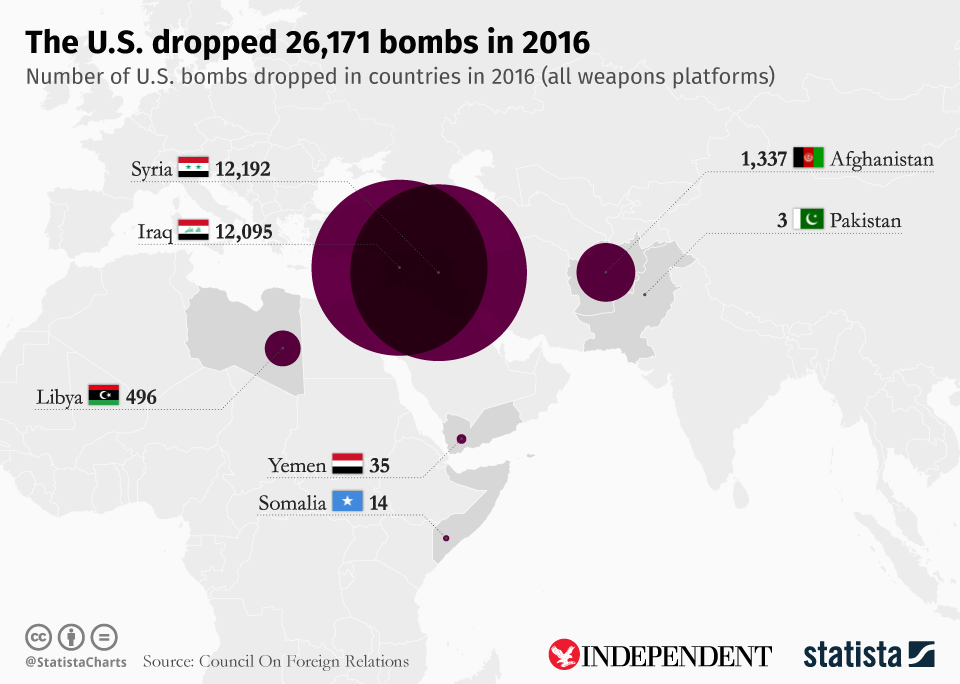
Map shows where President Barack Obama dropped his 20,000 bombs --outgoing US leader carries out 3,000 more strikes in 2016 than year before

And as the world gears up for a seemingly more violent four years, it is worth reflecting on President Obama's tenure.

According to newly released figures, President Obama had already upped the number of bombs on foreign countries.

US forces dropped over 3,000 more bombs in 2016 than 2015, taking the grand total of strikes for the year to at least 26,171.

This map by Statista shows you where they were:


Vast majority of strikes carried out in Iraq and Syria

The figures are likely to be an underestimate, since the only reliable data only comes from a handful of countries, and multiple bombs can be classed as a single “strike” under the Pentagon's definition.

Monday, September 23, 2019

The Monday Link Massacre

By Donald Sensing

An American civil cold war began in 2016. Next year it will get hotThe Long Civil War.

Will Trump go to war to protect Saudi oil? Nope. Foreign Policy: The Real Reason Trump Won’t Attack Iran

Because like the Terminator, it's what they do. It's all they do. Peggy Noonan: Why They’ll Never Stop Targeting Kavanaugh. This too: Democrats' Kavanaugh Smear Implodes -- Again

Remember: Hillary said your kids are not yours. They are the Village's. And you don't get a say in how to raise them

Like any religion, wokeness understands the need to convert children. The old Jesuit motto (sometimes attributed to Voltaire) was, after all, “Give me the child for the first seven years and I will give you the man.” And so I was moved but not particularly surprised by George Packer’s tale of a progressive school banishing separate restrooms for boys and girls because this reinforces the gender binary. The school did not inform parents of this, of course:
Parents only heard about it when children started arriving home desperate to get to the bathroom after holding it in all day. Girls told their parents mortifying stories of having a boy kick open their stall door. Boys described being afraid to use the urinals. Our son reported that his classmates, without any collective decision, had simply gone back to the old system, regardless of the new signage: Boys were using the former boys’ rooms, girls the former girls’ rooms. This return to the familiar was what politicians call a “commonsense solution.” It was also kind of heartbreaking.
("When the Ideologues Come for the Kids," By Andrew Sullivan, Intelligencer). John Sexton comments,
Bret Weinstein published a video arguing much the same thing. He said, “People who are the object of ire from the intersectionalists are going to be backed against the wall together. Who are they going to be? Well, primarily they are going to be straight and white and male.” He went on to predict that this combination of telling people that a) racial identity is paramount and b) your racial identity is suspect creates a breeding ground for the kind of white nationalism that we’d all like to avoid. Sullivan adds another note to his criticism, which is that there is no rational way out of this cult because reason has little to do with it. This is a substitute religion:
One of the key aspects about social-justice theory is that it’s completely unfalsifiable (as well as unreadable); it’s a closed circle that refers only to itself and its own categories. 
Speaking of ideologues coming for the kids, I give you Greta Thunberg.


Funny how Greta never goes outside white-majority countries to preach her religion. China and India are by leagues the worst polluters on earth. Has she gone there? Nope. Will she go there? You can bet your life savings, but I won't bet mine. Why? Well, I call racism, and I am darn serious about that.

Let us remember, though, that the Green movement depends on exploitation of black people.
A CBS News investigation has found child labor being used in the dangerous mining of cobalt in the Democratic Republic of Congo. The mineral cobalt is used in virtually all batteries in common devices, including cellphones, laptops and even electric vehicles.

A report by Amnesty International first revealed that cobalt mined by children was ending up in products from several companies, including Apple, Microsoft, Tesla and Samsung.
This is not news at all, except to CBS, of course. Electricity-powered cars, as as those Andrew Yang said must 100-percent replace petrol-powered cars, are horrendously polluting to manufacture because of their raw materials, especially rare-earths that are found mainly in Africa.

Forced child labor - actually, chattel slavery - had been used there for years and years for mining. But white elitists in America demand their Teslas, so let the black kids die, who cares. And yes, I am serious about writing that. The green movement in America is racist and exploitative to its very core.

Not to mention that Greenists are often (well, usually), factually incorrect:


But that's okay, because as Joe Biden and AOC have pointed out, the Left deals in Truth, not mere facts.

The Big Money behind Greta Thunberg: "Behind the schoolgirl climate warrior lies a shadowy cabal of lobbyists, investors and energy companies seeking to profit from a green bonanza" -- Greta’s very corporate children’s crusade

Liberals to black Americans: We do not want to hear what you think. We want to hear what we think, coming out of your mouths. White Liberals Lecture Candace Owens On White Supremacy. She Leaves Them In Tatters. Indeed, she does.

This is the Democrats' authority on being black in America, Prof. Kathleen Owens of the University of Chicago, testifying before the House Oversight Joint Subcommittee as they took on the subject of white supremacy.


And here is Prof. Owens directly lecturing black American Candace Owens on how she does not understand what it's like to be black in America.


And here is the tear-down Ms. Owens delivers in return.


Speaking of white supremacy, here it is:


More links to the enslavement of children in the Congo:

https://www.forbes.com/sites/jamesconca/2018/09/26/blood-batteries-cobalt-and-the-congo/#6c3ed237cc6e

https://www.iisd.org/story/green-conflict-minerals/

https://www.theguardian.com/global-development/2016/jan/19/children-as-young-as-seven-mining-cobalt-for-use-in-smartphones-says-amnesty

https://www.amnesty.org/en/latest/news/2016/01/Child-labour-behind-smart-phone-and-electric-car-batteries/

The Climate Change Cult is a religion that does not turn away from child sacrifice.

But let's end with a smile.


Thursday, April 12, 2018

Panetta on Syria: We have never had a clue

By Donald Sensing

The former Obama official referred to is Leon Panetta, one of the most sensible figures of Washington in either party. This is not a particularly well-written essay, but it does illuminate the fact that neither the prior administration nor the present one had/has a clue what the US objective is in Syria: Former Obama Defense, CIA Chief: U.S. 'Has Really Never Had a Strategy' on Syria

"And so, rather than developing that strategy, rather than trying to play a role in forcing Syria to figure out some kind of political settlement there that would get rid of Assad and allow Syrians to decide what their political future is, frankly, we have been hitting ISIS, on the side talking about Assad, but really don't have an overall strategy," he added. "And if we're going to strike Syria I don't think this ought to be a reflex action without a strategy. That's what this administration has to do, is figure out what is our long-term strategy in Syria going to be."
Which is to say that we do not like what Assad has done in using chemical weapons, but we have  no strategy to respond and no national objectives in responding. So to go to war with Syria would be like entering a dark room blindfolded in search of something that is not there.


Furthermore, absent specific Congressional authorization, a strike now against Syria would be an illegal war. Congress alone has the authority to declare war against a foreign power. That Congress' record of carrying out its Constitutional duties is one of abject failure and abdication, does not create a vacuum that a president may occupy to usurp Congress' authority.

Even if Congress did so declare, absent decisive and attainable national objectives to lead to a more just peace, the war would be unjust.

Yes, Assad is a monster. And his Russian sponsor, Putin, is a thug. And Iran is wielding strong influence in Syria also. That does not change the American domestic equation or our Constitutional requirements or the mandates of Just War Theory.

"Decide in hast, repent in leisure," said the ancient Greeks. It's long past time for Trump (and not only Trump) to take that to heart.

No war against Syria!

Related: "Just War and Syria Strikes"

Bookmark and Share

Thursday, May 25, 2017

Tuesday, May 23, 2017

Enemies who shouldn't be, enemies who must be

By Donald Sensing


This is a photo of Soviet army and US Army officers shortly after World War II. They seem to be at least halfway to getting drunk, and the Soviet in the middle is probably winning the race.

In my military career I was fortunate enough to have served with officers of many foreign nations, not all actually allied nations. German officers of course were my most common foreign companions; I well remember the Prussian haughtiness of Hauptmann Schneider - but it was an act and he was a great guy.

I wrote before about Egyptian Lt. Col. Solomon, with whom I served at Fort Sill, Oklahoma, where he was representing the Egyptian army along with Lt. Col. Osman, both wonderful companions and great friends who were also outstanding military men.

There were many others, such as Brits and some Aussies and a handful of Indian army officers and Saudis, and many Honduran officers, who were simply superb. My personal acquaintance with Soviet officers was quite limited. The first time I met one in person was when I stepped into the corridor outside my office at the Pentagon and almost ran into two Soviet officers walking down the hall! Quickly I reached for a pistol that I wasn't wearing and then watched dumbfounded as they ambled on down the hall.

That day was not long after the failed coup attempt against Soviet general Secretary Gorbachev, which marked the beginning of the dissolution of the Soviet empire. Shortly the USSR ended and was succeeded by the Commonwealth of Independent States. Russia would become Russia again, and it was officers of this post-Soviet military whom I encountered in the Pentagon. But their uniforms were the same.

The Russians were here to learn how to be an army of a democratic, free-market state, and I think that  at the time both they and we believed that this would come about. Of course, it did not. Putin came to permanent power and former die-hard communists morphed into die-hard capitalist oligarchs. (You think we have pay gaps here? Ha, we're pikers compared to the former commies of both the USSR and China.)

That being said, the Russian officers I did work with (though briefly) were great guys, too, and serious about their craft.

And herein is the issue. In 2013 wrote a review of a book by the late Lt. Col. Phillip Corso, who served in Army Intelligence at the Pentagon in the early 1960s. He wrote of the relationship between the CIA, the British MI-6 and the Soviet KGB:
They were all professional spies in a single extended agency playing the same intelligence game and trafficking in information. Information is power to be used. You don't simply give it away to your government's political leadership, whether it's the Republicans, the Tories, or the Communists, just because they tell you to. You can't trust the politicians, but you can trust other spies. At least that's what spies believe, so their primary loyalty is to their own group and the other groups playing the same game. The CIA, KGB, British Secret Service, and a whole host of other foreign intelligence agencies were loyal to themselves and to the profession first and to their respective governments last.
This kind of informal integration was not the case among the countries' armed forces, but I am confident that regular officers of the US Army, the British Army, the Soviet army, the Egyptian army, the German army, you name it, all felt a fundamental distrust of their nation's government at a very basic level, even if on the choice, responsibilities and intricacies of employing military forces. And every one of us, distrusting though we probably were, would have gone (and we did go) when told.

Even so, if you ever could have locked a group of American, Soviet, Egyptian, British, Saudi, and (even) French officers of equal rank in the same room, gave them a few cases of Coors to pass the time, and locked the door on your way out, when you came back in a couple of hours you would find a group of best friends telling each other war stories and nodding their heads at each others' tales, exclaiming, "Us, too!"

Did you ever notice that when two nations on the brink of war hold a last-gasp peace conference, the confreres are always wearing business suits? Funny that they never let the generals and colonels and captains get together and sort the thing out - maybe the suits are afraid we would. After all, of all men or women, military veterans know the futility and stupidity of war. And every one of them who might take the place of suits at a peace conference don't really trust their own governments, anyway.

For almost all of American history, we have fought enemies who shouldn't be enemies. The exceptions can be easily listed in one breath: The Nazis, the bushido Japanese and the North Koreans. The Nazis and the bushido Japanese are gone and North Korea is more dangerous than ever. But that's about it.

And now ISIS. They are enemies who must be. I cannot imagine any fellowship, any negotiation, with ISIS' officers or commanders that could come to a peaceful accommodation. ISIS seeks only to kill.

And so we must fight. After Manchester the task seems clear and unavoidable. To paraphrase J.R.R. Tolkien, we may not want to fight ISIS, but ISIS definitely wants to fight us. Our choice is not whether to go to war. We are already at war. Our only choice is how the war will end.


Bookmark and Share

Friday, April 7, 2017

Syria reaction, right on cue

By Donald Sensing

Well, of course.


But not all Republicans are Constitutionally feckless.


However,
Illinois Senator Dick Durbin, a member of the Senate Democratic leadership, also urged future congressional involvement, but took a more measured tone.

“My preliminary briefing by the White House indicated that this was a measured response to the Syrian nerve gas atrocity,” he said. “Any further action will require close scrutiny by Congress, and any escalation beyond airstrikes or missile strikes will require engaging the American people in that decision.”

Most top Democrats took a similar approach, balancing support for Thursday’s airstrike with caution against leaving out congressional leaders in future military decisions.
Even Sen. Schumer was more measured than the screen grab above indicates.
“Making sure Assad knows that when he commits such despicable atrocities he will pay a price is the right thing to do,” Senate Minority Leader Chuck Schumer said. “It is incumbent on the Trump administration to come up with a strategy and consult with Congress before implementing it.”
Which seems to me that Schumer is endorsing (or at least not protesting) last night's strike, but is insisting that further military action against Assad must be authorized by Congress. Well, with the strike a fait accompli that seems to me to be the best we can do.

Oh, an endnote: I do not understand how Assad could have carried out the chemical attack when In January, Susan Rice Assured NPR the Obama Admin Removed Chemical Weapons From Syria.

Update: Heh! "It would be foolish to predict what Trump will do—he may not even know himself."

And I pretty much never agree with Michael Savage, but I do think he's on to something here.

Bookmark and Share

Syria kabuki dancing

By Donald Sensing


What We Know and Don’t Know About the Missile Attack on Syria

I'm so old that I remember when the Senate majority leader said,

"Given the atrocities committed by Bashar al-Assad against his own people, including the use of internationally prohibited chemical weapons and the murder of innocent children, it is time for Congress to debate and vote on whether Syria's heinous actions should be met with a limited use of American military force,” [Senator Harry] Reid said in a statement.

"I believe the use of military force against Syria is both justified and necessary,” he added. “I believe the United States has a moral obligation as well as a national security interest in defending innocent lives against such atrocities, and in enforcing international norms such as the prohibition against the use of chemical weapons. Assad must be held accountable for his heinous acts, and the world looks to us for leadership."
That was in 2013. I have not at this hour found a statement by present Senate majority leader Mitch McConnell about last night's attack. Presumably he'll make one this morning. But Speaker of the House Paul Ryan jumped in almost right away:


A bit of a far cry from what he said about President Obama's intention to bomb Syria for the same offense in 2013 (which Obama never ordered).

What changed? Nothing but the party of the occupant of the Oval Office. And you will see the Democrats flip just as firmly. But at least Harry Reid gave a head nod to the Constitution's requirement that only Congress can declare or authorize war. I don't see the Republicans of Congress doing even that. Senator John McCain (R.-Ariz.) has already said Trump didn't need it.

Update: Senator Rand Paul (R.-Ky.) has said that Congressional authorization should have been requested first.

Bookmark and Share

Thursday, April 6, 2017

Trump just went to war with Syria

By Donald Sensing

File photo of US Navy warship firing a Tomahawk cruise missile
The United States attacked Syria directly Thursday night with dozens of cruise missiles.
The United States launched dozens of cruise missiles Thursday night at a Syrian airfield in response to what it believes was Syria's use of banned chemical weapons that killed at least 100 people, U.S. military officials told NBC News.

Two U.S. warships in the Mediterranean Sea fired 59 Tomahawk missiles intended for a single target — Ash Sha'irat in Homs province in western Syria, the officials said. That's the airfield from which the United States believes the government of Syrian President Bashar al-Assad fired the banned weapons.

There was no immediate word on casualties. U.S. officials told NBC News that people were not targeted and that aircraft and infrastructure at the site, including the runway, were hit.
As is the imperial habit of US presidents these days, there was no authority from the Congress asked for or received before initiating a new war with a country that has not attacked the United States, nor poses an imminent threat to US lives.

On TV news reporting, President Trump stated that the strikes were "in vital national interests" of the United States. I would very much like him to explain in full just how. After all, in 2013 when President Obama was leaning toward the same action, Trump tweeted:


What, exactly, changed on the ground when Assad used chemical weapons this week? The casualty count hardly budged - hundreds of thousands of people have already been killed. Chemical weapons are indiscriminate and cruel, but are they more so than barrel bombs, area shelling and area bombing? And for that matter, does not the brutality of anti-Assad rebels, not just ISIS, pose a dilemma for the United States?

So what is really going on? I find it hard to conclude other than this cruise-missile attack was mainly a signaling operation aimed mainly at Chinese President Xi Jinping, whose first face-to-face meeting with Trump was tonight and will continue tomorrow. Trump has said repeatedly that he wants China to rein in Kim Jong Un's nuclear weapons and ballistic missiles programs. The signaling was also undoubtedly directed at Teheran as well.

As I type, Trump is on camera speaking of the cruise missile attack. He is speaking angrily about the images of the chemical attack's aftermath and the suffering of children caught in it. He is saying that it is in the interests of the United States to prevent the spread of the use of chemical weapons. I agree with that but protest strongly the unconstitutionality of Trump's attack against a nation with whom we were not already at war.

As I wrote in 2013,
"Joint Chiefs Chairman Gen. Martin Dempsey made it clear that a few runs on target would do no good, that if the bombing was not be be merely symbolic, it would require a sustained, large effort of no short duration."
Does Secretary of Defense Mattis think differently today? If so, why? I also observed,
As for deterring leaders of other nations, assessing what example to make of Syria to deter them is like entering a dark room blindfolded, in the dead of night in a dense fog, to look for a black cat that may not even be there. Does anyone really expect that the Iranian government [or N. Korea's] will abandon its goal of attaining nuclear capability just because the United States mounted bombing campaign against Syria?
But Trump in his appearance tonight did not mention encourager les autres as a motive for the cruise missiles. The only stated motive was deterrence. If the question is only protection of the innocent, then I want to know whether this administration considers chemical weapons to be sui generis so that American warmaking on their users is justifiable for that reason alone. That is: in a civil war in which everyone agrees that hundreds of thousands of people on all sides have died, untold numbers of whom were murdered outside the laws of war but by conventional means, is the use of chemical weapons by itself a just cause of war for the US to wage on Syria, a nation not at peace with itself but with which the US is now at peace except for al Qaeda and ISIS terrorists with whom the US is already at war?

If that is the case being made, then it is being made very, very poorly. Let the case be made if there is one to make, and let it be made coherently and sensibly within the framework of existing US law and justice.

Syria's Shayrat airfield, the target
Because otherwise, absent a direct and imminent threat to US lives, there is no Constitutional justification for tonight's attack. Stopping the spread of chemical weapons is not exactly a new goal for the US government; every president since Woodrow Wilson has oriented on that. What was the urgency for this attack now that foreclosed deliberations with bipartisan leaders of the Congress on how to proceed?

No one ever made a good decision in anger. I fear that that this president has set the table for us to learn (again) the hard way the ancient proverb, "Decide in haste, repent in leisure."

Bookmark and Share

Thursday, February 9, 2017

ISIS is full of slackers!

By Donald Sensing

No, its' not The Onion or Duffelblog, it's hard news reporting: "Fair-weather fighters: ISIS jihadists claim headaches, bad backs to get out of battle, documents show."

Headaches, bad backs and general malaise are plaguing the ranks of ISIS, with jihadists calling out sick from the fight to save their caliphate, according to a report. 
Foreign fighters in particular seem to be going soft in the face of an offensive led by the Iraqi national military, Kurdish fighters and international forces. Documents discovered in recently liberated sections of Mosul show how the fair-weather jihadists go to great lengths to get out of combat. 
The Washington Post reported that Iraqi forces who took over an ISIS base in Mosul found a document lamenting 14 “problem” fighters from the Tariq Bin Ziyad battalion. On the surface, reports that militants are on the ropes in former stronghold cities appears to be a good thing, but some disenfranchised members may work their way back to Europe. 
“He doesn’t want to fight, wants to return to France,” one note reportedly said about a 24-year-old Algerian, who is  a resident of France. “Claims his will is martyrdom operation in France. Claims sick but doesn’t have a medical report.” 
Another man from Kosovo complained of a headache. A Belgian militant got out of fighting by offering a doctor's note saying he had back pain.
A former US Marine infantry officer with several years' Middle East service emailed me the article with the comment, 
I love the light-duty-chit approach that is shared by [slackers] around the globe - the mysterious, but ubiquitous, "Oh my back!!".
Yeah, "martydom operations" ain't all they're cracked up to be, right? So legions of jihadis seem to be as smart as Simpkins here:


Things will go rapidly downhill from here for ISIS, especially since the US Marines accidentally mis-routed one of their regimental clerks to Raqqa, Syria, capital of the self-proclaimed Islamic State.
RAQQA, Syria — The self-proclaimed Islamic State has been reportedly paralyzed by administrative paperwork and bureaucracy after a U.S. Marine administrative clerk was mistakenly sent there, Duffel Blog has learned.

Marine Staff Sgt. Alonso Gray executed a mistaken set of permanent change-of-station orders to Raqqa earlier this month, moving to ISIS’s de facto capital and starting work in their administrative section. Within days of his arrival however, pay errors, late morning reports and “improperly routed routing sheets” have caused the group to crumble from within.

Seemingly unaware that he was working for the global terrorist organization, Gray insisted they submit their DTS vouchers to him at least 90 days prior to going TDY. Commanders then panicked when he told them that their units were “non-mission capable” due to incomplete annual training requirements.

Abu Bakr al-Baghdadi, the former leader of the group, says taking Gray on board was the worst decision he ever made.

“I was supposed to PCS from Mosul to Raqqa before the Iraqi Army attacked, but instead he sent me here,” said Baghdadi, speaking from his cell in Guantánamo Bay, Cuba.
I'll bet one reason that the Greeks' Trojan War lasted 10 years was because it took that long to get the requisitions approved for the Trojan Horse.


Bookmark and Share

Wednesday, February 1, 2017

Saudi Arabia's religious tolerance

By Donald Sensing

Which is to say, there ain't none: Saudi Arabia Bans National Geographic Cover Featuring Pope Francis

Pope Francis has won praise around the world for advancing a more humble, tolerant version of Catholicism, but there’s one country that he evidently hasn’t won over. Saudi Arabia banned the August issue of the National Geographic’s Arabic edition, whose cover featured Francis standing in the Sistine Chapel, due to what the magazine said were “cultural reasons.”

“Dear readers in Saudi Arabia, we apologize that you did not receive August’s magazine,” read a statement published on National Geographic’s Arabic-language Twitter account, from the editor in chief, Alsaad Omar al-Menhaly. “According to the distribution company, the magazine was refused entry for cultural reasons.”

The very act of putting the Vicar of Christ on a magazine cover could have been controversial enough for senior officials from a country where mosque and state are closely intertwined. But Saudi censors might have also seen dangerous implications for the Wahhabi state in how National Geographic framed its coverage, as the cover referred to Francis leading a “quiet revolution” to reform the Catholic Church.

An editor’s note published in National Geographic’s Arabic edition in August lauded Pope Francis for moving to revitalize his church by making changes that “will dislodge some of the ingrained principles of the followers of the church.” Its argument, however, went beyond Catholicism: It made the case that religious institutions must adapt to a rapidly changing world. Religious pillars, the article argued, “are only tools aimed at preserving something, and if they are no longer capable of that, they must be altered.”

It’s not hard to see why that could be read as a challenge to Saudi Arabia’s Wahhabi religious authorities, who insist on a literal interpretation of the Quran. Wahhabis strive for a return to the practices of the first generations of Muslims from the seventh century; the notion that religion should be fluid and change with the times is precisely the idea that they are arrayed against.
And the House of Saud simply can't have any of its subjects, especially women, getting any bright ideas.

Monday, December 5, 2016

OPEC and the tragedy of the commons - why its members will cheat

By Donald Sensing

This is OPEC's basic problem and it has no solution
US opening-market oil prices are presently up from Friday's close, although prices dropped about one percent over the weekend in Asian markets after the US rig count showed a net gain. Brent oil futures have topped $55 per barrel, its highest level in 18 months.

The bull market for oil is still resounding from OPEC's Nov. 30 deal to cut production by 1.2 million barrels per day. OPEC is also seeking another 600,000-bpd cut by non-OPEC countries, with half coming from Russia. Russia has already said it would and by the end of Dec. 10 we should know whether other non-OPEC producers will meet the goal.

But here's the thing: oil production both in and out of OPEC is already at near all-time highs and has been rising since summer. OPEC and other producers have been running production up preparing for a deal to run it part-way down.

Example:
Russia on Friday reported average daily oil production of 11.21 million bpd for November - its highest in almost 30 years.

And while Moscow has agreed to cut its output by 300,000 bpd in early 2017, it said it would do so against November levels. That means that even after a reduction, its output would remain higher than it was at the peak of the oil glut in the first half of 2016.

Jeffrey Halley of brokerage OANDA in Singapore said oil traders were "nervous (as) Russia's output has hit record levels, meaning their part of the production cut takes them back to what they were producing only quite recently". 
In the Middle East, where the deepest OPEC production cuts are expected, there are also signs that production will rise before it gets cut.

Saudi Arabia and Kuwait are expected to agree this month to resume oil production, with a potential of 300,000 barrels in daily output, from jointly operated oilfields which were shut down between 2014 and 2015 for environmental and technical difficulties.
This is cheating on the agreement in advance of when it kicks in next month. And producers' track record on keeping such agreements is really, really lousy. Brown University professor Jeff Colgan wrote in Foreign Affairs in October, after the Nov. 30 summit had been announced, that historically OPEC's deals have been meaningless:
In a detailed analysis of OPEC’s behavior since 1982, I found that OPEC cheated on its own aggregate production target a whopping 96 percent of the time—and every member is guilty of taking part. Worse still, changes in production targets had almost no impact on production itself. Maybe 2016 will be different, but this pattern cannot be ignored.

OPEC’s main problem is that it has no real way of enforcing its agreements. Members such as Algeria, Iraq, and Venezuela typically want the organization to do what cartels do: constrain oil supplies and raise world prices. But even though they understand that restraint would benefit the organization as a whole, they are not usually willing to sacrifice their own output. 
Any economist understands this almost intuitively. Its the classic "tragedy of the commons."
The tragedy of the commons is an economic problem in which every individual tries to reap the greatest benefit from a given resource. As the demand for the resource overwhelms the supply, every individual who consumes an additional unit directly harms others who can no longer enjoy the benefits. Generally, the resource of interest is easily available to all individuals; the tragedy of the commons occurs when individuals neglect the well-being of society in the pursuit of personal gain.
Understand that in the worldwide oil commons, the "given resource" is not oil, but dollars. To restate the definition:
As the demand for dollars overwhelms the supply (because of falling oil prices), every oil-producing nation that keeps producing high levels gains revenue at the expense of nations that cut production. Generally, dollars are easily available to all producers; the tragedy of the commons occurs when individual nations neglect the revenue of other producers to maximize their own revenue.
This kind of behavior is universal no matter the "given resource."
The concept and name originate in an essay written in 1833 by the Victorian economist William Forster Lloyd, who used a hypothetical example of the effects of unregulated grazing on common land (then colloquially called "the commons") in the British Isles. The concept became widely known over a century later due to an article written by the ecologist Garrett Hardin in 1968. In this context, commons is taken to mean any shared and unregulated resource such as atmosphere, oceans, rivers, fish stocks, or even an office refrigerator.
As Brown demonstrated, 96 percent of the time OPEC's members follow the commons principle quickly and readily. There is no reason to expect anything different this time except, perhaps, that cheating will occur sooner this time than before because most member states are more cash crunched than they were in prior agreements.

End note: One more thing to remember about the OPEC deal. It is an agreement to reduce oil production but is silent on oil exports.
It is also worth noting that the OPEC agreement refers only to production, not exports. The Saudis have been shipping crude from a stockpile of near 280 million barrels and will continue to meet its market commitments from those stockpiles. Cutting production by half a million barrels a day has no short-term impact on how much oil the Saudis export.

In September, for example, Saudi Arabia’s crude stocks dropped by about 2.3 million barrels, according to JODI data, and the country ended the month with 278.7 million barrels in its stockpile. 
In 2015, the latest year for which I could find figures, Saudi Arabia exported 7,163,300 bpd and produced 10,192, 600, for a net stockpile gain of three million (rounded) bpd. Some of that excess the country uses for itself, of course, but even so it has been stockpiling oil a long time. Even if Saudi Arabia cuts production by its agreed-upon rate of 500,000 bpd, it can keep exports unchanged for at least 18 months.

Update: Here are the bpd production charts of every OPEC nation, by quarter, since January 2005. Here is the overall OPEC chart:


Even at almost 34 million bpd, OPEC's share of global oil supply is less than 35 percent and shrinking. And that's before the cuts kick in next month.

Bookmark and Share

Friday, April 29, 2016

Oil Prices Just Hit a 2016 High - Unexpectedly!

By Donald Sensing

Here's Why Oil Prices Just Hit a 2016 High - Fortune:


It has to do with a surprise drop in
U.S. crude stockpiles.

Crude oil prices hit 2016 highs on Tuesday on the back of a rally in the gasoline market and after an industry group reported a surprise draw in U.S. crude stockpiles.
Analysts seem always to be taken entirely by surprise.

Are we witnessing The Collapse of the Old Oil Order?
Sunday, April 17th was the designated moment. The world's leading oil producers were expected to bring fresh discipline to the chaotic petroleum market and spark a return to high prices. Meeting in Doha, the glittering capital of petroleum-rich Qatar, the oil ministers of the Organization of the Petroleum Exporting Countries (OPEC), along with such key non-OPEC producers as Russia and Mexico, were scheduled to ratify a draft agreement obliging them to freeze their oil output at current levels. In anticipation of such a deal, oil prices had begun to creep inexorably upward, from $30 per barrel in mid-January to $43 on the eve of the gathering. But far from restoring the old oil order, the meeting ended in discord, driving prices down again and revealing deep cracks in the ranks of global energy producers.

It is hard to overstate the significance of the Doha debacle. At the very least, it will perpetuate the low oil prices that have plagued the industry for the past two years, forcing smaller firms into bankruptcy and erasing hundreds of billions of dollars of investments in new production capacity. It may also have obliterated any future prospects for cooperation between OPEC and non-OPEC producers in regulating the market. Most of all, however, it demonstrated that the petroleum-fueled world we've known these last decades -- with oil demand always thrusting ahead of supply, ensuring steady profits for all major producers -- is no more. Replacing it is an anemic, possibly even declining, demand for oil that is likely to force suppliers to fight one another for ever-diminishing market shares.
Methinks the writer has missed the boat. Saudi Arabia definitely wanted (and still wants) oil prices to rise. The Saudis make a very good profit at $70 per barrel, which happens to be the price point where American fracking becomes marginally profitable. So in the Saudis' mind, seventy bucks is an optimum price: it funds their programs and lifestyles and is not high enough to bring massive fracking operations back into the market.

Besides, if Doha was the "debacle" the writer says, then why did spot-market oil hit its year high today? Let's take a look at oil prices since the April 17 (a Sunday) "debacle," using as a proxy the United States Oil Fund, which rises or falls in a 1:1 direct ratio with spot prices. That is, if spt oil rises two percent, USO's share price rises two percent. Here is USO's chart starting April 18, the day after Doha's "debacle."


So if you had bought USO at opening on April 18 (disclosure: I am not invested in this fund and never have been) at $9.985, you could sell today, 11 days later, for $11.39, a 14 percent profit! Some debacle!

Here is USO's chart for the last three months.


Note the rise since the beginning of April. The Doha conference came and went and pretty much no one noticed. After all, no one in the oil biz expected Doha to do anything. The pretty much shrugged it off before it was held and after it adjourned.

I covered why Iran's promise to pump at full capacity means nothing much because they can pump all they want but they can't ship it anywhere.

Bookmark and Share

Saturday, April 16, 2016

The evil empire of Saudi Arabia

By Donald Sensing

The evil empire of Saudi Arabia is the West’s real enemy

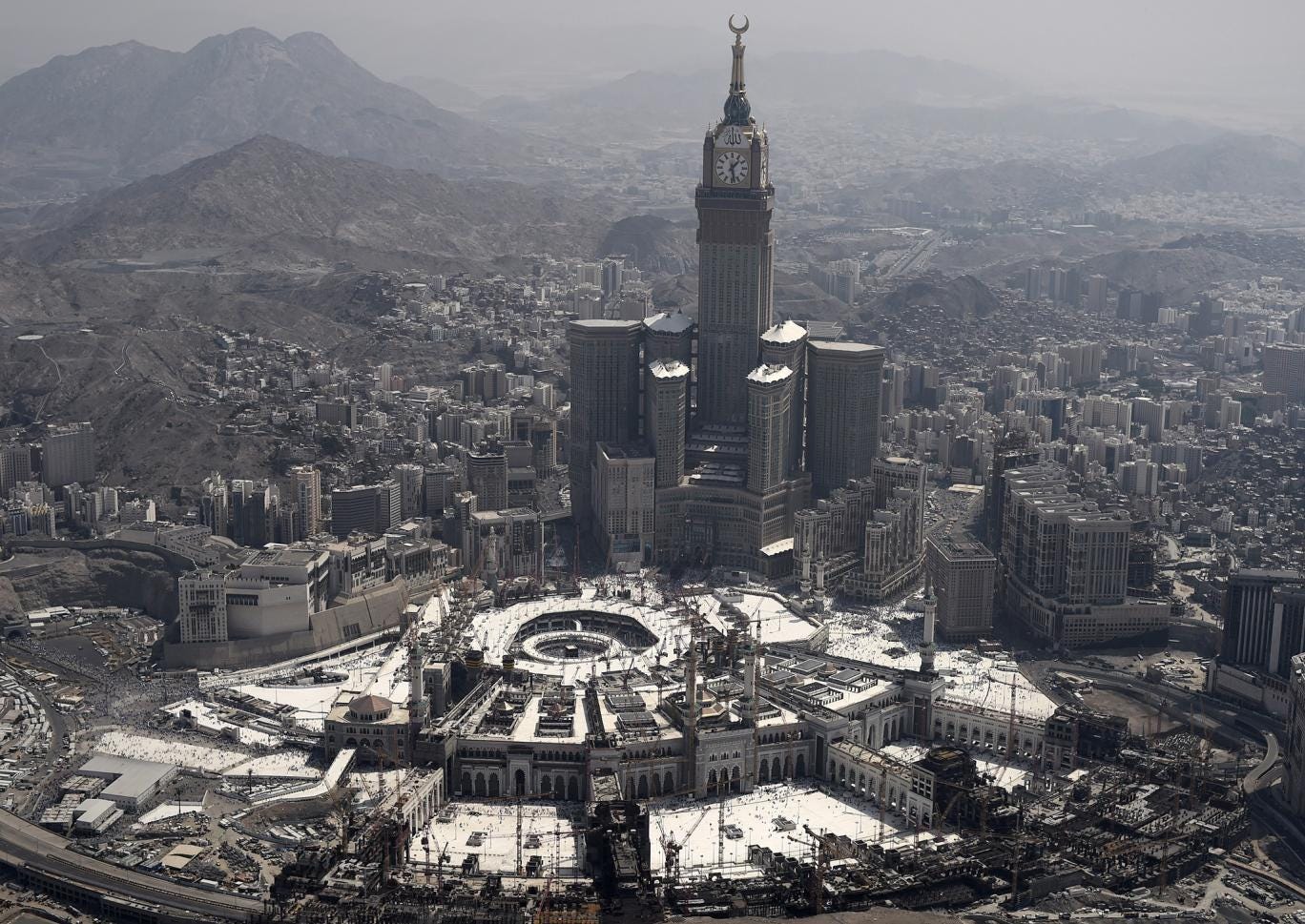
Some Brits do get it, in this case a British Muslim. Take for example what has happened to Mecca:

The Clock Tower and the Grand Mosque in the Saudi holy city of Mecca, September 25, 2015 MOHAMMED AL-SHAIKH/AFP/Getty Images
For all the thousands of people Osama bin Laden caused to die on 9/11/2001, he reserved his principal hatred for the corrupted House of Saud. As I wrote in my 2003 essay, "Osama bin Laden’s strategic plan: well, folks, he ain't got one:"
Bin Laden has been emphatic that the Saudi regime is un-Islamic, corrupt and oppressive of the Saudi people, although, of course, he blames the United States for all this. His most serious charge against the Sauds is that they permitted the occupation of "the Land of the Two Holy Mosques" (meaning Saudi Arabia itself, wherein lie Mecca and Medina) by the Americans, who are conspirators with Zionists to destroy Islam.  In his 1996 fatwa, bin Laden said of the House of Saud: 
The latest and the greatest of these aggressions, incurred by the Muslims since the death of the Prophet (Allah's blessing and salutations on him) is the occupation of the land of the two Holy Places - the foundation of the house of Islam, the place of the revelation, the source of the message and the place of the noble Ka'ba, the Qiblah of all Muslims - by the armies of the American Crusaders and their allies. . . .  From here, today we begin the work, talking and discussing the ways of correcting what had happened to the Islamic world in general, and the Land of the two Holy Places in particular. . .  But the competition between influential [Saudi] princes for personal gains and interest had destroyed the country. Through its course of actions the regime has torn off its legitimacy:  (1) Suspension of the Islamic Shari'ah law and exchanging it with man made civil law. . . .  (2) The inability of the regime to protect the country, and allowing the enemy of the Ummah - the American crusader forces- to occupy the land for the longest of years. . . .
 There followed a long list of grievances against the Saudi regime, particularly emphasizing its un-Islamic rule, the wealth-corruption of its princes and accusing it of being a puppet of the USA. 
But back to our British Muslim commentator and the evil of the House of Saud:
The state systematically transmits its sick form of Islam across the globe, instigates and funds hatreds, while crushing human freedoms and aspiration. But the West genuflects to its rulers. Last week Saudi Arabia was appointed chair of the UN Human Rights Council, a choice welcomed by Washington. Mark Toner, a spokesperson for the State Department, said: “We talk about human rights concerns with them. As to this leadership role, we hope that it is an occasion for them to look into human rights around the world and also within their own borders.”

The jaw simply drops. Saudi Arabia executes one person every two days. Ali Mohammed al-Nimr is soon to be beheaded then crucified for taking part in pro-democracy protests during the Arab Spring. He was a teenager then. Raif Badawi, a blogger who dared to call for democracy, was sentenced to 10 years and 1,000 lashes. Last week, 769 faithful Muslim believers were killed in Mecca where they had gone on the Hajj. Initially, the rulers said it was “God’s will” and then they blamed the dead. 
Mecca was once a place of simplicity and spirituality. Today the avaricious Saudis have bulldozed historical sites and turned it into the Las Vegas of Islam – with hotels, skyscrapers and malls to spend, spend, spend. The poor can no longer afford to go there. Numbers should be controlled to ensure safety – but that would be ruinous for profits. 
There is a lot more, so read the whole thing.

As I first wrote in 2002, "In fact, Saudi Arabia is much more a family-run business than a true nation-state (and it's a Corleone-like family at that)."

Related: Cheap oil isn't Saudi Arabia's only big risk

Bookmark and Share

Tuesday, April 5, 2016

Kuwaiti activist on the Arab mentality

By Donald Sensing

Kuwaiti Activist Nasser Dashti: Islamic Conquests Constitute Colonialism; the Arab Mentality Is Sectarian, Dictatorial, Tyrannical

This from the Middle East Media Research Institute.


Kuwaiti Activist Nasser Dashti: Islamic Conquests Constitute Colonialism; the Arab Mentality Is Sectarian, Dictatorial,...
Posted by The Middle East Media Research Institute (MEMRI) on Sunday, April 3, 2016

Bookmark and Share

Saturday, March 5, 2016

War and the reshaping of societies

By Donald Sensing

First published in 2002 at a now-defunct site

Various commentators have pointed out that during the Persian Gulf War, only about 10 percent of the bombs US air forces dropped were precision guided. But during the Afghan campaign, so far, two-thirds or more have been precision guided.

There are many military and political advantages of using precision guided munitions, or PGMs. But may be some long-term drawbacks as well. Crudely put, our reliance on PGMs make it possible for a foreign power to fight us and lose, yet not suffer many of the consequences of war.

World War II "precision" bombing

The primary advantage of PGMs is actually hitting the target. During World War II, when there were no PGMs, the allied air forces sent up to 1,000 heavy bombers over German targets at a time. Yet the number of bombs that actually had militarily significant target effects was small in comparison to the number dropped. The British knew this would be the case from the beginning, and didn't even try to hit their targets except by using the law of averages. "Area bombing" was their tactic. They hoped that if they dropped as many bombs as they could, enough would happen to hit the target to make the mission worthwhile.

Area bombing of a German city
American commanders believed that intentionally accurate bombing was possible; they even misnamed their technique "precision" bombing. Yet long before the end of the war, American bomb wings were really conducting area bombing tactics; they just continued to pretend they were conducting "precision" bombing. In all, according to the US Strategic Bombing Survey completed after the war, "2,700,000 tons of bombs were dropped [on Germany], more than 1,440,000 bomber sorties" were flown. Yet the Survey reports that "only about 20% of the bombs aimed at precision targets fell within [the] target area."

That this was "precision bombing" was simply propaganda. US Air Corps bombing raids' accuracy was severely affected by German weather, which was almost never suitable for accurate bombing. An enormous number of US bomb missions were conducted by radar, which in that day was very inexact. There was no such thing as precision-guided bombs for these raids.
The destruction achieved was enormous. Almost 60 years later we can scarcely comprehend what the Germans and Japanese endured. In Germany, "3,600,000 dwelling units, approximately 20% of the total, were destroyed or heavily damaged. Survey estimates show some 300,000 civilians killed and 780,000 wounded. The number made homeless aggregates 7,500,000. The principal German cities have been largely reduced to hollow walls and piles of rubble."

Hamburg, Germany, 1943. Destruction of this magnitude across the whole of Germany was the deliberate war aim of both Britain and the United States.
Most of this destruction was what we now term, "collateral damage." With an average of 80 percent of the bombs falling outside the target area, it was inevitable that non-target areas would suffer heavy damage. The British intended from the beginning to inflict massive destruction on civilian populations and facilities. Partly, this desire was revenge based, since the German Luftwaffe had terror-bombed England. But it was mostly based on the mistaken notion that heavy bombing of civilian centers would reduce civilian morale to the point where they would not support the war any longer. (Why the British thought that German morale was more frail than their own is an unanswered question.)

The Americans rejected terror bombing, but not for long. As the war went on and on, and German and Japanese resistance failed to slacken, President Roosevelt decided that the German and Japanese peoples must realize after the war that not only had their armed forces been defeated: the entire nation, as a nation, had been beaten. He and Churchill were well aware that German militarism had survived World War I because its apologists had successfully propagated the myth that the Kaiser's army had not really been defeated, it had been "stabbed in the back" by disloyal factions at home.

Hence, wrote Roosevelt in a letter to Secretary of War Henry Stimson,
It is of utmost importance that every person in Germany should realize that this time Germany is a defeated nation. . . . The fact that they are a defeated nation, collectively and individually, must be so impressed upon them that they will hesitate to start any new war.
(Roosevelt's policy seems not far from Civil War Gen. William T. Sherman's observation of the Confederate States, "War, and war alone, can inspire our enemy with respect, and they will have their belly full of that very soon.")

So, according to historian Richard B. Frank in his award-winning book, Downfall, the End of the Imperial Japanese Empire:
Viewed in this light, massive urban bombing complemented the aim of unconditional surrender. It was not just a handful of vile men who flaunted vile ideologies; whole populations imbibed these beliefs and acted as willing acolytes. Unconditional surrender and vast physical destruction would sear the price of aggression into the minds of the German and Japanese peoples. No soil would be left from which myths might later sprout that Germany and Japan had not really been defeated. These policies would assure that there would be no third world war with Germany, nor would Japan get a second opportunity.
One notes that Japan and Germany have been well behaved since 1945. But we also have to note that massive, destructive bombing was alone not the reason. It was simply impossible for either country's armed forces to claim that they had prevailed, or at least held their own, on the field of battle. German and Japanese orphans, widows and grieving parents were in almost every other household, and a lie that their armed forces had not really lost could not possibly have found legs to stand on.

Most importantly, US forces occupied both countries for several years after the war. In Germany, the division of the country into free and communist states imbued it and Europe with a forced stability that they might not otherwise had. This gave time for democratic institutions to take serious root, and today German democracy is as strong as any in the world. It helped that Germany had no ages-long tradition of centralized authority in monarchs; it had been unified into a single nation only a few decades before.

But in Japan, the situation was quite different. Militarism was deeply rooted; in fact, the entire culture of the country was oriented on producing warriors. The imperial throne had been intact for 2,400 years, although its present polity dated only to the 1860s. Women were politically and socially powerless. And in 1945, its army, navy and air forces virtually eliminated, General of the Army Douglas MacArthur arrived as the first successful invader ever to set foot on the soil of Japan.

In Japan, MacArthur eliminated Japanese militarism, first by emplacing a democratically-based constitution, and second by liberating Japanese women from centuries of patriarchal oppression. He gave women the right to vote and to serve in democratic assemblies and government offices. MacArthur saw these steps as essential to ending Japanese military aggressiveness. America also bore the brunt of rebuilding Japan's economy and infrastructure. The result: today Japan may fairly be characterized as a Western country. It bears all the hallmarks of Western culture and tradition: a capitalist economic system, a representative parliament, a toothless monarchy, a vibrant university system and the rule of law.

A comparison to America's present enemies is therefore apt. What made Japan's transition from a medieval culture to a modern one so successful so quickly was the fact that the Japanese people, from top to bottom, realized that the way they had been doing things, in every arena of their society, was no longer tenable and had to be abandoned. This realization was profound and wrenching, but it had been brought about through great violence and enormous cost to their nation.

I have noted before that there is no inherent contradiction between the religion of Islam and democratic institutions. On the contrary, I am convinced that state Islam, as practiced in the Arab countries today, serves mostly to amplify rather than create political and cultural oppression. The real problem with Islam is not actually Islam; it is how Islam is practiced in Arab lands.

Saudi Arabia is a paradigm. According to Prof. Fouad Ajami of The Johns Hopkins University, Islam has been "the handmaiden of the state" since the beginning of the modern Saudi realm, resulting from "an alliance between a desert chieftain, Muhammed bin Saud, and a religious reformer named Muhammed ibn Abd al-Wahhab. This partnership anchored the kingdom. The House of Saud defended the country and struck bargains with world powers, while the descendants of the Wahhab family dominated the judiciary and an educational system suffused with religion.

The real enemy of Western civilization today is not Islam. It is arabism: a system of political and social authoritarianism in Arab lands using Islam as a handmaiden, as Prof. Ajami put it. (Remember, most Muslims are not Arabs.)

Our task is therefore over the long term to bring home to these nations, at every level of their societies, the fact that Japan had to face: the times, they are a-changing. These nations must come to realize at every level that they cannot successfully continue with business as before. They must transition into democratically based institutions with free-market systems and individual freedoms. The question is, can these reforms be brought about either non-violently or do they require profound suffering by their peoples?

Directly related: "Trump is unfit to command the military" and why. I quite agree.

Bookmark and Share