News and commentary concentrating on foreign policy, military affairs and religious matters. And other things that come to mind. Click for Feedburner siteor Smartphone Site
Why is this a problem?You might think this is great for the environment. A smaller population would reduce carbon emissions as well as deforestation for farmland.
"That would be true except for the inverted age structure (more old people than young people) and all the uniformly negative consequences of an inverted age structure," says Prof Murray.
The study projects:
The number of under-fives will fall from 681 million in 2017 to 401 million in 2100.
The number of over 80-year-olds will soar from 141 million in 2017 to 866 million in 2100.
Prof Murray adds: "It will create enormous social change. It makes me worried because I have an eight-year-old daughter and I wonder what the world will be like."
Who pays tax in a massively aged world? Who pays for healthcare for the elderly? Who looks after the elderly? Will people still be able to retire from work?
"We need a soft landing," argues Prof Murray. ...
Prof Ibrahim Abubakar, University College London (UCL), said: "If these predictions are even half accurate, migration will become a necessity for all nations and not an option. "To be successful we need a fundamental rethink of global politics.
"The distribution of working-age populations will be crucial to whether humanity prospers or withers."
Elizabeth Nickson’s story has all the makings of a Hollywood bio pic: A Westmount exile, who rebels against power and privilege, becomes a globe-trotting leftist journalist chronicling the great revolutionary narratives of her time. Then she sets out to discover the awful truth about her patriarchal 400-year-old colonist clan and everything changes. But Hollywood won’t touch her script because what she finds are eternal truths, about love, charity, sacrifice, Christianity and genuine freedom. ...
"The first thing I discovered was that they were Christian. And I mean very, very Christian. This was unnerving since on the intellectual left, faith in God, and particularly Christ, signifies a weak mind. But these people were anything but weak."
The dream of Marxism is to eradicate Western civilization and replace it with itself; its reaction to the legitimate evils that have been committed by Occidentals is not reform but obliteration.
Marxism assumes that because the windows are dirty and cracked, the entire house must be demolished. We see this same hatred today in the insurrections occurring right now. There is no reason for mobs pulling down statues of Ulysses S. Grant or Hans Christian Heg or calling for statues of Abraham Lincoln as the Great Emancipator to be removed.
But if Western Civilization is evil, that means all the elements that went into creating Western Civilization must also be destroyed. That includes Christianity.
Yet there are some disturbing parallels, or at least echoes, of what happened during the Weimar years. First, the very emergence (or re-emergence) in the US of ideologically inspired rioting, looting, and street violence. Second, the fact that at least some of the violent factions – like Antifa – appear to be systematically organised and funded, with fairly sophisticated recruitment, training, and communications capabilities. Third, there is the truly disturbing fact that violence seems to winked at – if not actively encouraged – by sympathetic office-holders and by the ever-more-politically-one-sided media, in thrall to the political Left.
(In Weimar Germany, too, the political armies represented the political parties, and they were protected by office-holders – and also by the courts – which were sympathetic to them. In the Weimar Republic, it was especially right-wing governments and judges who winked at right-wing or Nazi violence. Hitler, for example, was liable for severe punishment, or even the death penalty, for the Beer Hall Putsch – his attempted coup by armed force in Bavaria in 1923. Instead, after a trial by sympathetic judges, he served less than nine months “fortress confinement” in Landsberg Prison, where he was accommodated comfortably and free to write, or rather to dictate, Mein Kampf.)
Politically-inspired rioting, looting, arson; bitter racial and ethnic grievances and divisions; deepening ideological antipathies. Colleges and universities that foster one-sided extemism. (The Nazis were especially strong in the Weimar-era universities.) Public officials and media who minimise or cover for violence – creating an atmosphere of impunity for one side in the political struggle. None of these are healthy symptoms.
History – thankfully – may not repeat itself. It’s worrisome though, or at least rather creepy, when it begins to rhyme.
A fountain dedicated to Holocaust survivors was toppled into pieces at Santa Rosa Memorial Park, where police are investigating the act of vandalism to determine if it is a hate crime.
The other enemy is Christianity, which cannot be tolerated by atheistic humanism because Christian faith simply contradicts not only that atheistic humanism is correct, but that it is even possibly correct. And so we have anarchist race warrior Shaun King:
So, did Jesus have a northern European appearance? Of course not. In fact, we do not know what Jesus looked like. Over the centuries since his day, Christians around the world have created art showing a Jesus who looked like them:
There are thousands of similar examples in countries around the world. Are these wrong, also? When Chinese Christians portray Jesus with Asian features, are they guilty of Chinese supremacism (and that definitely is a thing)? Are African Christians' portrayals of Jesus as an African guilty of cultural or racial appropriation? Or is it only the whites whose Jesus must be destroyed? To ask the question is to answer it. Not all mainly-humanists are atheists. But whenever Christians begin to consider other persons, either other Christians or not, mainly as enemies who must be defeated, well, that is when they have in their hearts denounced Christ and have embraced the powers and principalities of the world. Understand this: "white Jesus" is not the real target at all. It is only a beginning point. Anyone of any race who renounces the call to violence and carries out the commandments of Christ is the real target.
The story is told of Sean O'Flannery, a lad who moved to Boston from Dublin. Coming home from school one day he went into an ice cream shop and told the jerk behind the counter (the soda jerk) "One scoop of yer best chocolate ice cream in four dishes!"
Soda jerks get strange requests, so he set four dishes with one scoop each in front of Sean. Sean took a spoon of one, held it before his face and loudly announced, "This is me beloved cousin eating ice cream back in the old country!" He ate the ice cream and took a spoonful from another scoop, "This is me dear friend Kelly eating ice cream back in me homeland!" The third dish he said was his favorite uncle, Finian, eating ice cream back home.
Sean raised the last scoop and said, "And this dish is for me!"
This practice went on for several months until one evening as the soda jerk was filling the four dishes Sean stopped him and said quietly, "Only three dishes today, please."
The soda jerk asked, "Did you suffer a loss and that is why you only want three scoops?"
"Heaven's no!" protested Sean O'Flannery. "It's Lent now, and I've given up ice cream!"
The word “Lent” comes from the Anglo-Saxon word, “lencten,” meaning Spring, the season in which Easter occurs. The forty days before Easter constitute the Lenten season, but the forty-day count does not include Sundays. All Sundays celebrate the resurrection, and so are excluded from the forty days count. The forty days duration is drawn from the length of time Jesus spent in prayer and fasting in the wilderness before he set out on his three-year ministry.
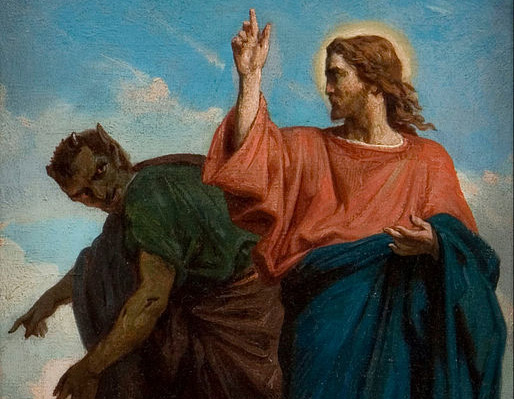
Matthew 4.1-4:
1 Then Jesus was led by the Spirit into the wilderness to be tempted by the devil. 2 After fasting forty days and forty nights, he was hungry. 3 The tempter came to him and said, “If you are the Son of God, tell these stones to become bread.”
4 Jesus answered, “It is written: ‘Man shall not live on bread alone, but on every word that comes from the mouth of God.
As originally conceived by the church long ago, the Lenten sacrifice was instituted as a “means of penitential preparation and preparation for baptism, which in the early church customarily took place on Easter Sunday.”
The tradition of fasting during Lent is an early one, originally done between Good Friday and Easter morning, the forty hours that Jesus was in the tomb. Christians would partake of no food or drink at all during that time. The fast was extended to the forty days before Easter sometime between 300 and 325, and changed so that food could be eaten only when evening had come.
The idea behind the fast was to imitate Christ. In addition to fasting, Christians would devote themselves to making prayer a faithful habit. So “prayer and fasting” have been closely linked for a long time.
And that brings me, by a rather circuitous route, to chocolate.
Chocolate is an absolutely unessential food, nutritionally speaking. We eat chocolate for no reason other than it is pleasurable. Since denial of the flesh is a prominent theme of Lent, rejection of chocolate in Lent is often offered as the Lenten sacrifice, particularly by people who wish to diet anyway.
But the Lenten season is also a time we ponder and wonder about the love of God. God’s love knows no bounds or limits and was so strong that not even the prospect of cruel death could deter Jesus from his redemptive mission. While we deny the pleasures of life during Lent, Jesus denied his life itself for the sake of his love for us.
Perhaps that fact could put a different spin on our concepts of giving something up for Lent. The Lenten sacrifice is best oriented toward that which most blocks our spiritual growth. It is each to ask ourselves, “What is it that most keeps me from Christ-likeness?” If that thing is chocolate, then it is appropriate to give up chocolate for Lent. But if something else is your greatest obstacle in being more Christlike, then giving up chocolate is a spiritually pointless exercise.
The question is this: “What is the one thing that most hinders my Christian growth into the person whom God wants me to be?” The answer may not be easy, but it will always involve self-denial. We think that following Christ is hard because to obey Christ we must first disobey ourselves, and it is disobeying ourselves that makes us think following Christ is hard.
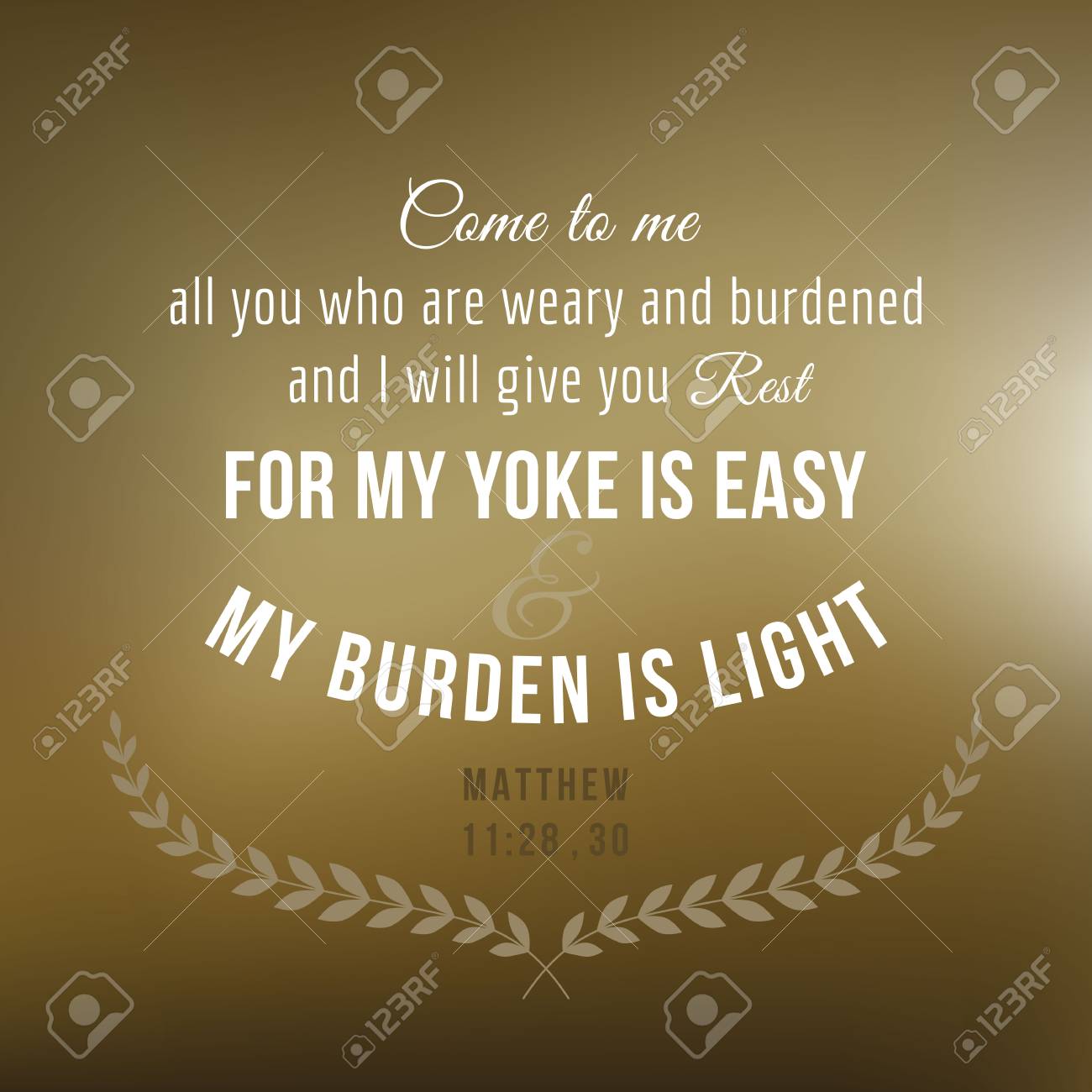
But Jesus said his yoke is easy, his burden is light. We just have to get over ourselves to do it.
As Robert Mulholland put it, “Jesus is not talking about giving up candy for Lent. He is calling for the abandonment of our entire, pervasive, deeply entrenched matrix of self-referenced being.”
If we focus on that between now and Easter Day, then we have a chance to become more mature in Christian faith and practice. It may be a habit that is out of true with Christian character that needs to be overcome for further growth. Or it may be a thing undone which must be done for deeper development to occur. The Lenten idea is for our habits to change enough in the next few weeks so that we can continue at a higher level of discipleship after Easter. The Lenten season and the Lenten sacrifice are not the points in and of themselves, the whole life of discipleship is.
Focusing on the one big thing is not the only Lenten discipline that would be helpful for spiritual development. Methodism’s founder, John Wesley, insisted that the only thing that distinguishes the Christian from the non-Christian are how we use our time and money. So, for the period of Lent I would suggest focusing on those two things in addition to whatever one big spiritual obstacle you might have. Some suggestions:
Tithe all your income until Easter.
Devote yourself to prayer daily and attending worship every Sunday. If you are traveling, say on business or spring break, then worship wherever you are.
Read the Bible each day.
Call someone you love and let them know.
Ask people who live alone to join you for lunch or whether you can visit them.
Become involved in Christian ministries.
Re-establish or reinforce important relationships in your life.
Spiritually speaking, it is not enough to simply excise sin or personal vices from our lives. We have to replace vice with virtue. Thus, simply giving up something like chocolate for Lent is simply silly if we are only counting the days when we can start doing it again. That’s a game, not a spiritual discipline.
Lent should be a period of joyful, God-directed introspection into how we may be further united with Christ in godly love. If we make Lent into a severe, joyless, self-justifying exercise in self-denial, we have missed the point. Jesus sternly admonished teachers of the religious law and the Pharisees not to practice the letter of the law while neglecting “the more important matters of justice, mercy and faithfulness” (Matt 23:23).
When a lawyer asked Jesus, “which is the greatest commandment in the Law?” Jesus replied, “‘Love the Lord your God with all your heart and with all your soul and with all your mind.” And the second is like it: ‘Love your neighbor as yourself.’”
That is the whole point of spiritual growth and spiritual discipline, and hence the whole point of Lent: love. We are to be living ambassadors from God to one another and the world at large in Christ’s name. Christ was crucified, buried and raised from the dead for our sake and the sake of the whole world. Let us rededicate ourselves to being Christ’s ambassadors. It’s Lent, after all; it’s all about love, you see, Lent is all about love.
Just after New Year’s Day there was national and regional news coverage announcing, “United Methodist Church Announces Proposal to Split Over Gay Marriage” (NPR), or similar headlines.
Why did this become suddenly worthy of such large-scale coverage? That the church has been wrestling with homosexuality since at least 1972 is no secret. Accurate headlines would read, "United Methodist Church leaders agree to catch up to fact that the UMC is already splitting over gay rights."
The UMC is the America’s second-largest Protestant denomination with about 7.5 million US members, and about that many around the world, with the largest foreign numbers in Africa.
The massive coverage of the latest split proposal, called “Protocol of Reconciliation & Grace Through Separation,” does not really break much new ground. There were already a few breakup plans proposed and on the table several months ago.
So, what is the situation now, what comes next, and what after that?
“Status quo” is Latin for “the mess we’re in”
In fact, nothing has been decided and no actual actions have been taken to split the UMC. That a split is nearly certain to come before this summer is not much in doubt. But what the details will be no one can predict.
The UMC’s only body that can determine policy denomination-wide is the General Conference. Presided over by bishops, who can speak to issues but may not vote, the GC convenes once per four years and does not exist in between. It will convene again on May 5. The “gay issue” will certainly be the priority matter. Voting delegates come from the church’s conferences, which is what the UMC calls dioceses. The number of delegates is fixed; how many come from each conference is based on their membership number. Delegates per conference must be both laity and clergy.
So, what will the fight be about?
The present canon law of the UMC, called the Book of Discipline, says this:
• ¶ 304.3: The practice of homosexuality is incompatible with Christian teaching. Therefore self-avowed practicing homosexuals are not to be certified as candidates, ordained as ministers, or appointed to serve in The United Methodist Church. View full statement.
• ¶ 341.6: Ceremonies that celebrate homosexual unions shall not be conducted by our ministers and shall not be conducted in our churches.
This has been the policy for many years. However, a special, called General Conference in February 2019 added mandatory penalties for violations and prohibited giving …
… United Methodist funds to any gay caucus or group, or otherwise use such funds to promote the acceptance of homosexuality or violate the expressed commitment of The UMC "not to reject or condemn lesbian and gay members and friends."
That GC also adopted means by which churches that could not abide by these provisions could withdraw from the UMC while retaining possession of their real estate and buildings. Some did, but not many.
Instead, the vast majority of progressives remained in the UMC to continue the fight. This caused two major consequences:
Traditionalists rebelled against the never-ending infighting and started to leave the UMC individually, causing a significant decline in attendance and collections. This was amplified by the relatively smaller number of progressive Methodists who made the same choice. Progressive churches (in aggregate) sharply dropped paying their apportionments (denominational dues) in protest. Only two months after the special GC, The Hill reported, "Liberal Methodist churches withholding dues after denomination vote to ban LGBT-inclusive practices." Presently, the denomination and its congregations are financially tenuous.
While traditionalists patted themselves on the back for winning, progressives redoubled to orient on the election of delegates to this May’s GC. As a result, it is generally acknowledged that the majority of American delegates elected are clearly progressive.
Long before the “Protocol” was released on Jan. 3, clergy from one end of the spectrum to the other had concluded that some sort of split of the UMC was not merely inevitable, it was desirable.
That the new changes to the Discipline formally provided for churches to withdraw was simply dismissed by UM progressives. They were determined that the UMC itself would become fully progressive, not some church splintered from it.
The near horizon
The preplanned media campaign to maximize exposure of the Protocol with the imprimatur of the Council of Bishops succeeded. True, the Protocol is not even on the agenda for this May’s General Conference, although there are ways it can be added. Even so, that it was released by the COB in an obviously pre-planned, coordinated national media campaign for maximum coverage, compels pulpit pastors like me to understand a sobering fact: We may not be interested in the Protocol, but the Protocol is very interested in us.
Dale M. Coulter, associate professor of historical theology at Regent University, observed in First Things, that
... the Protocol does not allow local churches or conferences to remain neutral any longer. In its current configuration, the Protocol requires that a choice be made—even if that choice is not to vote and thus remain in the post-separation UMC after the dust settles. The fight will now be taken to the local level.
The Protocol simply torpedoes what might have remained of the center. The center, or what was left of it, now no longer exists. When the president of the Council of Bishops is a Protocol signatory and its first appearance is on the COB's web site, the idea that there remains sort of centrist path is shredded. It is reasonable to assume that this is the outcome preferred by a clear majority, perhaps all, of the UM's bishops. Even if some bishops think there should still be a middle way, their peers just shut them down. (Although the Council of Bishops formally endorsed a centrist plan for the UMC at the February special General Conference, which was promptly rejected by both left and right.)
That means that pastors' shepherding of congregations will be challenging, to say the least. Each pastors will have to choose a side while still pastoring all the people of the church, and the people will be choosing their side, too. Most congregations' members by far will not be unified with one another. I have known, for example, members who hold the traditionalist position but who also have homosexual immediate-family members. For them, the issue is very personal. And that puts ministers right here:
The reason is that congregants will fall into three basic groups of response:
Those who will leave the church because the pastor chose the "wrong" position,
Those who will leave the church because the pastor would not announce his/her position,
And those who feel so deeply rooted that they are not going to leave their church no matter what, or who simply want this whole issue to just go away - until a very progressive or very traditionalist pastor takes the pulpit in their church. Then, to borrow Robert Heinlein's metaphor, they will hoist the Jolly Roger.
Which is to say, we ministers (but not only us) are being presented with a Star Trek Kobayashi Maru no-win scenario, for which this Forbes article is useful in understanding in trying to maintain ethical leadership. It explains, among other things,
A crucial feature of good ethical decision-making in the real world is understanding the limits of your powers. You try to make choices that bring lots of good consequences and minimal bad ones, that fulfill your obligations to everyone to whom you have obligations (including yourself) — but you’re doing it in a complicated world where you must make your choices on the basis of imperfect information, and where other people are doing things that may impose constraints on your options. Ethics cannot require us to be omniscient or omnipotent. This means that sometimes even the most creative and optimistic ethical decision-maker has to face a situation where none of the available choices or outcomes are very good.
Even allowing for all that, the Protocol's basic premise that traditionalists and progressives must divorce one another is not disputed. The Protocol likely will be added to the handful of "split up" proposals already on the General Conference's agenda. For sure, no one expects “the mess we’re in” to continue post-GC.
A safe assumption is that at least two Methodist denominations will arise from this May's GC. One will be progressive/liberal and the other orthodox/traditionalist/conservative. What the actual names will be who knows, but theologically and ideologically that’s how they will be. There could be other denominations, too.
It must be recognized that individual churches will get to choose. If My Town UMC's conference votes to be in the progressive church but MTUMC's members are mostly traditionalist, then MTUMC's members will be able to vote to join another denomination. But they will still lose some members when they do. Likewise if a progressive congregation votes to leave a traditionalist conference. Not all the sheep will follow. Shrinkage is inevitable.
And then what? There will be no Promised Land for either faction.
My predictions? First, whether there will be two, three, or thirty American denominations to come out of the months ahead, the total number of all their members combined will be less - I predict significantly less - than the number in the American UMC today.
And that means, as night follows day, that both or all new denominations will be significantly down-funded from now. Staffs at the denominational, conference, and local-church level will diminish and there will be significant downward pressure on salaries from top to bottom. That means that pastors and staff who can retire will do so and those who cannot yet retire but have other options will take them. The already-over bureaucratic structure of today's UMC will not collapse, exactly, but it will shrink and probably a lot.
As for the two main denominations, let's start here: Traditionalists will fall into conflicts of their own.
A long-service colleague I know personally and greatly respect wrote of a difficulty arising from the UMC’s traditionalists forming their own denomination:
I think you're going to have a hard time defining "traditional" and arriving at a definition people are comfortable with. For some, "traditional" means Southern Baptist; for others, "traditional" means "traditional United Methodist," and still others, it means more conservative Methodist (like Nazarenes or Wesleyan Church). Some rural churches are going to have a hard time going with the conservative Wesleyan Covenant Association because of the Nicene Creed (which is "too Catholic" for many rural UM churches, in particular: “one holy and apostolic church” and “one baptism for the remission of sins”).
The thought that there is monolithic understanding within the “factions” is at best a myth. I can see some annual conferences considering becoming autonomous and continue what they’ve been doing for the most part. Unlike being a citizen of a country, Methodists have a convicted-but-voluntary relationship with their church.
That is exactly why a traditional denomination will be mired in bickering about a whole host of matters other than homosexuality. I have already seen a thread on a conservative UM page trying to demand that the pastors in the coming traditionalist denomination be permitted to use only two approved translations of the Bible. And whaddya know, they justified it by declaring that progressives just hate those versions! Well, QED, right?
The UM Right has been defining itself mainly by its opposition to the UM Left. Once the divorce is finalized, then what? They do not yet know and it will be conflict-riven to find out. It will splinter the traditionalists' merely-apparent monolith a lot. Purity codes inherent in religious conservatism will be fought over and will be their own source of energetic dissension. Unity there will not be.
This will further cause church members to vote with their feet, accelerating the decline of Methodism in America. The Baptists, however, will probably be very grateful. And then there was this posted by a friend I have known since before the internet:
Went to a Catholic funeral. At the supper I mentioned how beautiful their church was.
The answer was, "Beautiful yes, but it takes a lot of money for upkeep. We couldn't afford it if it were not for all the Protestants that are converting."
That will continue.
This is not to say that the progressive UM church will be all unicorns and rainbows.
Progressives, whether religious or political, simply must have an enemy. There is always an oppressor who must be subdued, always and -ism to be overcome, always a class war that must be fought.
So, after a fully-progressive UM church is formed there will be a period of sweetness and light, and then the in-fighting will begin, then the purges will begin. The only way forward will be ever-more leftward (see: Democrat party). No one will count the casualties because Leftism has never cared about casualties, either literal or figurative. The Left has its own purity codes, too, and enforces them at least as vigorously as the Right does.
As has always happened when the Left attains power, a self-appointed revolutionary vanguard will cement its position and focus primarily on retaining control. The Progressive UM church will become effectively a social-justice-driven political party that uses religious language. In fact, it will become heavily active in actual politics and pastors' involvement in approved political causes will greatly determine their appointments. Bishops who do not go along will be sidelined and new bishops will be chosen for political reliability. It will truly become a church of Leftism. And one thing to remember about the religious Left is this:
[T]he liberal church – evangelical or mainline denomination – isn’t as liberal as they think they are. They are no more committed to diversity than the people they claim are the bigots. Diversity only works for them when it works for them. Otherwise, they are unwilling to even consider any thoughts, arguments or wisdom that [others] have to offer. It is unthinkable.
Leftism only works for Leftists when it works for Leftists. Others simply get shut out or shut down.
Where do we find God here?
I would love to bring this to an encouraging close. Yet I can only in part because the future of Methodism of the “United” legacy is dim. In our history since our founding in the Christmas Conference of 1784, there have been quite a number of splits. The only one approaching the scale of what is coming this year was a full schism in 1844 over slavery. But slavery was ended and the two denominations reunited in 1939. The coming schism will be permanent. After all, homosexuality is not going to simply be ended like slavery was.
As a minister, I know that God never withdraws his grace and guidance. Jesus' resurrection never becomes less efficacious. But I also remember this:
And that we will get good and hard.
If you think I am overstating all of this, for either side, I only reply, wait and see. Because you ain't seen nothing yet.
The outcome will resemble this, only it will not be funny.
In any given year, for every person murdered with a rifle, there are 15 murdered with handguns, 1.7 with hands or fists, and 1.2 with blunt instruments. In fact, homicides with any sort of rifle represent a mere 3.2 percent of all homicides on average over the past decade.
Given that the FBI statistics pertain to all rifles, the homicide frequency of “assault-style” rifles like the AR-15 is necessarily lesser still, as such firearms compose a fraction of all the rifles used in crime.
With an average of 13,657 homicides per year during the 2007-2017 timeframe, about one-tenth of one percent of homicides were produced by mass shootings involving AR-15s.
According to a New York Times analysis, since 2007, at least “173 people have been killed in mass shootings in the United States involving AR-15s.”
That’s 173 over a span of a decade, with an average of 17 homicides per year. To put this in perspective, consider that at this rate it would take almost one-hundred years of mass shootings with AR-15s to produce the same number of homicide victims that knives and sharp objects produce in one year.
With an average of 13,657 homicides per year during the 2007-2017 timeframe, about one-tenth of one percent of homicides were produced by mass shootings involving AR-15s.
Speaking of guns, in Texas, 50,000 more babies were killed in the womb in 2017 than by firearms.
=============
NO POLITICS Initial Analysis of Murders in White Settlement TX Church
“Extreme poverty has fallen below 10 percent of the world’s population for the first time. It was 60 percent when I was born,” Ridley writes, referring to the year 1958, a time that some of us can actually remember.
As you are probably aware, the United Methodist Church is committing hari-kiri, which will be completed (well, mostly) before the end of May, 2020. Today a long-term friend and law-enforcement officer posted this article from lawofficer.com: "The End of Law Enforcement." Here is how LE and the UMC are suffering from the same malady.
Law enforcement:
Retirement eligible officers are retiring even though they have many years of useful service ahead of them.
Mid-career officers are miserably trying to make it to retirement and are "are trying to get off the streets, afraid of the next 'viral' video showing them doing nothing wrong but ruining their reputation and ability to work forever." Some are leaving LE anyway.
Less than 10-year officers "have now realized that they work in the only profession that can ruin you for doing nothing wrong. They have stopped working. Some call it the 'Ferguson Effect' but they just call it trying to save their ass. It’s not worth staying and the majority are looking to leave."
I responded thus:
There is a French phrase from maritime history that was adopted by some other nations' services that is usually, though inaccurately, translated as, "every man for himself." The French is Sauve qui peut, and don't ask me how to pronounce it.
It was the command given when a vessel's captain decided the ship was lost and was going to sink no matter what. So he would order, "May he save himself, whoever can" (literal translation) or basically, "Stop trying to save the ship and save yourselves."
ISTM that is what this writer has concluded about the profession of law enforcement.
Regarding my own profession, I had a conversation recently with a staffer of one the UMC's general councils - an agency that works on behalf of the whole denomination. It was clear to me that Sauve qui peut has already been adopted by large numbers of our laity. Both attendance and giving have plummeted at UM churches across the nation, including mine. The laity who have left because of all the intra-church fighting over the homosexuality question have absolutely abandoned ship and are not even looking back.
I can only wonder how many serving clergy will decide the same between now and the end of General Conference in May 2020. I already know I cannot stay in my present appointment at the end of my third year next June, but I am retirement eligible and just bought a home in 2017. Have not made up my mind whether to move or retire.
Just as law enforcement, the UMC still has many strengths and still is doing great work. But we are more and more resembling Centralia, Penn. Our foundation and "solid rock" on which we stand is being destroyed from underneath us. Seems like that is happening in LE, too.
The ground burning beneath our feet applies to much more than the UMC or law enforcement. I would be hard-challenged to find any national-level institution not affected by this threat. I hope our military is standing fast; Machiavelli wrote that a nation's final repository of its virtues is its military, and that when the military goes, there is nowhere else to turn. The Romans, of course, are proof of concept.
Here is a short YouTube explaining the Centralia reference. It was a coal-mining town in Penn. where the mine shafts caught fire in 1962 and the town was destroyed from underneath. The fire is still burning and estimates are that it will burn at least 250 more years.
I attended a Mon-Wed. GCFA conference last month with pastors from across the nation present, although the majority from the southeast and eastern seaboard. Here is my takeaway summary:
Basically, retirement-eligible pastors are doing so, even if they have years left to 72. I met some who are younger than I who are retiring in 2020, including two who pastor mega-churches (neither in my conference).
Several ministers from about age 50 openly told me that when they hit 62, they're gone. Very few were there much younger than that, but if I was 44 rather than 64, I almost certainly would be covertly making contingency plans.
And the denomination is going broke. Giving across America is way down. Way. Down. This is not going to be reversed and will, if anything, accelerate. At current trend, the GCFA's episcopal fund will be at zero dollars by the end of 2024
One minister told me that giving is down so much in his present appointment (not only because of people leaving a strife-torn denomination, also several major donors died) that his church can no longer afford his compensation. But he wonders what the point in a new appointment will be if it will probably run out of money also within a year. May as well retire, right?
BTW, even apart from people voting on the "issue" with their feet and checkbooks, the UMC will still be in accelerated rate of decline due to increasing deaths of an aging laity and our inability (and frankly, denominational unwillingness) to evangelize, especially evangelize unconnected to politics.
You may recall that early last year, Dick's Sporting Goods announced it would no longer sell "assault" weapons and would require age 21 for buying any kind of firearm. Just this quarter, Dick's CEO admitted that the move cost the company a quarter-billion dollars.
Another example of the pithy observation, "Get woke, go broke."
And so it is with American churches: "Go left, become bereft" (a phrase I admit I just made up). More accurately, American conservative churches grow and liberal churches shrink, according to Canadian Prof. David Millard Haskell, who presumably does not have a dog in the hunt regarding American churches.
While most mainline Protestant churches are declining, there's been no consensus as to why. Hoping to solve this sociological riddle, some colleagues and I conducted a study. We tracked down an elusive sample of growing mainline congregations and compared them to a sample of declining congregations. We surveyed more than 2,200 of the congregants, half attending growing churches and half at declining churches, and the clergy who serve them.
We found, without exception, the clergy and congregants of the growing mainline Protestant churches held more firmly to traditional Christian beliefs, such as the belief Jesus rose physically from the grave and that God answers prayer. The clergy of the growing churches were the most theologically conservative and the declining church clergy the least.
What is the difference? Those of us in the clergy business already know:
... all the growing church clergy in our study, because of their theological outlook, held the conviction that it is "very important to encourage non-Christians to become Christians." As theological conservatives, these pastors believe Jesus is the only way to salvation and that they must "Go and make disciples everywhere."
Conversely, half the clergy at the declining churches held the opposite conviction, believing it is not desirable to convert non-Christians. As theological liberals, these pastors believe there are many paths to salvation and that it's culturally insensitive to peddle your beliefs on those outside your religious community. Comparing the two theological outlooks, which do you think is more likely to generate church growth?
This characterization of liberal clergy is correct. A few years ago, when the Obama administration began admitting Syrian refugees into the United States, there was a broad discussion within the UMC (my denomination) on how to support the refugees and give them aid. I posted and emailed a suggestion that we should give them not only clothing and personal-use supplies and the like, but also Arabic-language New Testaments(Gideon's prints them). The shocked and energetic rebuttals from my liberal/Left colleagues was immediate and unambiguous. My suggestion was termed insensitive, oppressive, culturally inappropriate, irrelevant, and offensive.
Gun control—whether an assault weapon ban, prohibition on concealed carry, or restrictions on gun shows—is the simulation of a tough-on-crime measure.
Gun control is how Democrats pretend that they are serious people thinking serious thoughts about a truly serious fact: that in America today, young black men are murdering other young black men -- and occasional bystanders, including children -- in carload lots. But almost all these killings are in jurisdictions where Democrats have ruled without a break for many years, usually decades. So that subject and associated facts are simply off limits.
Because:
So why do they beat their chests about confiscating guns from everyone else? Well, the pretense is one reason, but also they just hate firearms, they hate the (white) people who use them, and they do not care about the facts. After all, as Biden and AOC have both said, they deal in Truth, not mere facts. And the only important Truth in their minds is that they must be in charge, they must have control, and the rest of us must submit. Gun control is merely a presenting issue.
Iran attacks Saudi Arabia - the facts and background. Retired US Army Col. Austin Bay explains, no politics.
Back then, quite a few people disagreed with me. Almost nobody who hadn’t been exposed to such theories at a university could bring themselves to believe that sex was wholly a social construct, because such beliefs went against common sense. That’s what makes it so amazing that the cultural turnaround on this issue has happened so quickly. Reasonable people might readily admit that some—and maybe a lot—of gender identity is socially constructed, but did this really mean that sex doesn’t matter at all? Was gender solely based on culture? Yes, I would insist. And then I would insist some more. There’s nothing so certain as a graduate student armed with precious little life experience and a big idea.
And now my big idea is everywhere. It shows up especially in the talking points about trans rights, and policy regarding trans athletes in sports. It is being written into laws that essentially threaten repercussions for anyone who suggests that sex might be a biological reality. Such a statement, for many activists, is tantamount to hate speech. If you take the position that many of my ’90s-era debating opponents took—that gender is at least partly based on sex, and that there really are two sexes (male and female), as biologists have known since the dawn of their science—uber-progressives will claim you are denying a trans person’s identity, which is to say, wishing ontological harm upon another human being.
If you don't know exactly what "social construction" means, read the whole article and also my essay on linguistic deconstructionism.
Violent socialism? There has in fact never been another kind. When Sweden was full socialist from the 1930s to the 1970s, their,
... welfare system developed in explicit conjunction with a violent and coercive eugenics policy, intended to ensure its fiscal solvency and prevent abuses of its programs by persons who were deemed genetically “unfit” by the state.
One of the priorities socialist governments always have, everywhere they come into power, is to start identifying what classes of people they are going to kill. Because socialism is based on class struggle, and you better believe that all classes are not equal when socialists take over.
We gotcher UFOs rat cheer! The Navy Says Those UFO Videos Are Real. Which is to say, the videos are real, but the Navy is not saying the UFOs are. They are “unexplained aerial phenomena,” doncha no. Like this:
Hey, ya want ya some Medicare for All? Well, a self-described "left wing liberal" physician who worked for several years in one of the federally-funded test locations says to do this:
So, I put my head down. I shut my mouth. I stopped suggesting improvements or changes that might make the system more efficient and improve patient care. I humbled myself before my managers and administrators, saying “yes, sir,” and “no, ma’am.”
This technique worked like a charm. No one screamed at me anymore. I even got a large raise.
But inside I seethed. My blood pressure spiked. My neck ached. I was anxious and depressed.
The day that my government contract expired was one of the happiest days of my life. I was free. Never again would I sell myself into indentured servitude—not to the government or any other agency.
The NHS is in a state of perpetual crisis characterized by doctor shortages, long wait times, and rationing. The UK lost 441 general practitioners last year and had 11,576 unfilled vacancies for doctors as of last June.
But in the last six years, 585 surgical practices have closed down, affecting 1.9 million patients. Last year alone, 138 surgery facilities closed their doors, up from 18 in 2013.
"There are a lot of giant companies who like to call themselves 'American,' but face it: they have no loyalty or allegiance to America," she says in the video.
As proof, Warren points to the "famous no. 2 pencil," which is mostly manufactured in Mexico and China. Her video doesn't make clear why pencils should have to be made in America—or why that lack of good, pencil-making jobs in America is a problem.
That Warren chose to use pencils to illustrate the supposed need for "economic patriotism" is darkly hilarious to anyone familiar with "I, Pencil," Leonard Read's 1958 parable about the merits of free markets and comparative advantage. Reed's lesson is that no one on the planet has the means or knowledge to make an item as mundane and ubiquitous as a simple pencil. A pencil requires wood, graphite, brass, and rubber, but each component part is the result of supply chains that might stretch around the world—from the forests of the Pacific Northwest to the mines of Mexico to the factories of Indonesia.
But what does that have to do with election sound biting? We need a pencil factoryhere, dang it! And Warren is going to build that!
First thing we do is keep all the poor people poor. If you were a national leader and decided to make sure that poor people stayed that way, what would you do? Well, this, of course: 7 Things I'd Do if I Wanted to Keep Poor People Poor
First on the list? Socialism, baby! Because remember:
The fracturing of the post-1960s family and the flight to collective identities have not only been occurring at the same time. As the timeline and other evidence show, they cannot be understood apart from one another.
Identity politics is also a product of the revolution in another way. Whether one looks left or right, to politics or culture, the question, “Who am I?” has become the most frantic of our time. Traditionally, that question has been answered at least in part via primordial relations: I am a sister, a daughter, a cousin, a mother, a grandmother.
When answers that revert to family identity are more attenuated than ever before, “Who am I?” gets answered in a different way.
What are the seven deadly sins of progressivism?PEWSLAG, of course.
Long ago, there was a mnemonic for the seven deadly sins, PEWSLAG. In order, it meant Pride, Envy, Wrath, Sloth, Lust, Avarice, and Gluttony. So common have the elements of PEWSLAG become in our time that they can no longer be considered as ‘The 7 Deadly Sins,” but rather as the PPAF, The Progressive Platform for America’s Future.
Let’s review the PPAF in greater detail:
Explained in detailed by the inimitable Gerard Vanderleun, who was a founding member of the SDS at UC-Berkeley back on the 60s and so knows what he is talking about.
Just last July, Britain's Foreign Secretary Jeremy Hunt - the equivalent of our secretary of state - pointed out that Christians around the world were the most persecuted group of all.
When the Berlin Wall fell 30 years ago, the European nations that Brother Andrew had visited undercover won their liberty and achieved one of the greatest advances of human freedom in modern history.
Yet when I became Foreign Secretary, I learned that almost a quarter of a billion Christians were still enduring persecution around the world.
The evidence shows sadly that the situation is becoming worse. The number of countries where Christians suffer because of their faith rose from 128 in 2015 to 144 a year later. In the Middle East, the very survival of Christianity as a living religion is in doubt.
A century ago, 20% of the region’s people were Christians; today the figure is below 5%.
The American Center for Law and Justice (ACLJ) shared the report compiled by the Bishop of Truro, the Right Reverend Philip Mounstephen. It states that violence and oppression against Christians are worsening as time goes by.
"Evidence shows not only the geographic spread of anti-Christian persecution, but also its increasing severity," the report states. "In some regions, the level and nature of persecution is arguably coming close to meeting the international definition of genocide, according to that adopted by the UN."
The evidence shows that Christianity is "by far the most widely persecuted religion."
Meanwhile, in the United States the hip and "woke" compete with one another on who belongs to the most oppressed victim group. Because victimhood brings status in the US today; the US is rapidly becoming ever-more dominated by a victimhood culture.
What we call victimhood culture combines some aspects of honor and dignity. People in a victimhood culture are like the honorable in having a high sensitivity to slight. They’re quite touchy, and always vigilant for offenses. Insults are serious business, and even unintentional slights might provoke a severe conflict. But, as in a dignity culture, people generally eschew violent vengeance in favor of relying on some authority figure or other third party. They complain to the law, to the human resources department at their corporation, to the administration at their university, or — possibly as a strategy of getting attention from one of the former — to the public at large.
The combination of high sensitivity with dependence on others encourages people to emphasize or exaggerate the severity of offenses. There’s a corresponding tendency to emphasize one’s degree of victimization, one’s vulnerability to harm, and one’s need for assistance and protection. People who air grievances are likely to appeal to such concepts as disadvantage, marginality, or trauma, while casting the conflict as a matter of oppression.
The result is that this culture also emphasizes a particular source of moral worth: victimhood. Victim identities are deserving of special care and deference. Contrariwise, the privileged are morally suspect if not deserving of outright contempt. Privilege is to victimhood as cowardice is to honor.
When I posted the ACLJ report elsewhere, adding that "Americans would not know actual victimhood if it punched them in the face," a liberal friend of 20-plus years responded,
Suggest that to the family of the black man shot dead by police in a Walmart for holding a toy gun. Or the family of the black child shot dead by police in a Chicago park a few years ago for the same thing. The cop just rolled up, jumped out of the car and opened fire.
Then there are the thousands driven into bankruptcy by medical bills. The mentally ill walking the streets because we won't pay for treatment.
Or the veterans who can't receive decent care or who rely on food stamps that may be cut again so corporations can have tax cuts.
Or...
Don, I don't deny that Christians are being killed in other lands and that it is indeed genocide. But I think you are being pretty selective in defining victims. There are indeed many victims to be found in the US.
Of course there are true victims in America today. The murder rate in Chicago, Baltimore and some other Democrat-controlled cities is shocking. Those killed are certainly victims and often innocent victims.
But what we do not have is a real victim class, despite the devoted efforts of the Left to paint all black people, all homosexuals, all women, etc. as members of a specially-victimized class of persons, all of whom are dragged into victimhood just because of that identity.
No. Not even close to that. In the US today we do not have anything that even approaches the loosest definition of genocide as is happening to our brothers and sisters in Christ in much of the world. We do not have anything that approaches deliberate, planned, lethal persecution of a victim-class of people who are being killed, harmed, injured, deprived of rights or punished simply because of their religion.
And anyone who says, "Oh, America has lots of victims, too!" simply proves my point, that in America today, status-victimhood is a sought-after possession, and those who say that are incredibly equating, "I was triggered and offended by that joke about gays," with, "My husband and my children were beheaded because they were Christians."
I will backtrack, though, on one class of people who are definitely being killed genocidally in America purely because of their identity. That is the unborn, especially unborn black Americans.
But that is not merely acceptable to the Left, it is positively desirable. So perhaps you will understand when I find such protests against this post entirely unpersuasive and in fact unserious.
Jeff Klinzman is a former adjunct Antifa College Professor at Kirkwood Community College in Cedar Rapids, Iowa. “Former” because he turned in his resignation after his online comments garnered a considerable backlash. ...
Klinzman also acknowledged that he was Antifa, and made incendiary statements on his facebook page…such as wanting to “stop evangelical Christians” and then included a poem that said, “Kill them all and bury them deep in the ground.”
“It’s not pretty, and I’m not proud, but seeing what evangelical Christians are doing to this county and its people fills me with rage, and a desire to exact revenge.”
He knows he need not worry, though. Another college will quickly hire him, and at a large increase in compensation.
The very existence of the universe is so vexing to comprehend (see "anthropic principle") unless one posits a creator thereof, that determined atheists have come up with many ways to avoid a deity. That there are countless billions of universes, all existing apart from one another, is one proposition. Our universe only appears inexplicable without a creator because it is the only universe we apprehend. But universes are actually common and ours is just one of them; the rest are different and not anthropic at all. So they say.
But there is zero scientific evidence for the existence of any other universes. I remember reading an article some time ago by a physics professor of the University of Toronto, who said she believes that multiverses are real, but said it was time for scientists to state plainly that there was no evidence of them.
Six of America’s 10 most “post-Christian cities” are in New England, once the “City on a Hill” of the Puritans, and all 10 are in deep blue states, according to The Barna Group’s latest annual survey results for the top 100.
Not surprisingly, perhaps, seven of the 10 least post-Christian are in the states of the old Confederacy or border states that were culturally attached to the South. All of those, of course, are today either mostly or deeply red.
Which leads me to politics as religion, and who best to explain that (unintentionally) but Piers Morgan?
Speaking of new-time religion and Europeans, let's turn to environmentalism, the hip religion for people who want other people to make huge sacrifices in the way they live, but not themselves because hypocrisy, it turns out, is a status symbol among the environmentally woke.
And who knew that religious environmentalism (there is no other kind, though) is a religion of human sacrifice? Well, thousands and thousands of sacrificed Europeans did, and some may have figured out right before they died what altar they were being sacrificed on, because Environmentalists Killed More Europeans Than Islamic Terrorists Did.
A 2003 heat wave killed 15,000 people in France. And, in response, the authorities have deployed Chalex, a database of vulnerable people who will get a call offering them cooling advice.
The advice consists of taking cold showers and sticking their feet in saucepans of cold water.
Desperate Frenchmen trying to get into any body of water they can have led to a 30% rise in drownings. The dozens of people dead are casualties of the environmentalist hatred of air conditioners.
Only 5% of French households have air conditioning. Even in response to the crisis, the authorities are only deploying temporary air conditioning to kindergartens.
The 2003 heat wave killed 7,000 people in Germany. And, today, only 3% of German households have air conditioning. Germany’s Ministry of the Environment refused to back air conditioning as a response to global warming.
This site has gone through a few iterations. Archived posts from March 2002 - Aug. 22, 2008 may be found at two URLs on the the Internet Archive Wayback Machine, 2002 and 2003-2008.
This site became active in October 2007 and most of the 2008 posts at the link above are duplicated here. We sometimes transfer earlier posts from the previous sites to this one, but we do not revalidate the links therein. Posts on this site dated before October 2007 are transferred posts.








 Posts
Posts

