There are is some good information here, but overall this is not very good history. Watch the video, then keep reading.
The idea that Lincoln changed the emphasis of the war from preserving the Union intact to freeing the slaves because of elevated ideals is highly problematic - in fact, rebutted using Lincoln's own writings. Abraham Lincoln was a racist whose personal bigotry was barely this side of CSA Vice President A. Stephens, who was probably Lincoln's closest friend when they both served in Congress.
Lincoln changed the focus of the war effort to emancipation because Northern support for the war was melting away. Its costs in lives, treasure and time was magnitudes more than anyone ever imagined. By the end of 1862 there was already an active peace movement in the North that grew stronger even after the Proclamation was issued.
There was serious (though ultimately unfounded) concern in Washington that Britain would openly side with the South because of the Union blockade's cutting off of Southern cotton to the backbone of England's economy, textiles. The Jeff Davis's government made the same miscalculation, but at the time both North and South thought the threat was very possible.
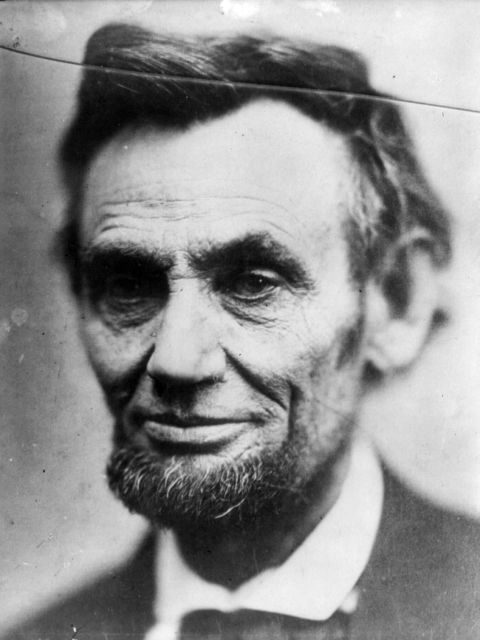 |
| The deadliest political trickster in American history. |
The second thing the Proclamation did was turn the North's casus belli from political to holy. Lincoln did not become an abolitionist until he understood that the the North would never suffer the abattoir of the Civil War merely to preserve the Union, but it would bleed profusely "to make men free," as Julia Ward Howe's hymn urged.
In July 1862 the first draft of the first emancipation proclamations was written. (There were two proclamations, this one released on Sept. 22, 1862, the other released on Jan. 1, 1863. That is the one usually thought of as "the" Emancipation Proclamation, and that is the one counted as such by the National Archives. But the first was months before.)
Having accepted counsel that the proclamation needed to be released from a position of military strength, lest it be seen as desperation to shore up the war effort, this draft was parked until a battlefield victory of note could be made. The relevant part of this proclamation to this discussion is that it specifically said that the purpose of abolishing slavery was to restore the Union. In it, the federal government promised to help states pay for the "gradual abolishment of slavery within such State or States---that the object is to practically restore, thenceforward to be maintain[ed], the constitutional relation between the general government, and each, and all the states ..." (link).
The month after the drafting of the first proclamation, Lincoln wrote to influential New York editor Horace Greeley. In it, Lincoln explained (emphases are his):
As to the policy I "seem to be pursuing" as you say, I have not meant to leave any one in doubt.Remember, Lincoln wrote this letter to Horace Greeley actually after the first proclamation had been written, which spins it somewhat differently than Lincoln the great humanitarian liberator. Clearly, considering both the first proclamation and the letter to Greeley, written so close together, Lincoln saw abolition as an instrument to achieve his never-changed goal: the Union of states must be preserved. It was not abolition for the sake of abolition nor even for the sake of slaves!
I would save the Union. I would save it the shortest way under the Constitution. The sooner the national authority can be restored; the nearer the Union will be "the Union as it was." If there be those who would not save the Union, unless they could at the same time save slavery, I do not agree with them. If there be those who would not save the Union unless they could at the same time destroy slavery, I do not agree with them. My paramount object in this struggle is to save the Union, and is not either to save or to destroy slavery. If I could save the Union without freeing any slave I would do it, and if I could save it by freeing all the slaves I would do it; and if I could save it by freeing some and leaving others alone I would also do that. What I do about slavery, and the colored race, I do because I believe it helps to save the Union; and what I forbear, I forbear because I do not believe it would help to save the Union. I shall do less whenever I shall believe what I am doing hurts the cause, and I shall do more whenever I shall believe doing more will help the cause. I shall try to correct errors when shown to be errors; and I shall adopt new views so fast as they shall appear to be true views.
In the movie Gods and Generals there is a scene where Union Col. Joshua Chamberlain (Jeff Daniels) tells his brother, also a Union officer, that if they both have to die to free the slaves, then so be it, even though abolition was not an original aim of the war.
It is the Northerners kind of war that Americans have waged more utterly than any other. As military historian T. R. Fehrenbach wrote in This Kind of War, "Wars fought for a higher purpose must always be the most hideous of all." War is such an awful thing that it must be entered into for only the most transcendental purposes. Hence, any war - as opposed to a punitive expedition, such as Panama, 1989 - that Americans engage in must be a crusade, because only crusades can justify the costs and the suffering. War is to be waged only reluctantly, even sadly, but when waged, done so ferociously.
Gen. Douglas MacArthur said, "In war there can be no substitute for victory," because when war is entered into for supreme purposes, to stop short of victory is to betray that purpose. In American Holy War, the political end is secondary to the military victory. Political structures are imposed by Holy War's victorious conclusion, they do not determine the conclusion. The role of politics is to pick up the pieces when total victory has been won.
This was Lincoln's insight: that absent a morally transcendent cause, the North would not continue the war. He provided the cause, but to him it was all smoke and mirrors, indeed it was politically-calculated trickery.
To Lincoln slavery was not even the point politically. In his inaugural address he explicitly supported of the "Corwin Amendment" to the US Constitution, which had passed both houses of Congress shortly before. The proposed amendment to the US Constitution stated simply,
No amendment shall be made to the Constitution which will authorize or give to Congress the power to abolish or interfere, within any State, with the domestic institutions thereof, including that of persons held to labor or service by the laws of said State.Observed John A. Lupton, Associate Director and Associate Editor for The Papers of Abraham Lincoln Project,
By tacitly supporting Corwin's amendment, Lincoln hoped to convince the South that he would not move to abolish slavery and, at the minimum, keep the border states of Maryland, Virginia, Tennessee, Kentucky, and North Carolina from seceding.There is some good analysis in the USMA professor's piece, but ultimately it is just not very good history.


 Posts
Posts

