The Great Plague of London killed one-quarter of its population from 1665-1666, the last major plague outbreak in Britain.
Historians and researchers have long thought it was bubonic plague, but proof was never found. Until now.
It's taken a year to confirm initial findings from a suspected Great Plague burial pit during excavation work on the Crossrail site at Liverpool Street.It was a gruesome way to die.
About 3,500 burials have been uncovered during excavation of the site.
Testing in Germany confirmed the presence of DNA from the Yersinia pestis bacterium - the agent that causes bubonic plague - rather than another pathogen.

Daniel Defoe wrote that plague victims "died by heaps and were buried by heaps"
Back in 1988-89 I wrote a 105,000-word novel about an Iranian plot to infiltrate a weaponized, extremely lethal form of Y. pestis into the United States, aiming to kill millions of Americans. The plotters were not the Khomeinist government, but the dwindling number of Iranian communists who were supported from Moscow by a small, rogue element of the Soviet general staff. It is set in the late 1980s, during Gorbachev's tenure as General Secretary.
After the jump is the first section of the third chapter. Click here and page down a little (Blogger's page-jump coding is pathetic, sorry).
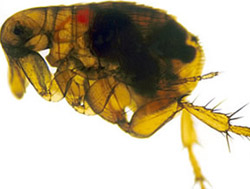 |
| Yersinia pestis, plague, and its host flea |
Moscow
Ivan Shotsov Ilanko arrived at his office building in the heart of Moscow by chauffeured limousine. Unlike most limousines for high-ranking army officers, though, there was no reserved parking space for Ilanko's car or for any other this particular office building . The driver merely pulled up to the sidewalk and Ilanko got out. The limousine pulled away. It would return promptly at 4:45 p.m. Ilanko ruefully recal led that perestroika would eliminate half the limousines for high officials and that his would be one of them.
Ilanko was dressed in a two-piece suit, but carried no briefcase. He did not wear a watch, nor did his pockets hold any loose change; neither did he have even a pen or mechanical pencil. Like everyone else who worked in this building, presently concealed behind a ten-meter high, concrete wall, he wore suspenders rather than a belt.
It was a uniform, of sorts, that Ilanko had been wearing for five of his 25 years in the Soviet Army. The last twenty of those years he had spent in the GRU. His army uniforms, which displayed the rank of a major general, were hung neatly in his closets at home. Few officers were privileged to wear civilian clothes to GRU head quarters; Ilanko was one of them.
After walking a few paces along the sidewalk, Ilanko turned and passed through an unattended, revolving gate in the wall, which led to a narrow lane. The lane twisted in its course so that one could never see more than five meters ahead at one time . On either side of the lane the wall continued.
There were four check points along the lane, manned by highly trained guards with red tabs on their uniforms . At each checkpoint Ilanko was subjected to an intensive examination of his credentials.
At the end of the foot path there was a wide open space where one might or might not find several hard-looking old men playing cards or chess. They were semi-retired GRU soldiers . All of the area was under constant surveillance by electronic devices.
Ilanko came to the entrance of his office building, a nine-story-high concrete and glass structure known as the Aquarium. At the door, he showed his credentials to the guard, who, despite having seen Ilanko enter the building no fewer than 1,250 times, motioned him into an inspection room.
Ilanko thought nothing of the guard's apparent lack of faith in him, and fully agreed with the very elaborate security precautions -- as far as it was known, the only information ever to leave the building travel led in the brains of the staff. The hundreds of other officers and analysts there were never permitted to take so muc h as a cigarette into the building or out of it. The GRU furnished cigarettes inside. In fact, a running joke was that before leaving the building, the guards made smokers blow the smoke from their lungs into a special balloon, which was taken to a lab and the smoke analyzed for classified-information content.
There were two warrant officers in the inspection room. They bowed slightly, respectfully, toward the general and began their search. Ilanko automatically raised his arms parallel with the ground, while one of the guards, mumbling "Permit me, General," passed over his clothes with an extremely sensitive electronic sensor. It detected all forms of metal and even the magnetism of recording tape. This was followed with a careful, thorough pat-down . The whole process took less than sixty seconds.
"Please continue, Comrade General," said one of the warrants, and Ilanko passed through the exit door into the lobby of the Aquarium.
Ilanko turned his steps toward the corridor which passed across the lobby. Before going to his office, he would have tea and hard rolls for breakfast, as was his custom. Ilanko had learned long ago that in the GRU, orderliness, routine, and no surprises were the key to successfully escaping harassment from political officers . Thus, he made a concrete habit of fol lowing exactly the same routine each day upon arriving at the Aquarium, aware that there was literally no place in the entire complex which was not subject to overt or covert surveillance at any time.
In the cafeteria, Ilanko chose two hard, black -bread rolls and Indian tea. A tall, rather unattractive man moved in the line behind him.
Ilanko turned. He recognized Major-General Anatoli Khrupov, a man for whom Ilanko had little use. "Good morning, Anatoli Radov, 11 he said civilly to him.
Anatoli Radov Khrupov nodded to Ilanko. "Good morning, Ivan Shotsov," he said. His voice was harsh, like an out-of-tune piano, irritating. "I noticed you in line here, and thought I would join you, if you are willing."
"Of course. Is there something you need to see me about, or is this purely social? "
Khrupov shrugged. "Let's wait til we sit. I'm quite hungry. "
They paid for their breakfast and chose a table away from the other patrons. Ilanko felt his appetite waning rapidly. He had always found Khrupov repulsive and not very friendly. Ilanko could not think of anyone else he would less want to start the day with.
"Listen, Ivan Shotsov," said Khrupov, "I'll come straight to the point. " Ilanko noticed that he fidgeted and did not touch his food. "You are the the chief of analysis for the Operational and Technical Directorate... ."
"Within a somewhat specialized field, yes. Chemical and biological warfare." Ilanko grew wary. Khrupov was in the operations planning branc h, third in command of it, in fact.
"Well," Khrupov continued, "you must be aware of what our enemies are doing in this area."
Ilanko nodded slowly. "My speciality is defensive techniques , so it does follow that I need to know what to defend against. " What, he wondered, is this fellow up to? "Anatpli Radov, please, I am confused... "
"Yes, of course," Khrupov said. He drank a little tea. "Ivan Shotsov, to the point directly: what can you tel l me -- theoretically, of course -- about plague?"
Ilanko blinked. "Plague? Do you mean bubonic plague, the Black Death?"
Khrupov nodded. "Yersinia pestis, exactly ."
Immediately, Ilanko 's mind raced. He thought, Mustn't refuse or act uncooperative, but this was very odd. Why plague?
Ilanko buttered a roll and stirred sugar into his tea. "Well, it killed 25 million people in Europe in the 14th century, and another seventy thousand in London from 1664 to 1665."
"Only seventy thousand?" Khrupov interjected.
"A quarter of the city's people." Ilanko drank some tea.
"I don 't really care about the history, Ivan Shotsov, but I am more interested in what plague is." Khrupov leaned forward, his elbows on the table, staring at Ilanko.
"Very well," Ilanko said. He thought, Give him a short course in plague, that's all. "You know that we do not experiment with plague, after Sverdlovsk, of course."
"Why?" demanded Khrupov.
"When the anthrax was released accidentally, killing thousands of people, it was very difficult to control. The explosion there almost broke the containment structure around the plague experimentation area. We know that if Y. pestis had been released as well, the deaths could have been in the tens of thousands, even hundreds of thousands."
"Or more?"
"Or more." Ilanko waited to see if that was all Khrupov wanted to know, but Khrupov waved slightly, as if to say, continue.
Ilanko said, "There are three variations: bubonic, which has gotten the most attention in history books, pneumonic, and septicemic. The chief vector, or host which spreads the disease, is the tropical rat flea, Xenopylla cheopis, which is found worldwide."
Khrupov appeared very interested. "Is the flea the only way it can be spread?"
Ilanko shook his head. "No, but the most common. If there are insufficient rats for the flea population, the fleas, many of which may be infected with plague, turn to other hosts, such as man. In the pneumonic form, the plague can be spread aerially, by coughing or even hard breathing, or by personal contact with the victim or something he has touched. It is highly infectious in that form, and is fatal within three or four days. Septicemic plague, or blood plague, kills within twenty-four hours."
Ilanko thought for a moment. "Laboratory-bred strains were designed to be extremely infectious after a person was infected, but before the onset of symptoms, about three days later. Then the victim would die in a matter of hours . Say between breakfast and lunch.
"One talks to a lot of people in three days," Khrupov said. "What is the treatment? Penicillin?"
"No, penicillin doesn't work at all. Streptomycin, aureomycin, and choram phenicol are used."
Khrupov sat back. He took a large bite of bread and said, brushing crum bs from his coat, "Thank you, Ivan Shotsov."
Ilanko, mystified, replied, "You're welcome." For a moment he entertained the notion that an actual operation with plague may be planned, but instantly rejected it. He could not imagine a target population, and above all he could not fathom any reason. Besides, the disease was just too uncontrollable, once it got loose. It could rage unchecked across entire continents, with no hope that antibiotic stocks could be sufficient to treat even a significant fraction of those infected. Laboratory-bred forms could be especially virulent, and easy to make,
"Anatoli Radov," Ilanko said cautiously, "if you want any further information, I really wish you 'd make an official request through proper channels , especially regarding technical information."
"Oh, it's all right!" Khrupov exclaimed. "There's nothing official about this; it just came up the other day in conversation, that's all."
Ilanko thought, You are a poor liar. Then Ilanko slowly felt a chilling fear creep through his flesh. Before the Sverdlovsk incident, he recalled, the scientists engaged in the USSR's massive bio-war projects had discovered and refined extremely potent forms of several bacterial diseases, anthrax among them, and plague.
The particularly frightening thing about the plague strain, though, was that it could be produced with very primitive equipment.
Khrupov spent a few minutes discussing soccer. He then excused himself from Ilanko, who was mightily relieved to be rid of him, and walked into the corridor, holding a napkin. Exactly three steps from the doorway, he touched the napkin to his mouth twice.
Twenty meters down the corridor, Lieutenant Colonel Rudi Abramstevo smiled humorlessly and turned to the major beside him. "General Khrupov says we will proceed, Major Rostovo. Notify Lieutenant Colonel Pavlenko immediately,"
"Yes, Comrade Colonel," replied Yuri Rostovo . He was a hard-looking man, compact and muscular, a veteran of elite Speznaz units in Afghanistan, where he had led 156 missions into rebel strongholds on assassination and kid napping missions.
They saw Ilanko exit the cafeteria . "There is General Ilanko," said Abramstevo. "General Khrupov told him as little as necessary, but we cannot be sure of what Ilanko may have inferred. "
Stonily, Rostovo examined Ilanko as he walked across the lobby. "I know my instructions, Comrade Colonel. "
Abramstevo nodded. "Do what is necessary, but only if it is necessary." He walked away. Rostovo glanced at his watch, waited four minutes, and left the building.


 Posts
Posts

