Showing posts sorted by relevance for query syria. Sort by date Show all posts

Friday, June 29, 2012

Syrian Christians face dim future

By Donald Sensing

I wrote earlier this month that if the so-called freedom fighters attacking Assad's regime gain victory, "expect a bloodbath of non-Sunnis, especially the Alawites and Christians." Now the New York Times understands that, too.

TEL AVIV, ISRAEL — Earlier this month, reports came from the Syrian city of Qusayr of an ominous warning to the town’s Christians: Either join the Sunni-led opposition against Bashar al-Assad or leave. Soon after, thousands of Christians fled the town.

After decades of protection by a secular-leaning dictatorship, the Qusayr ultimatum warned of a dark future for Syria’s Christian community. As the 15-month conflict rages with no end in sight, Syria’s many minorities have come face to face with the emerging threat posed by radical Sunni Islamists. These elements have established themselves as a key factor in Syria’s future, backed by immense political and economic support from the Arab world and indifference from the West.

Throughout the years, Christians, like many other minorities in the region, have lent their support to those regimes that have guaranteed their security and religious freedom. In Iraq, Christians rose to the highest levels of society under Saddam Hussein’s regime, while in Egypt, Coptic Christians were protected from ultraconservative Salafists under Hosni Mubarak. As secular leaders from the secretive Alawite sect, the Assad dynasty largely preserved Christian life, protecting Syria’s minorities from what was perceived as a collective threat from the country’s Sunni majority.

Watching their once-shielding dictators fall like dominos across the region, Christians have suddenly found themselves on the wrong side of history. Faced by a rising tide of radical Sunni Islam, Christians in Iraq and Egypt have fled by the thousands. In Syria, concern over Christian repression has fallen on deaf ears, drowned out by popular support for the country’s opposition in the face of the Assad regime’s brutal crackdown.

This March, months before the Qusayr ultimatum, Islamist militants from the opposition’s Faruq Brigade had gone door to door in Hamidiya and Bustan al-Diwan neighborhoods of Homs, expelling local Christians. Following the raids, some 90 percent of Christians reportedly fled the city for government-controlled areas, neighboring countries or a stretch of land near the Lebanese border called the Valley of Christians (Wadi al-Nasarah). Of the more than 80,000 Christians who lived in Homs prior to the uprising, approximately 400 remain today.

The cleansing of Homs’ Christian neighborhoods occurred as the Syrian military bombarded the Sunni opposition stronghold of Baba Amr, naturally focusing the international media on stories of children maimed by Assad’s artillery shells and sniper bullets. At the United Nations, Assad’s opponents could not afford to highlight Christian persecution in Homs, as they risked catering to a Russian-led campaign to preserve the dictator’s rule by de-legitimizing the Syrian rebels for their atrocities.

As rebel forces continue to chip away at Assad’s control over the country, Syria’s Christians continue to be expelled or held at the mercy of an increasingly extremist Sunni opposition.

For the newest generation of Sunni jihadists, Syria has become the latest front in the struggle to wrest control of the region from rival religious sects and foreign occupation. Many of these fighters hail from the vast reaches of North Africa and the Gulf, arriving in Syria with weapons, funds and a radical ideology.

Inside Syria, the reluctance of the international community to thwart Assad’s onslaught has left the Sunni population with feelings of isolation and abandonment, driving large swathes of youth into the arms of radical clerics. This uncompromising ideology leaves little place in Syria’s future for the country’s many minorities — including Christians.

Saving Syria’s Christian community is coherent with Western strategic interests. If the experiences of Iraq and Egypt are any indication, religious intolerance breeds insecurity and volatility. The Syrian case is no different. Assad’s opponents on both sides of the Atlantic must prevent radical Islamists from embedding themselves in the Syrian opposition and should adopt a firm stance against their patrons in the Gulf.

As Kamal Jumblatt, the former leader of Lebanon’s Druze minority, once said, “In the Middle East there is space for all men, just not their ambitions.” Jumblatt himself was eventually assassinated at the hands of Hafez al-Assad, but his words ring true to this day.

The ousting of the Assad regime has become a global moral obligation, but so has the duty to ensure that Syria’s future holds a place for all minorities.
Consider that last sentence. Because absolutely no nation is both willing and able to accomplish the entire sentence, the whole sentence is made false. There is no moral obligation to oust Assad's regime only to see it replaced by another, Sunni-Islamist regime that will likely be even more ruthless and bloody.

I say again: Stay out of Syria!

Bookmark and Share

Friday, August 30, 2013

Obama: Syria Strike Will Have No Objective at All - The New Yorker

By Donald Sensing

Obama Promises Syria Strike Will Have No Objective : The New Yorker

When you read this you honestly will not know at first whether it is satire or straight reporting.
WASHINGTON (The Borowitz Report)—Attempting to quell criticism of his proposal for a limited military mission in Syria, President Obama floated a more modest strategy today, saying that any U.S. action in Syria would have “no objective whatsoever.” 
“Let me be clear,” he said in an interview on CNN. “Our goal will not be to effect rĂ©gime change, or alter the balance of power in Syria, or bring the civil war there to an end. We will simply do something random there for one or two days and then leave.” 
“I want to reassure our allies and the people of Syria that what we are about to undertake, if we undertake it at all, will have no purpose or goal,” he said. “This is consistent with U.S. foreign policy of the past.” 
While Mr. Obama clearly hoped that his proposal of a brief and pointless intervention in Syria would reassure the international community, it immediately drew howls of protest from U.S. allies, who argued that two days was too open-ended a timeframe for such a mission. 
That criticism led White House spokesman Jay Carney to brief reporters later in the day, arguing that the President was willing to scale down the U.S. mission to “twenty-four hours, thirty-six tops.” 
“It may take twenty-four hours, but it could also take twelve,” Mr. Carney said.
“Maybe we get in there, take a look around, and get out right away. But however long it takes, one thing will not change: this mission will have no point. The President is resolute about that.”
Now compare that parody with what the president actually did say on PBS. Is there really any difference? No, not really. How do we know? Well, after speaking about Syria and the strikes for seven paragraphs encompassing almost 500 words, here was interviewer Judy Woodruff's response:
JUDY WOODRUFF: But Mr. President, with all due respect, what does it accomplish? I mean, you’re – the signals the American people are getting is that this would be a limited strike or of limited duration. If it’s not going to do that much harm to the Assad regime, what have you accomplished? How – what – what’s changed?
And here is what Obama said in reply:
PRESIDENT OBAMA: Well, Judy, again, I have not made a decision, but I think it’s important that if, in fact, we make a choice to have repercussions for the use of chemical weapons, then the Assad regime, which is involved in a civil war, trying to protect itself, will have received a pretty strong signal, that in fact, it better not do it again. And that doesn’t solve all the problems inside of Syria, and, you know, it doesn’t, obviously end the death of innocent civilians inside of Syria. 
Now compare to the New Yorker piece: “I want to reassure our allies and the people of Syria that what we are about to undertake, if we undertake it at all, will have no purpose or goal,” he said.

The harm that this president has done and is doing to our country's standing and reputation across the globe is incalculable.

Bookmark and Share

Thursday, April 12, 2018

Panetta on Syria: We have never had a clue

By Donald Sensing

The former Obama official referred to is Leon Panetta, one of the most sensible figures of Washington in either party. This is not a particularly well-written essay, but it does illuminate the fact that neither the prior administration nor the present one had/has a clue what the US objective is in Syria: Former Obama Defense, CIA Chief: U.S. 'Has Really Never Had a Strategy' on Syria

"And so, rather than developing that strategy, rather than trying to play a role in forcing Syria to figure out some kind of political settlement there that would get rid of Assad and allow Syrians to decide what their political future is, frankly, we have been hitting ISIS, on the side talking about Assad, but really don't have an overall strategy," he added. "And if we're going to strike Syria I don't think this ought to be a reflex action without a strategy. That's what this administration has to do, is figure out what is our long-term strategy in Syria going to be."
Which is to say that we do not like what Assad has done in using chemical weapons, but we have  no strategy to respond and no national objectives in responding. So to go to war with Syria would be like entering a dark room blindfolded in search of something that is not there.


Furthermore, absent specific Congressional authorization, a strike now against Syria would be an illegal war. Congress alone has the authority to declare war against a foreign power. That Congress' record of carrying out its Constitutional duties is one of abject failure and abdication, does not create a vacuum that a president may occupy to usurp Congress' authority.

Even if Congress did so declare, absent decisive and attainable national objectives to lead to a more just peace, the war would be unjust.

Yes, Assad is a monster. And his Russian sponsor, Putin, is a thug. And Iran is wielding strong influence in Syria also. That does not change the American domestic equation or our Constitutional requirements or the mandates of Just War Theory.

"Decide in hast, repent in leisure," said the ancient Greeks. It's long past time for Trump (and not only Trump) to take that to heart.

No war against Syria!

Related: "Just War and Syria Strikes"

Bookmark and Share

Wednesday, June 27, 2012

Stay out of Syria!

By Donald Sensing

Blackfive has an excellent post entitled simply, "THERE IS NO US NATIONAL SECURITY INTEREST IN A SYRIAN INTERVENTION."

Which is exactly right. As I have mentioned before, the Syrian rebels are not Jeffersonian wanna-bes and the Syrian rebellion is not about freedom.

As usual, Walter Russell Mead cuts to the heart of the matter about The Real News From Syria:
[R]adical and Salafist sheikhs and organizations in the Gulf are getting into the weapons delivery act. For many jihadis, the fight against Assad is first and foremost a struggle against Alawite “heretics”, and the goal is to build a radical Islamic state on the ruins of Ba’athist, secular Syria.
If the rebels win, expect a bloodbath of non-Sunnis, especially the Alawites and Christians.
Now over to Blackfive:
Now the backstory, so you at least understand why this presents a possibility of NATO, and thus the US, being pulled into such an intervention (possibly willingly, I’ll get to that later).  It comes from Andrew McCarty at PJ Media:
Prime Minister Recep Tayyip Erdogan is a Sunni Islamic supremacist with longstanding ties to the Muslim Brotherhood, the world’s most influential Sunni supremacist organization. The Brotherhood isleading the mujahideen (called the “opposition” or the “rebels” by the mainstream media) that seeks to oust the Assad regime in Syria — dominated by the Alawites, a minority Shiite sect. Unsurprisingly, then, Turkey’s government has taken a very active role in abetting the Brotherhood’s operations against the Syrian regime, which have also been joined by al-Qaeda and other Sunni militants. 
On Friday, a Turkish air force jet entered Syrian air space, and Assad regime forces shot it down. Turkey claims the jet “mistakenly” cruised over Syria, and that, by the time it was taken down, it was in international air space over the Mediterranean. One need carry no brief for Assad to conclude that, given the interventionist drum-beat for no-fly zones and direct military and logistical aid to the “opposition,” Syria rationally took the presence of a Turkish military aircraft in its air space as a provocation. Turkey insists it was not “spying” — that this was just an accident to which Syria overreacted. That would be a good argument if the regime were not under siege and if the Syrian and Turkish governments had not been exchanging hostile words (mostly, threats from Erdogan) for months. That, of course, is not the case.
Confused?  Well don’t be.  This is just another chapter in the eternal war between the Sunnis and Shiites and between the religious and secular.
But the movement of forces on the ground or in the air are not the real point. This is:
Point: This is not a NATO or US fight.  This is something that we should stay as far from as we can.  
Politics, however, will be integral to any decision made at this point, at least in the US. Domestic electoral politics.  What scares me is the possibility the Obama administration may conclude it is a good idea politically to use NATO to “change the subject” and make Obama a “war time President” hoping the advantages of that situation will make the difference in November.  And it wouldn’t be a unilateral decision, but instead receive bi-partisan support as Sen. McCain and other GOP members have been outspoken in their desire to intervene. 
Call me paranoid but I find nothing in my analysis that’s at all infeasible or improbable.  In fact, having watched this administration at work, I consider it to be a completely possible scenario.
Fortunately, NATO is toothless and broke. But Blackfive is right: this is completely plausible. However, I would rate it as unlikely for the following two reasons.

1. The NATO nations, except Canada (!), are broke. With the very possible imminent collapse of the Euro, NATO nations have every incentive to avoid expeditionary expenditures. I this reason alone obviates the possibility of Chapter 5 being successfully invoked by Turkey.

2. Angela Merkel and most of the rest of NATO's heads of state are more than aware of the basic facts of the Sunni/al-Qaeda grab for power in Syria, and are not going to bring down Assad to bring up the Islamists. They are also well aware that the bloody aftermath in Libya is not even an opening act for that would follow in Syria if the "resistance" topples Assad. NATO's countries are also much closer, literally and figuratively, to Russia; the weight of the Russian Bear's opposition will press much more heavily on Eur-NATO than us.

I would add that NATO's Euro nations have almost no strategic "throw" to bring effective forces against Assad. At the minimum they would have to rail through Turkey while also forming naval forces off Syria (where only two Russian cruisers would form a no-cross line that not one Eur-NATO head of state would dare cross).

The problem is that it is not implausible that our current president would be more than satisfied to see Assad replaced by Sunnis in Syria. If you think that makes no sense, then I would say you have the basic grasp of the essentials of Obama's foreign policy.

All this is all more the reason for the United States to quit NATO's military pact. 

We must stay out of Syria, militarily.

Bookmark and Share

Saturday, April 8, 2017

Just War and Syria Strikes

By Donald Sensing

Can we frighten this man into killing
people only conventionally?
This is a revisit of an essay I wrote in 2013 when President Obama was contemplating bombing Syria because of the Assad government's chemical-weapons attacks against militias opposing his regime.

As then, I am framing this in the context of Just War Theory (JWT henceforth), a theological inquiry in Christianity going back at least to Saint Augustine, 354-430. It's most robust treatment was by St. Thomas Aquinas, 1225-1274, whose exposition was so thorough that it still forms the basis of modern theory. I have written over the years quite a bit about JWT in different contexts.

Today my main points are that going to war justly requires that at least these questions to be answered in the affirmative, below.

1. Is there just cause for the war?

2. Is the war authorized by proper authority?

3. Is it wise, as far as we can discern, to wage the war?

4. Is there a just objective to waging war?

First, though, there is the question whether the cruise-missile strikes against Sharyat airfield the evening of March 6 constituted "war," or were they military violence of a kind other than war. I think the answer is straightforward, for here the key point is not what President Trump wanted to do (frighten Assad) but the means he used to do it. And the means were exclusively military and violent.

Throughout history, to attack another country with military forces has been seen unambiguously as an act of war. Just imagine that the evening of Dec. 7, 1941, the Japanese government messaged President Roosevelt that the air raid against Pearl Harbor should not be construed as as act of war, but only as a warning to the US not to inhibit Japan's imperial plans in the Far East. "We are prepared to do more," Japan might have said, if the United States did not comply. What do you think Roosevelt's response would have been?

And that leads to a second key point: Though President Trump initiated the violence, he does not get to call it war or not-war. Bashar Assad does. To expect that Assad sees the strikes as anything other than war is fantasy thinking.

This doesn't mean that Assad won't be cowed away from using chemical weapons again. My point is that no matter how the strikes are spun by the administration or others, they opened an actual war against Syria. The war may be brief, it may not. Syria might respond, it might not. But war it is. And we must remember that it takes both sides to end a war. The United States unilaterally began it, but we cannot unilaterally end it. This war will not be ended until Assad either says so or is removed from power. And even then his successor may choose to continue it.

Is there just cause for war?

Just Cause of war is the fundamental question, of course. I remember reading a (probably apocryphal) story of a South Seas island native chieftain who after a large battle between the US Marines and the Japanese in World War 2 asked the American commander who was going to eat the vast quantities of flesh of the slain soldiers.

The Marine general explained that neither the Japanese nor Americans killed people for food.

"What barbarians you are!" the chief replied, "To kill for no good reason!"

Historically, Western thought on war has held that war cannot be separated from larger concerns of nations, and in fact is one part of national relationships. "Politics is the womb in which war develops," said Prussian officer and theorist Carl von Clausewitz. More famous is his observation that, "War is not an independent phenomenon, but the continuation of politics by different means."

JWT has generally held that the political just cause for war is pretty narrowly expressed: either to defend one's own nation from actual or imminent attack, or to protect innocent third parties from lethal aggression or oppression. Some years after the American Civil War, Union General William T. Sherman put it simply: "The only just aim of war is a more just peace," which is a political goal. Absent a political orientation, warfare becomes just what the South Seas chieftain said, an exercise in pointless killing.

Not all JWT theorists agree that a nation may strike pre-emptively even in the case of clearly imminent attack, but since no one in the Trump administration claims that Syria poses any kind of military threat to the US, I'll not address the self-defense tenet here, especially since in his remarks following the missile strike, President Trump never invoked it at all. (In fact, when President Obama was contemplating similar strikes in 2013, he said specifically that the United States did not face an imminent threat.)

Absent self defense, then, the question then becomes one of protection of the innocent. Is that the case here?  Undeniably, victims of March 4's sarin attack against Idlib Province, held by opponents of the Assad regime, were innocent. After all, of the 85-plus people who died and scores more injured, many were children. So it would seem that a prima facie case can be made that the cruise-missile attacks against Sharyat airfield were justified on the basis.

However, the question is then begged whether chemical weapons are so unique that American warmaking on their users is justifiable for that reason alone. The Syrian civil war has already taken the lives of 400,000 people, perhaps as many as 500,000, of whom many thousands were children and countless thousands more were adult non-combatants. Neither President Obama nor President Trump ever invoked the prospect of military strikes against Syrian government forces for that reason.

So what, exactly, makes Tuesday's chemical attack so uniquely objectionable? It cannot be the number of victims, which in war's sanguinary calculus was rather small compared to other attacks by Syrian forces on civilian targets. Nor can it truly be that children were killed, even though President Trump did cite that specifically. Children have been killed all along.

It would seem, then, this administration like the prior one, maintains that the use of chemical weapons by itself was the reason for the cruise missiles to be launched. Is that a just cause of war against Syria?

If the answer is no, then war making against Syria cannot justly be done on that basis alone.

If the answer is yes, as the administration clearly claims it is, we move to closely-related inquiry of JWT - the war we wage must be justly conducted to achieve a just objective, which Trump says is the cessation of chemical weapons.

Here is the sticking point as I see it. By focusing exclusively on chemical casualties, Trump has written off a half-million or so violently killed by other means. Trump spoke not a syllable indicating he would take active steps to end that slaughter. But Trump did call for a political settlement -- as did Obama, as have many other states, ad infinitum and ad nauseum.

But this simply means that at best the war will continue with conventional violence only, and unnumbered thousands more will die -- unless truly decisive military steps are taken to remove Assad from power and enforce a ceasefire. Absolutely no nation is contemplating that -- which makes the claim that the deaths of this week's 85 persons are uniquely offensive simply hollow and morally unsustainable.

Let's look at the the JWT tenet of proportionality. The doctrine of proportionality is simply stated that the means of conducting the war must be proportionate to the goal for which the war is waged. Another way of looking at it is that while the just ends desired do not justify any means to attain them, they absolutely justify some means. The tenet of proportionality, then, is to assess what the justified means are, then employ those means and not the unjustified ones.

Which leads directly to the question: what exactly is the goal here? The president, secretary of state and others, in multiple remarks and interviews, have announced four key things:

A. There is no intention of effecting regime change in Syria by military means.

B. The strikes are to punish Assad's regime for using chemical weapons.

C. The strikes are intended to deter Assad from using such weapons in the future.

D. It is more urgent than ever that a political solution to the conflict be obtained.

Are these just objectives of war? If so, it is apparently just to "punish" Assad for using chemical weapons, and to deter him from using them again, but not just to remove him from power. Why? (I will note that these are identical objectives to those of President Obama in 2013.)

In fact, is punishment itself a just aim of war? This tends to slide the war into a legal enforcement mode, which indeed the president has more or less confirmed in his denunciation of Assad's use of chemical weapons. But that only makes us confront a key question: why is it just to punish Assad but leave him in power - when it was his criminal exercise of power that is at the heart of the violation?

The question of means

"Without killing," wrote Clausewitz, "there is no war." Conducting war is a matter of intentional lethality. In the proposed war against Syria, then, this is the question of means: What constitutes a level of violence inflicted upon the Assad regime that is effective deterrence against using WMDs by the regime again or, in future years, deters other bad actors in the region?

The centering question of the doctrine of proportionality is deciding the violence necessary to achieve the war's objectives while not using excessive violence to do so. To employ too little violence is as disproportionate as to employ too much. It is unjust to wage war ineffectively even for a just cause.

Hence, planning for such strikes necessarily involved a massive amount of guess work on what level of lethality and destruction needed to be inflicted upon Syria to ensure the Assad regime never orders the use of chemical weapons again. But that is a heavily psychological calculation for which a high-confidence answer is practically impossible!

The reason is that we do not know the calculations Assad used to to order the chem-weapons attack in the first place. What was going through his mind when he gave the order? We don't know, although in 2013 the Obama administration said it had intercepted some messages that gave some clues. Even if the Trump administration has such messages, they are almost certainly originated mostly by subordinates and oriented toward action rather than rationale, and are many levels removed from what Assad was thinking, Since making him fearful of re-use is a stated goal of the president, our own calculations' margin of uncertainty is bound to be very vast.

As for deterring leaders of other nations, namely Iran and North Korea, assessing what example to make of Syria to deter them is like entering a dark room blindfolded, in the dead of night in a dense fog, to look for a black cat that may not even be there. Does anyone really expect that the Iranian or North Korean governments will abandon their goal of attaining nuclear capability just because the United States mounted a very limited missile strike against Syria, even if the president has promised would be repeated if he sees fit?

All of these things mean that the proportionality calculus has no answer. It is like a math question to solve the value of X in which both the variables and constants are also unknown. We do not know how much death and destruction to inflict upon Assad-Syria to persuade the regime to refrain from using a single class of weapons in the future, and have no realistic prospect that we even can know. And this is a problem cubed for deterrence of other national regimes.

So the question: Even stipulating that the use of chemical weapons is a just cause for the proposed war, can the war be justly waged when we have no way of assessing, within reasonable margins of error, what waging it will require to achieve its stated goals?

When I was assigned to the Pentagon during the planning for Operation Desert Storm, the first ground war against Iraq in 1991, Army Chief of Staff Gen. Carl Vuono emphasized that in our planning we needed to remember two simple concepts: "Hope is not a method and wishes are not plans." Good advice now, too. To which I add: launching missiles is not a strategy.

This is not a strategy. It may be a means to achieve a strategy. Or it may not. 
But is there a strategy?

ABC News Radio reported March 8 of the aftermath of a meeting between the Senate's leaders and Chairman of the Joint Chiefs of Staff Gen. Joseph Dunford on the previous day:
“We don’t have the benefit of a larger strategy, for the same reason that I think the previous administration had difficulty coming up with a strategy, because it’s very, very complicated,” Sen. John Cornyn, the second-highest ranking Republican in the Senate, said Friday after a meeting with the Chair of Joint Chiefs of Staff. 
The Hill adds,
Senators left a closed-door briefing Friday saying the Trump administration did not lay out a comprehensive plan for Syria. 
Cornyn added that there were “discussions” about the legal authority being used in Syria and whether the administration’s main target is President Bashar Assad government's or the Islamic State in Iraq and Syria (ISIS).

“We ... need a strategy to figure out what is our goals in Syria,” he said. “Is our goal just to defeat ISIS or is our goal to change the regime, and if there is policy to change the regime what comes next?”
There is presently no answer to that question.

My conclusion: The Trump administration has no strategic objectives evidenced by the missile strikes. "No chemical weapons" is not a strategic goal because it leaves untouched and undeterred almost all of Assad's total offensive capability and gives assent to the war's continuation, even escalation, by conventional means and offers no remotely significant protection of the innocent from lethal attack.

There is no just cause for this war if we use the terms and conditions that President Trump himself has set.

2. Is the war authorized by proper authority?

I covered this in my post, "Trump just went to war with Syria." The US Constitution clearly grants to Congress, and only to Congress, the authority to "declare war." However, the Constitution does not define just what constitutes a declaration. As then-Senator Joe Biden accurately explained in 2001, the Congress has declared war when the Congress thinks it has. Hence, he said, an Authorization for the Use of Military Force meets Constitutional muster as a declaration of war.
I happen to be a professor of Constitutional law. I'm the guy that drafted the Use of Force proposal that we passed. It was in conflict between the President and the House. I was the guy who finally drafted what we did pass. Under the Constitution, there is simply no distinction ... Louis Fisher(?) and others can tell you, there is no distinction between a formal declaration of war, and an authorization of use of force. There is none for Constitutional purposes. None whatsoever. 
Constitutional lawyers over the decades have held that varying kinds of enabling acts, such as monetary appropriations for military action, have also amounted to Constitutional satisfaction and, at least, consent of the Congress to action ordered by the president, in whom the Constitution grants authority to conduct warfare.

Neither of these conditions pertained to the missile strikes. The president did not even bring into consultation the senior leaders of either chamber of Congress before the strikes took place. As I pointed out in "The fierce urgency of bombing now!",
Even stipulating that bombing Assad's forces may be justified under humanitarian concerns, what the Guardian [newspaper] is conflating is the difference between moral justification of war and legal basis for it. They are not the same.

Under classic just war theory, both just cause and rightful authority are required. In Syria today there may be just cause for Western intervention, but so far there has been no rightful authority for it.  
... Since the dawn of the American republic, the Congress and the presidents have generally agreed that the president may order US forces into combat against another nation, solely on his own authority, if and only if there is:

1. Imminent danger of attack from the other power, so imminent that time taken for Congressional deliberations would hinder defense against it, or,

2. To protect actual threat against US citizens abroad, or to rescue them from actual danger.  
Neither of these were the case in Syria. Therefore, no matter the moral justification of them, the missile strikes failed the test of rightful authority. This is the president wielding military power not in a representative-democratic manner,  but in a monarchist manner.

There was and is no threat to the United States or to the Syrian people that is so immediately imminent that no time dare be spent in Congressional deliberation to authorize the strikes. If there is, the president should explain why, with 400,000-plus already dead, a few more days of deliberation is unwarranted.

My conclusion: The "proper authority" test was not met.

3. Is it wise, as far as we can discern, to wage the war?

With the failure of the first two criteria, it is hard to see how this war is being waged wisely so far. That the risk of confrontation with Russia has risen, perhaps sharply, seems incontrovertible. However, this question is really one of consequences as cannot be well answered except retrospectively.

My conclusions: Although I do not think the strikes were wise, based on their failure of proportionality (mainly meaning that Assad, not concrete and dirt, should have been the target), I'll keep an open mind. It may turn out to have been better than ill-advised. We will just have to wait and see.

4. Is there a just objective to waging war? 

Well, not yet. See all of the above. But to the point: the deaths and suffering inflicted by chemical weapons have been and are such a tiny part of the overall deaths and suffering inflicted that merely ending their use is not in itself a just objective of waging war against Assad's Syria.

Final thought

One thing the chemical and missile attacks have done is illustrate that the status quo - unending war that is effectively a proxy war between the Western powers one one side and Russia and Iran on the other - cannot be maintained for long. Eventually, Trump and his administration will be faced with doing something other than simply keeping their hand in. The United States will face the hard choice in Syria of going big or going home.

That is exactly is the reason that Congressional and public debate must be entered into sooner rather than later. Going to war against Assad-Syria may be the right thing to do (or maybe the least-bad option) but President Trump initiated it the wrong way politically, strategically, and tactically.

Related:

When Secretary of State John Kerry insisted in June 2013 that US warplanes should begin bombing Assad-regime targets right away, I wrote an extended essay on JWT and Syria, "No justification for Syria Intervention," in which I claimed that not only would such intervention fail the Just War test, it also failed the test of the rigidly secular concept of Realpolitik.

A key note from that day: "Joint Chiefs Chairman Gen. Martin Dempsey made it clear that a few runs on target would do no good, that if the bombing was not be be merely symbolic, it would require a sustained, large effort of no short duration."

What has changed? Nothing. Except now there are Russian boots on the ground in Syria, which certainly does not simplify things.

Other essays here and here and here.

Update: "The Grim Logic Behind Syria’s Chemical Weapons Attack"

Bookmark and Share

Wednesday, June 19, 2013

No justification for Syria Intervention

By Donald Sensing

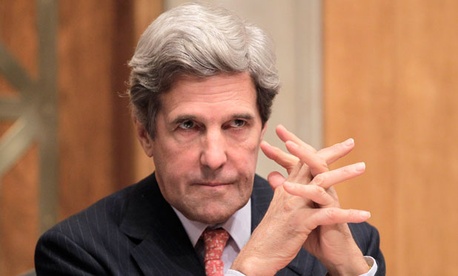
Secretary of State John Kerry leads the war faction in the Obama administration,
insisting that American warplanes should begin bombing Syria right away.
In the past few days, the White house announced that it will begin sending military materiel to Syrian rebels. This decision comes in the wake of the administration's determination that Syria's ruling Assad regime had used chemical weapons, including the nerve agent sarin, on the insurgents. This use constituted Assad crossing one of the Obama administration's "red lines," so named because crossing them would be seen as an intolerable act that could not be passively encountered by the United States.

International agencies estimate that the chemical attacks killed 100-150 people. As IBD puts it, "That's in addition to the more than 90,000 Syrians killed by conventional weapons that didn't seem to prompt any action."

Government Executive reports that Secretary of State John Kerry pushed hard for the United States to bomb key Syrian targets after the chemical use was confirmed.
On Thursday, President Obama confirmed what reports had been speculating for a few weeks: Syrian President Bashar al-Assad had used chemical weapons, notably sarin gas, on his own people, and tripping the president's "red line" that would rouse the United States to greater action. The response includes arming and training the rebels. It turns out that Secretary of State John Kerry also wanted the response to include an air strike on Syrian airfields, according to Jeffery Goldberg at Bloomberg View. 
According to Goldberg, Kerry's "vociferous" thoughts on the matter were not received well by Chairman of the Joint Chiefs of Staff Martin Dempsey during a meeting in the situation room last Wednesday.
(My own experience of working in the Pentagon from 1990-1993 is that the state department is considerably quicker to reach for the sword than the defense department.) The reason Kerry's push did not prevail is that Joint Chiefs Chairman Gen. Martin Dempsey made it clear that a few runs on target would do no good, that if the bombing was not be be merely symbolic, it would require a sustained, large effort of no short duration.

Secretary Kerry lost the debate that day, but the desire is out in the open: there is a powerful faction within the Obama administration that wants direct military action by the United States against the Assad regime.

My position is that no just rationale can be proffered for American intervention in the civil war, whether by supply, air campaign or boots on the ground. Such action fails to meet the standards of the two major influences that have shaped American military action since the country's founding: Just War theory and Realpolitik, or foreign-affairs Realism.

Realpolitik and the national interests

Realpolitik is the easier of the two to deal with, so I'll start with it. Realpolitik "refers to politics or diplomacy based primarily on power and on practical and material factors and considerations, rather than ideological notions or moralistic or ethical premises." The United States has (let us be thankful) not been skilled in its practice - both the Bay of Pigs and Vietnam War come to mind as two prominent, recent examples.

In Syria, however, even if the Obama administration was inclined toward Realpolitik it would find there is no upside for American power interests in intervention. Simply put, the outcome of the  civil war there is wholly immaterial to the national-security interests of the United States. The fight is not a fight between repressed Jeffersonian democrats and their cruel oppressors. It is a fight between what we may understand as a Stalinist regime in power and a fascist movement that wants to replace it.

There are no good guys in this war. It is not a war about repression vs. liberty. It is a war about who will do the repressing. As Atlantic Council managing editor James Joyner puts it, "Syrian Rebels Today, Syrian Taliban Tomorrow."
Radical Islamists now dominate the Syrian opposition. And you’re arming them.
Reuters (“Syria’s Islamists seize control as moderates dither“):

During a 10-day journey through rebel-held territory in Syria, Reuters journalists found that radical Islamist units are sidelining more moderate groups that do not share the Islamists’ goal of establishing a supreme religious leadership in the country. 
The moderates, often underfunded, fragmented and chaotic, appear no match for Islamist units, which include fighters from organizations designated “terrorist” by the United States.
The Syrian resistance, such as it is, is dominated by foreign al Qaeda elements. If the resistance loses, Assad's Syria will become even more of an Iranian client than it already is. If the resistance wins, Syria will be a a Muslim Brotherhood client with a strong share of Saudi Salfism thrown in for good measure.

So what is the Syrian civil war really about? It is another round in the centuries-old conflict between Sunni and Shia Muslims (in which Assad is ironically neither). Understand, the conflict between Sunnis and Shias is not a religious conflict, it is political. The Islamic-theological differences are actually rather minor. They dispute who should be authoritative in setting doctrinal standards for Muslims, but this springs from a centuries-old schism over Mohammed's successors as leaders of Islam. Islam itself is basically identical for both.

The center of Shia Islam is Iran, which named the United States the Great Satan in 1979 (Israel, by contrast, was only named the Little Satan). Al Qaeda began as a Sunni movement arising from the local jihad against the Soviet army declared by a Palestinian Sunni cleric living in Saudi Arabia. The occasion was the USSR's invasion of Afghanistan in December 1979. Out of the Islamic resistance to the USSR, led by Saudi Arabia and Pakistan, was born the organization that Osama bin Laden would use to form al Qaeda, whose hatred of all things American need not be explained further.

This history helps illuminate why both sides in Syria can each hate the United States as much (or more) as they hate one another. Whether the rebels prevail or Assad, neither outcome is inherently more desirable for the United States than the other. So simply from a Realpolitik point of view, there is no upside for the United States to intervene in any fashion.

There is, however, considerable downside, not least would be the expenditure of American blood and treasure to achieve goals that are unclear, mostly undefined, in a campaign of of indefinite duration, for no possible outcome that benefits the security of the country.

Syria Intervention and Just War theory

The failure of Realpolitik being understood, we may confront the moral issue with greater probity. The issue is simply stated: Does the violence and deaths of non-combatants in Syria justify the United States to kill Syrian soldiers (an inevitably civilians) and raise the level of violence there to even greater heights (there being no more violent or destructive military on the face of the earth than America's)?

That is really the central question of the use of force within the framework of Just War theory, devised by the Roman Catholic Church over the centuries between St. Augustine and St. Thomas Aquinas, who gave the theory its final polish. JWT, as I will short-type it henceforth, holds that there are only two circumstances in which war may be justly fought:
  • Actual self defense against aggression
  • To defend the innocent and otherwise defenseless against aggression
Catholic author Nicholas G. Hahn III says that Syria meets the latter criterion. In trying to rebut Senator Rand Paul's speech against intervention, Hahn writes,
Should Paul know anything about Augustine or Aquinas, he would know that war is sometimes necessary and a moral obligation. 
Aquinas quotes Augustine approvingly that a just war is "one that avenges wrongs, when a nation or state has to be punished, for refusing to make amends for the wrongs inflicted by its subjects, or to restore what it has seized unjustly." Even the United States Conference of Catholic Bishops, in its 1993 statement, defined casus belli where force may be employed to "correct a grave, public evil." 
Perhaps Paul should also read George Weigel's First Things primer on how pre-emption is simply another word for defense -- and defense, after all, fits perfectly within the just war tradition.
Now, I have been reading George Weigel's tomes on JWT and related issues for many years and I join Mr. Hahn in my admiration for his insights. But Hahn or his ideological allies simply fail to make a case here. Here is why.

JWT conceptually exists in three parts:
  1. Just cause for starting the war.
  2. Just conduct of the war.
  3. Just ending of the war.
Criterion 1 simply means a nation may not justly go to war for selfish gain hiding behind a smokescreen of moral language. That Mr. Hahn injected the word "pre-emption" into a discussion of moral necessity sort of gives the game away. Preemption (hit them before they can hit you) is not wholly without moral content but it is mainly a tactic of Realpolitik. Just whom would the United States be pre-empting? Assad? Al Qaeda? Iran? Russia?

Criterion 2 usually understood to mean that conducting the war may not be done more unjustly than the injustice sought to be remedied. This is not a matter of counting corpses killed by one side or the other and saying (as American critics of our entry into Afghanistan post-9/11 did) that we may not take more lives protecting the innocent than the number of innocent lives lost at the hands of the aggressors.

As my friend, Catholic cleric (and US Army War College graduate) John Krenson explained to me, if the cause is just and the objectives are just, then just conduct is the minimum violence necessary to attain the just objective. And that minimum violence might be very great, indeed.

This is known as the problem of the "Sanguinary Calculus," meaning how much suffering and death we may justly inflict in order to bring about the objective we desire. I would appeal to my readers to consider the years of American fighting in Iraq and Afghanistan and ponder whether they give us any cause for confidence. Would we still be in Syria eight to 10 years from now?

Let us remember Douglas MacArthur's warning that, "Prolonged indecision is never a just aim of war."

The sanguinary calculus must also include American lives. I would like to hear advocates of intervention tell me the plea they give to their own children why they should join the Marines to go fight Assad in Syria and what they will say when their children are killed or maimed. (For the record, I thought that invading Iraq was as clearly justified by JWT as any war in the prior century or more and my eldest son did fight in Iraq as a Marine. My second son is today an officer in the Air Force Reserve.)

Or is this moral crusade only to be fought by children of others? As there is no American national-security interest at stake at all, I believe I am justified in insisting that intervention advocates put their own blood on the line and not simply outsource their morality.

I have not yet encountered an intervention advocate explain exactly why Syria is a special case. If Syria is a "yes," why would North Korea be a no? After all, the Kims' successive regimes have literally starved to death millions of their own subjects. Does not that call more strongly for American direct action to rescue?

In fact, the list of places in the world where the US would be morally justified in mounting military action to defend the innocent is very long. But it would be impossible for us to do so. And that requires exercising another principle of war, distinction or discrimination. If not everyone, then who and why? If there is an especially compelling reason we should intervene in Syria and not Lower Zambezi, then let advocates make it. But they do not even attempt.

There is neither a strong moral nor national security case to be made for US intervention. Intervention fails both just war theory and Realpolitik.

Endnote: On the other hand, Foreign Policy's Daniel Drezner says that in fact the Obama administration has been engaged in Realpolitik in Syria and that the recently-announced plan to send arms to the rebels is the logical extension of it.
[T]his is simply the next iteration of the unspoken, brutally realpolitik policy towards Syria that’s been going on for the past two years.  To recap, the goal of that policy is to ensnare Iran and Hezbollah into a protracted, resource-draining civil war, with as minimal costs as possible.  This is exactly what the last two years have accomplished…. at an appalling toll in lives lost
This policy doesn’t require any course correction… so long as rebels are holding their own or winning. A faltering Assad simply forces Iran et al into doubling down and committing even more resources.  A faltering rebel movement, on the other hand, does require some external support, lest the Iranians actually win the conflict.  In a related matter, arming the rebels also prevents relations with U.S. allies in the region from fraying any further.
Unlike Mr. Drezner, I don't think the administration is clever enough for this.

Update: David Goldman in an Asia Times op-ed points out that there is no good end in Syria no matter what the Western powers do.

Bookmark and Share

Monday, September 2, 2013

Just War and Syria Strikes, Part One

By Donald Sensing

Can we frighten this man into killing
people only conventionally?
While awaiting the call from the BBC at noon Monday to enter the discussion on its World Have Your Say program (podcast here), I outlined some notes to shape my remarks as the preceding guests spoke. This is a more methodical exposition of what I said.

I am framing this in the context of Just War Theory (JWT henceforth), a theological inquiry in Christianity going back at least to Saint Augustine, 354-430. It's most robust treatment was by St. Thomas Aquinas, 1225-1274, whose exposition was so thorough that it still forms the basis of modern theory. I have written over the years quite a bit about JWT in different contexts.

Today my main points are that going to war requires at least three questions to be answered in the affirmative, below. In this post I'll only address the first for brevity's sake and leave the other two for later this week.

1. Is there just cause for the war?

2. Is the war authorized by proper authority?

3. Is it wise, as far as we can discern, to wage the war?

Is there just cause for war?

Just Cause of war is the fundamental question, of course. I remember reading a (probably apocryphal) story of a South Seas island native chieftain who after a large battle between the US Marines and the Japanese in WW2 asked the American commander who was going to eat the vast quantities of flesh of the slain soldiers.

The Marine general explained that neither the Japanese nor Americans killed people for food.

"What barbarians you are!" the chief replied, "To kill for no good reason!"

Historically, Western thought on war, heavily influenced by Christian theology, has held that war cannot be separated from larger concerns of nations, and in fact is one part of national relationships. "Politics is the womb in which war develops," said German officer and theorist Carl von Clausewitz. More famous is his observation that, "War is not an independent phenomenon, but the continuation of politics by different means."

JWT has generally held that the political just cause for war is pretty narrowly expressed: either to defend one's own nation from actual or imminent attack, or to protect innocent third parties from deadly aggression or oppression. Some years after the American Civil War, Union General William T. Sherman put it simply: "The only just aim of war is a more just peace," which is a political goal. Absent its political orientation, warfare becomes just what the South Seas chieftain said, an exercise in pointless killing.

Not all JWT theorists agree that a nation may strike pre-emptively even in the case of clearly imminent attack, but since no one in the Obama administration claims that Syria poses any kind of military threat to the US, I'll not address the self-defense tenet here. (Update, Sept. 4: President Obama said today that the United States does not face an imminent threat.)

The question then becomes one of protection of the innocent, and whether chemical weapons are sui generis so that American warmaking on their users is justifiable for that reason alone. That is, in a civil war in which everyone agrees that at least 100,000 people on all sides have died, untold numbers of whom were murdered outside the laws of war but by conventional means, is the use of chemical weapons by itself a just cause of war for the US to wage on Syria, a nation not at peace with itself but with which the US is now at peace with all who dwell therein?

If the answer is no, then war making against Syria cannot morally be done. If the answer is yes, as the administration clearly claims it is, we move to the next crucial inquiry of JWT - the war we wage must be justly conducted.

I'll shape this discussion around the JWT tenet of proportionality. The doctrine of proportionality is simply stated that the means of conducting the war must be proportionate to the goal for which the war is waged. Another way of looking at it is that while the just ends desired do not justify any means to attain them, they absolutely justify some means. The tenet of proportionality, then, is to assess what the justified means are, then employ those means and not the unjustified ones.

Which leads directly to the question: what exactly is the goal here? The president, secretary of state and others, in multiple remarks and interviews, have announced three key things:

A. There is no intention of effecting regime change in Syria.

B. The strikes are to punish Assad's regime for using chemical weapons.

C. The strikes are intended to deter Assad (and others) from using such weapons in the future.

Are these just objectives of war? If so, it is apparently just to "punish" Assad for using chemical weapons, but not just to remove him from rule. Why?

In fact, is punishment itself a just aim of war? This tends to slide the war into a legal enforcement mode, which indeed the president has more or less confirmed in his insistence that Assad has violated "international norms." We thus circle back to the previous paragraph: why is it just to punish Assad but leave him in power - when it was his criminal exercise of power that is at the heart of the violation?

The question of means

"Without killing," wrote Clausewitz, "there is no war." Conducting war is a matter of intentional lethality. In the proposed war against Syria, then, this is the question of means: What constitutes a level of violence inflicted upon the Assad regime that is effective deterrence against using WMDs by the regime again or, in future years, deters other bad actors in the region?

The centering question of the doctrine of proportionality is deciding the violence necessary to achieve the war's objectives while not using excessive violence to do so. To employ too little violence is as disproportionate as to employ too much. It is unjust to wage war ineffectively even for a just cause.

Hence, campaign planning for the upcoming strikes will necessarily involve a massive amount of guess work on what level of lethality and destruction needs to be inflicted upon Syria to ensure the Assad regime never orders the use of chemical weapons again. But that is a heavily psychological calculation for which an answer is practically impossible!

The reason is that we do not know the calculations Assad used to to order the chem-weapons attack in the first place. What was going through his mind when he gave the order? We don't know, although the intercepted messages the Obama administration says it has should offer some clues. Even so such messages, originated mostly by subordinates and oriented toward action rather than rationale, are many levels removed from what Assad was thinking, and since making him fearful of re-use is a stated goal of the president, our own calculations' margin of uncertainty is bound to be very vast.

As for deterring leaders of other nations, assessing what example to make of Syria to deter them is like entering a dark room blindfolded, in the dead of night in a dense fog, to look for a black cat that may not even be there. Does anyone really expect that the Iranian government will abandon its goal of attaining nuclear capability just because the United States mounted bombing campaign against Syria that the president has already promised would be "brief and limited?"

All of these things mean that the proportionality calculus has no answer. It is like a math question to solve the value of X in which both the variables and constants are also unknown. We do not know how much death and destruction to inflict upon Syria to persuade the regime to refrain from using a single class of weapons in the future, and have no realistic prospect that we even can know. And this is a problem cubed for deterrence of other national regimes.

So the question: Even stipulating that the use of chemical weapons is a just cause for the proposed war, can the war be justly waged when we have no way of assessing, within reasonable margins of error, what waging it will require to achieve its stated goals?

When I was assigned to the Pentagon during the planning for Operation Desert Storm, the first ground war against Iraq in 1991, Army Chief of Staff Gen. Carl Vuono emphasized that in our planning we needed to remember two simple concepts: "Hope is not a method and wishes are not plans." Good advice now, too. To which I add: bombing is not a strategy.

Related:

When Secretary Kerry insisted in June that US warplanes should begin bombing Assad-regime targets right away, I wrote an extended essay on JWT and Syria, "No justification for Syria Intervention," in which I claimed that not only would intervention fail the Just War test, it also failed the test of the rigidly secular concept of Realpolitik.

A key note from that day: "Joint Chiefs Chairman Gen. Martin Dempsey made it clear that a few runs on target would do no good, that if the bombing was not be be merely symbolic, it would require a sustained, large effort of no short duration."

What has changed? Nothing.

Other essays here and here and here.

Update: Is this really the message we want to send to Assad?

Bookmark and Share

Tuesday, August 27, 2013

Libya and Syria - Second verse, same as the first!

By Donald Sensing

In March 2001, I posted about then-looming US war against Libya. Below is a cut and paste job from that post. I have changed nothing at all except the word, "Libya" to "Syria" or "Qadaffi" to "Assad." These questions were never answered satisfactorily (or at all) by the Obama administration.

But here we go again:

Before a single US plane flies over Syria, the president must explain to the American people the following at a minimum:

1. What is Assad's "actual or imminent threat" to America that justifies combat deployment of US forces on presidential order alone?

2. Absent such threat, what is his legal authority to send US forces into combat without prior Congressional approval? (Congressional approval, or not, may yet be forthcoming.)

3. What is the primary strategic objective that the United States will achieve through military forces that cannot be obtained otherwise? 

4. What is the moral imperative that justifies killing and being killed? 

5. Apart from opposing Assad, what exactly makes the Syrian revolutionaries worth the expenditure of American lives and treasure? 

6. The president is on record as saying that Assad must not remain in power. Does that mean that regime change is a US objective and if so, will US military power be used to achieve it?

7. If not, will a partition of Syria into territories controlled by Assad and the revolutionaries be acceptable, and if so, why?

8. What influence do you expect to have over the political nature of a potential revolutionary government? 

9. What are the conditions of success in Syria? What must happen before American combat forces are withdrawn? In other words, how will you know when you've won? 

About the moral imperative for war. If no one in the administration can explain what America is trying to do within the context of Just War Theory, which demands specifically to delineate the just cause of war, the just conduct of war and the just ending of war, then there is no justification at all. 

If there is a moral imperative to intervene in Syria, presumably to stop Assad's attacks against Syrian civilians, then inquiring minds want to know why this imperatives rules for Syria here when President Obama specifically rejected the very same imperative in warring against Iraq in 2003. 

My position hasn't changed. To paraphrase what Bismarck said about the Balkans in 1888, "The whole of Syria is not worth the bones of a single American pilot."
Don't expect any answers now, either.

Bookmark and Share

Thursday, April 6, 2017

Trump just went to war with Syria

By Donald Sensing

File photo of US Navy warship firing a Tomahawk cruise missile
The United States attacked Syria directly Thursday night with dozens of cruise missiles.
The United States launched dozens of cruise missiles Thursday night at a Syrian airfield in response to what it believes was Syria's use of banned chemical weapons that killed at least 100 people, U.S. military officials told NBC News.

Two U.S. warships in the Mediterranean Sea fired 59 Tomahawk missiles intended for a single target — Ash Sha'irat in Homs province in western Syria, the officials said. That's the airfield from which the United States believes the government of Syrian President Bashar al-Assad fired the banned weapons.

There was no immediate word on casualties. U.S. officials told NBC News that people were not targeted and that aircraft and infrastructure at the site, including the runway, were hit.
As is the imperial habit of US presidents these days, there was no authority from the Congress asked for or received before initiating a new war with a country that has not attacked the United States, nor poses an imminent threat to US lives.

On TV news reporting, President Trump stated that the strikes were "in vital national interests" of the United States. I would very much like him to explain in full just how. After all, in 2013 when President Obama was leaning toward the same action, Trump tweeted:


What, exactly, changed on the ground when Assad used chemical weapons this week? The casualty count hardly budged - hundreds of thousands of people have already been killed. Chemical weapons are indiscriminate and cruel, but are they more so than barrel bombs, area shelling and area bombing? And for that matter, does not the brutality of anti-Assad rebels, not just ISIS, pose a dilemma for the United States?

So what is really going on? I find it hard to conclude other than this cruise-missile attack was mainly a signaling operation aimed mainly at Chinese President Xi Jinping, whose first face-to-face meeting with Trump was tonight and will continue tomorrow. Trump has said repeatedly that he wants China to rein in Kim Jong Un's nuclear weapons and ballistic missiles programs. The signaling was also undoubtedly directed at Teheran as well.

As I type, Trump is on camera speaking of the cruise missile attack. He is speaking angrily about the images of the chemical attack's aftermath and the suffering of children caught in it. He is saying that it is in the interests of the United States to prevent the spread of the use of chemical weapons. I agree with that but protest strongly the unconstitutionality of Trump's attack against a nation with whom we were not already at war.

As I wrote in 2013,
"Joint Chiefs Chairman Gen. Martin Dempsey made it clear that a few runs on target would do no good, that if the bombing was not be be merely symbolic, it would require a sustained, large effort of no short duration."
Does Secretary of Defense Mattis think differently today? If so, why? I also observed,
As for deterring leaders of other nations, assessing what example to make of Syria to deter them is like entering a dark room blindfolded, in the dead of night in a dense fog, to look for a black cat that may not even be there. Does anyone really expect that the Iranian government [or N. Korea's] will abandon its goal of attaining nuclear capability just because the United States mounted bombing campaign against Syria?
But Trump in his appearance tonight did not mention encourager les autres as a motive for the cruise missiles. The only stated motive was deterrence. If the question is only protection of the innocent, then I want to know whether this administration considers chemical weapons to be sui generis so that American warmaking on their users is justifiable for that reason alone. That is: in a civil war in which everyone agrees that hundreds of thousands of people on all sides have died, untold numbers of whom were murdered outside the laws of war but by conventional means, is the use of chemical weapons by itself a just cause of war for the US to wage on Syria, a nation not at peace with itself but with which the US is now at peace except for al Qaeda and ISIS terrorists with whom the US is already at war?

If that is the case being made, then it is being made very, very poorly. Let the case be made if there is one to make, and let it be made coherently and sensibly within the framework of existing US law and justice.

Syria's Shayrat airfield, the target
Because otherwise, absent a direct and imminent threat to US lives, there is no Constitutional justification for tonight's attack. Stopping the spread of chemical weapons is not exactly a new goal for the US government; every president since Woodrow Wilson has oriented on that. What was the urgency for this attack now that foreclosed deliberations with bipartisan leaders of the Congress on how to proceed?

No one ever made a good decision in anger. I fear that that this president has set the table for us to learn (again) the hard way the ancient proverb, "Decide in haste, repent in leisure."

Bookmark and Share

Monday, September 9, 2013

Putin pulls rug out from under Syria strikes

By Donald Sensing

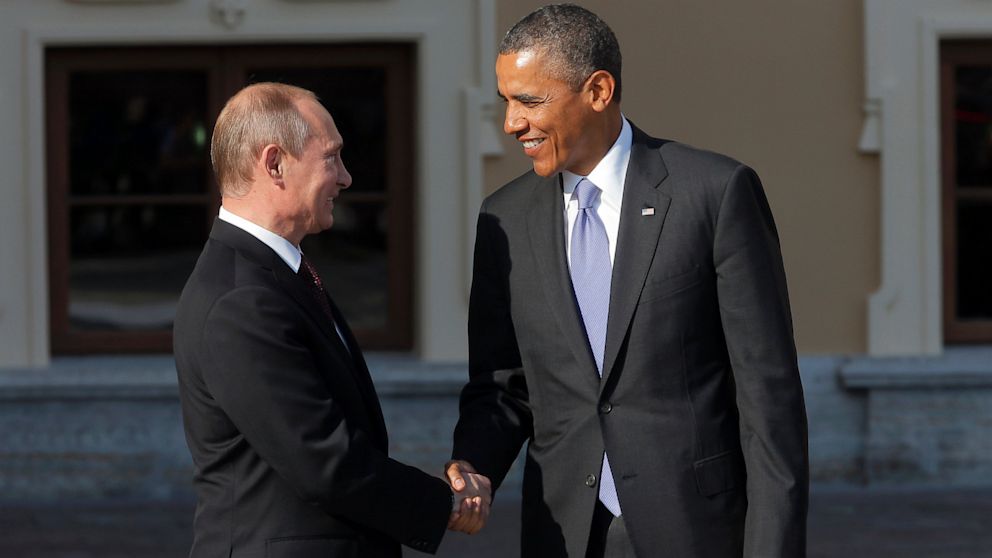
"Welcome to school, Barack."
President Obama is being taken to grand-politics school by Russian President Vladimir Putin. Der Spiegel reports,
Moscow - Russia has urged the Syrian regime to put its chemical weapons under international control. Russian Foreign Minister Sergei Lavrov on Monday called for a "quick and positive" response from the government in Damascus. Moscow hope from the measure that a possible military strike against the country could be prevented. 
"We do not know if Syria agrees, but when an international control of chemical weapons prevents military strikes, we are now ready to work with Damascus," Lavrov said, according to the Russian news agency Interfax. The Organization for the Prohibition of Chemical Weapons (OPCW) must receive full access to chemical weapons arsenal of the Syrians, he demanded. 
"We have already said Syrian Foreign Minister Walid al-Moallem passed our proposal and put on a fast, I hope, positive response," Lavrov said at a hastily transferred on state television recognized opinion. His Syrian colleague had visited Moscow on Monday.

"We call on the Syrian leadership to set the chemical weapons not only under international control, but to destroy later," Lavrov said. Also, Syria was to join the organization on the prohibition of these weapons.
Because Obama has described the purpose of his proposed strikes against Syria in terms of having no intended effect but to prevent Assad from using chemical weapons again, it will be very difficult for Congress to ignore the Russian proposal, although an astute US president would make US concurrence dependent on a number of Russian concessions.

But right now, on the face of it (and I admit the devil is in the details) Russia has put on the table a way of avoiding punitive US strikes while still, putatively at least, offering a course to accomplish the same objectives without America going to war.

Also, by placing the UN back into the thick of the proposed resolution, Obama would have to renounce UN involvement in international-security affairs to say nyet to the Russians. Which he may well do, but not even his base will swallow that easily.

So, assuming the Russian proposal is in good faith (which is a huge assumption, I admit) here is Obama's proposal compared to Putin's:

Obama: The United States will bomb Syria to persuade Assad not to use chemical weapons any more.

Putin: The United Nations will assume control of Syria's chemical weapons and remove from Assad the capability to use them at all, and will then destroy those weapons.

Without defending Putin, who is a former-KGB thug in his own right, I would say that he has pulled off a political master stroke that has no downside on Russia's waxing influence in international affairs, especially in the Middle East:

1. If Obama assents to pursuing this course, Russia's standing is strongly strengthened in the UN and in world public opinion.

2. If Obama says no, same thing: Russia is the nation urging peaceful resolution while the US is seen to be set on war - again.

3. If Assad says no - possible but since his survival depends of Russian patronage, not very likely. (Update: that didn't take long, Assad has already said it backs the Russian proposal. Of course, Assad and Putin had already worked this out together before Russian went public.)

It must be pointed out that Obama, insisting that "international norms" be adhered to, cannot pick and choose which norms he means and maintain the slightest credibility on the world stage. Every chemical-weapons convention that Obama says define the norms Syria has violated are specifically under the oversight and authority of international agencies under the auspices of the UN. That's an international norm, too. So foreign ministries around the world will be openly scornful of any attempt by Obama to cleave to one norm while explicitly rejecting another, both on the same issue.

Update: Another good question is why Obama didn't make the same proposal to begin with. Why did he immediately decide to bomb? As I asked before, what was the fierce urgency of bombing now?

Bookmark and Share